How much wedding stationery should you order? Counting invitations, place cards, menus and favours
A hundred people on your guest list does not mean a hundred invitations, a hundred menu cards and a hundred favours. Each product serves a different purpose. An invitation may be shared by a couple, a place card identifies an individual seat, and several people can use one menu. Separating these purposes is the first step towards an order that actually fits your celebration.
Start with your guest list and room layout before filling your basket. You do not need complicated calculations. You need a few separate totals and a clear answer to one question: who, or what, is each item for? This guide takes you from “a wedding for a hundred people” to specific quantities, accounting for children, plus-ones, different menus and a sensible reserve.
Four counting methods that organise the whole order
Before choosing wedding invitations, work out the quantity needed for your reception layout.
Divide your stationery into four groups. The first is counted per invitation recipient: an individual, couple or family invited together. The second is counted per participant or occupied place. The third depends on the number of tables. The fourth belongs to a particular area, such as the entrance or guest-book table. This distinction helps you spot mistakes before choosing designs.
Invitations usually belong to the first group, place cards to the second and table numbers to the third. With menus and favours, you decide whether each one is for a person, a couple or a table, depending on how it will be used. Seating plans and guest books should not automatically be multiplied by the number of guests. Their quantity depends on their location and purpose.
Write the counting unit beside each product, for example “one card per place” or “two cards per table”. A number without an explanation quickly becomes confusing. If the guest list changes a week later, you will know which quantities to recalculate. An extra guest does not necessarily mean another table or another guest book.
Invitations: count shared invitations, not individual people
Go through your list and group the people who will receive one invitation together. A couple invited jointly may occupy two places at the reception but need only one envelope. A family with children may receive one set if that is how you wish to invite them. Two adults at the same address do not automatically have to share an invitation. Your chosen approach matters more than the address itself.
An extra column containing an invitation number can help. Give everyone covered by the same invitation the same number. The number of distinct entries tells you how many copies you need to deliver. This accommodates married couples, individual guests, adult children receiving separate invitations and couples living in different towns.
Do not apply a “half the guest count” rule without checking. It may be close when most guests come as couples, but it will underestimate your needs when many people are invited individually. A list containing many families sharing invitations works in the opposite direction. Counting actual recipient groups is more accurate than using a fixed percentage.
For example, twenty couples, ten individually invited people and five families of four make seventy guests but thirty-five shared invitations. This is an arithmetic example, not a recommended ratio. Your result may be entirely different even for a celebration of the same size.
For a design such as the sage-green Cejla No. 23 invitation, first count shared recipient groups, then add any other copies you need.

Plus-ones, children and different invitations
A guest invited with a plus-one usually receives one invitation covering two people. However, separate the number of invitations from the expected number of attendees in your records from the outset. One entry in the invitations column must not accidentally become one seat when planning the room. After attendance is confirmed, add the plus-one's name if it is needed for a personalised place card.
Apply the same distinction to children. First establish whether they are included in the invitation, then how many will have their own place at the table. These are different decisions. A baby, a child using a high chair and a teenager may be accommodated differently, so do not convert family numbers directly into place settings. Agree arrangements with the venue and parents.
If some people are invited to the ceremony only, separate them before ordering. Even when the design is shared, the wording may differ. Your list should show invitations to both ceremony and reception separately from invitations to the ceremony alone. Do not combine these variants into one quantity for personalisation.
Keepsakes and reserves: give each extra copy a purpose
After counting invitations for guests, add the copies that already have another purpose. A set you want to keep and a copy intended for detail photographs are not spare invitations for new recipients. If the same copy will serve both purposes, say so. If you want two separate sets, add two. The important thing is not to count on using one item twice.
A genuine reserve covers situations for which you cannot yet name the recipient. Its size depends on how settled the guest list is, the product you are ordering and the confirmed options for reordering later. Ask the shop about the chosen design rather than assuming any quantity will be available immediately at the same price.
Personalised reserves need particular thought. An extra invitation already printed with one couple's names cannot replace an invitation for someone else. Discuss with the shop what would actually help in your circumstances. Avoid buying a large surplus simply to ease uncertainty; first identify the problem those spare copies are meant to solve.
Place cards: work from attendees to actual seats
Before choosing wedding place cards, work out the quantity needed for your reception layout.
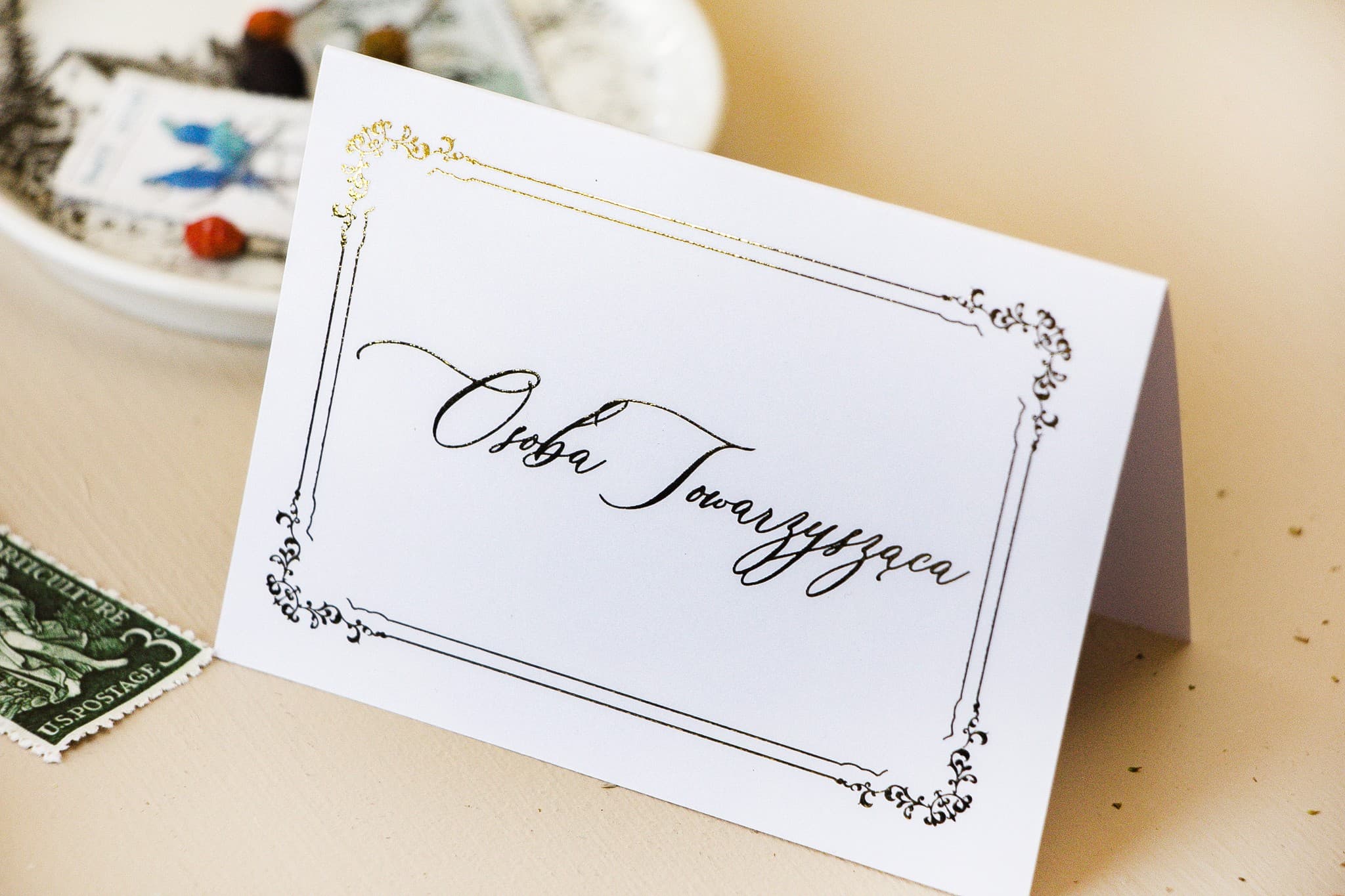
Count place cards according to the seats you want to identify by name. If every guest gets an individual card, start with confirmed attendees occupying those places. Do not copy the number of invitations: a family receiving one invitation may need several place cards. Check whether you have included yourselves if you also want cards at your places.
Make a deliberate decision about children. A child with an individual seat may benefit from a place card that helps both family and staff find the setting. That does not mean every child needs the same accessories as an adult. Arrangements may differ for a baby without a separate place setting. Decide the layout first, then count products rather than adapting the room to an order already placed.
Consider suppliers' places separately if the venue provides them. Do not automatically include them at guest tables or exclude them simply because they do not receive invitations. Ask how the venue organises their meals and whether any labels are needed. This is an operational decision based on your agreement with the venue.
Finally compare the card total with the names in the personalisation file. Matching totals are not enough: listing one person twice and omitting another still produces the right number. Review the names themselves. When people share a first name, choose wording that makes their places clear.
An example of individual place marking is Sand No. 4 place cards with a gold border. Count these by people, not envelopes.

Menus: choose how they will be used before counting
Before choosing wedding menu cards, work out the quantity needed for your reception layout.
You can provide one menu per guest or several shared menus per table. The first option is counted by places, the second by room layout. Neither produces a universally correct number for every wedding. What matters is whether guests can comfortably read the menu without passing a single card along an entire long table.
Two cards at each of ten tables means twenty menus as a starting point. But check whether all tables have similar lengths and numbers of places. Your own table or a long communal table may need a separate decision. Rather than multiplying one number across the whole venue, list the genuinely different arrangements and add their totals.
Count language versions and different meal selections separately. If some cards contain different text, their number should reflect a specific purpose. Do not simply add them to the full quantity of the standard version if they replace that version at selected places. Otherwise the order grows despite an unchanged number of seats.
A printed menu does not replace discussion of dietary requirements with the catering team. When ordering a variant for a particular guest, confirm both the wording and the serving arrangements. Card quantities and meal quantities are separate pieces of information: they should fit the plan, but need not be equal.
When choosing Sand No. 4 menu cards, list each text version and its quantity separately.

Table numbers and the seating plan
Before choosing wedding seating plans, work out the quantity needed for your reception layout.
Count table numbers once the room layout is agreed. Ten tables may mean ten signs, but if your own table has a separate name, list it separately. For very long tables, ask the person setting up the room whether one sign will be sufficient. Do not order additional numbers without deciding how they will be used.
Check the sequence as well as the total. Numbers one to ten are different from nine consecutive numbers plus two copies of number five. Your order should list the actual labels and the quantity of each. The same numbering must appear on the seating plan.
Count seating plans according to the points where they need to be available. One board at the main entrance may be enough, while a venue with several independent entrances requires more thought about guests' routes. A second copy is useful when it solves a specific problem, not simply because attendance exceeds an arbitrary figure. Agree its display position and any stand or equipment separately.
For items such as Eteryczne No. 1 table numbers, prepare a list of the actual numbers, not just their total.

If you choose the Bueno No. 1 seating plan, decide how many display locations you need and match its content to the approved room layout.

Favours: one per person, couple or family?
Before counting gifts, decide how you will give them out. If a favour will wait at each place setting, its quantity usually follows the number of people receiving it. If you give one gift per couple or family, count recipient groups instead. Do not automatically reuse the invitation groups: actual attendance and your chosen way of thanking guests may change them.
Decide how to include children and people attending only part of the celebration. Everyone need not receive an identical product; the point is to avoid accidentally leaving someone out. If there is a separate children's version, count it separately and clarify whether it replaces the standard favour or is an extra.
For edible favours, consider agreed guest requirements and the information on ingredients and storage. Attractive packaging is not proof that a product suits every person. When uncertain, check the current description and seller's information. Your quantity list does not need detailed health information: a clear division into agreed variants is enough.
Count products such as Rubin No. 7 sunflower chocolates according to how you plan to give out favours. The photos show items from different collections, not a particular real wedding.

Bottle tags and items shared by the whole reception
Count bottle tags according to the bottles you actually want to label. Do not use that calculation to estimate how much alcohol or other drink the reception needs. Agree the drinks arrangements with the venue first, then calculate accessories. List bottles initially placed on tables separately from other stock if that will also receive tags.
A guest book, a sign for a particular area and other shared items each have their own counting unit. One guest book can serve the entire celebration; another is needed only when it supports your plans. Do not add one just because a few names have joined the list. Similarly, changes to invitation quantities do not necessarily affect the guest-book table.
For each accessory, ask a simple question: where exactly will it be used? If the answer is only “it might come in handy”, postpone the decision until its purpose is clear. That makes it easier to limit excess without sacrificing items that genuinely help guests and create the atmosphere you want.
When ordering Malowane Kwiaty No. 18 bottle tags, base the quantity on the previously agreed batch of bottles.

An item such as the Eteryczne No. 1 guest book belongs to a shared area. Do not calculate it per person.

Worked example: an order for a hundred people
Imagine a guest list containing thirty couples, twenty individually invited people and five families of four. This gives a hundred people and fifty-five shared invitations. The couple want one keepsake and another copy for photographs, taking the total to fifty-seven before adding an agreed reserve. This is not a universal conversion for every wedding.
Once replies arrive, there are ninety-six attendees with allocated seats. In this example everyone, including the couple already counted within those ninety-six, receives an individual place card. That means ninety-six cards bearing the correct details. The number of invitations previously handed out no longer determines this calculation.
There are eight tables with two shared menus each: sixteen menus and eight table numbers if each table has one sign. The order also includes one seating board at the entrance and one guest book. Favours are provided per person, so the starting quantity is ninety-six, divided into the chosen variants. Any reserve is added separately for each product.
If individual menus were chosen instead of shared ones, their quantity would rise to ninety-six. The number of table signs, boards and books would not change. This is why a single overall guest count is not enough to prepare a complete stationery order correctly.
Keep one list with a clear purpose for every item
Use columns for product, variant, counting unit, basic quantity, keepsake copies, reserve and total. Add the date of the latest update and whether each quantity is provisional or approved. This prevents an early estimate from being mistaken for an instruction to produce the order. Several independent lists in separate messages are unnecessary.
For personalised products, attach the details corresponding to each variant. If you are ordering ninety-six place cards but the file contains ninety-five entries, resolve the difference before approval. If an extra copy is deliberately a keepsake, explain that too. The shop should not have to guess which total is binding or whose name is missing.
Before submitting the order, compare your list with the basket. Pay attention to the sales unit: an individual item, a complete set and a pack may mean different things. Check the current terms for your chosen products, including any minimum quantity and what a set contains. Do not assume every category has the same conditions simply because it comes from one shop.
Recalculate when the guest list changes
When one person joins, check the invitation, seat, place card, menu and favour in turn. Someone joining a couple or family already invited may not require another shared invitation, but may need an individual place card. If menus are shared, an extra guest may not increase the number of cards. Assess each item according to its counting unit.
Moving two people between tables may leave every total unchanged while requiring the seating-plan text to be updated. Adding a table can mean another number and more shared menus even if guests have merely moved from other tables. Separate changes in quantities from changes in information. This avoids ordering unnecessary copies.
If the order has already been approved, contact the shop first to find out what can still be changed. Updating your own file does not automatically notify the supplier. Confirm the agreed changes, the revised quantity and the deadline. Mark the earlier version as obsolete so it does not accidentally return to circulation.
A final check before approving quantities
Review the list again, this time from a guest's perspective. Pick one couple, one family and one individually invited person. Check which invitation they receive, how many seats they occupy, which cards they find at their places and who receives a favour. This simple exercise often exposes inconsistencies invisible in totals alone. It requires no additional products.
Next follow the room plan from the entrance to the last table. Check which items are shared and which need several copies. Make sure the same item has not been entered twice under different names. It is particularly easy to double-count the couple's menus if your seats are already included in the total attendance.
Finally separate confirmed decisions from questions for the shop or venue. Do not leave an unexplained question mark beside a quantity that is about to enter production. A short conversation can clarify the sales unit, set contents and how to list variants. Only then does the total in the basket represent the number of products actually needed.
Questions before ordering wedding stationery
Do a hundred guests need a hundred invitations?
Not if some are invited together. Count the actual recipient groups, then add keepsake copies and an agreed reserve separately. The guest count alone does not determine invitation quantities.
How many menus should be on a table?
That depends on its layout and how menus are shared. Choose individual or communal cards, then make a decision for each type of table, checking that everyone can comfortably access the information.
Are place cards and favours counted in the same way?
Only when both are intended for the same individuals. If a gift is shared by a couple or family, the quantities will differ. Record that decision before comparing the order totals.
Should every product have the same percentage of spares?
No. Reserves should reflect the product's purpose and the options for reordering. A named card, a shared menu and a guest book meet different needs. Applying one percentage to everything can create an unhelpful surplus.
Which number should be considered final?
For invitations, use the approved recipient list; for reception items, use the current attendance and room plan. Record the approval date for each stage. You do not need to finalise every product's quantity at the same time.
An accurate order starts with a few simple distinctions. Once you know what is counted per recipient, person, table and area, choosing accessories and checking later changes becomes easier. Instead of buying everything according to the guest count, you order a set that fits your celebration.
Szymon Jędrzejczak
Wedding industry expert and stationery designer at Amelia-Wedding.pl. For years, she has been helping couples create unforgettable moments by combining tradition with modern design.