How to Invite Guests to a Wedding?
Introduction
Wedding invitations: More than just a card
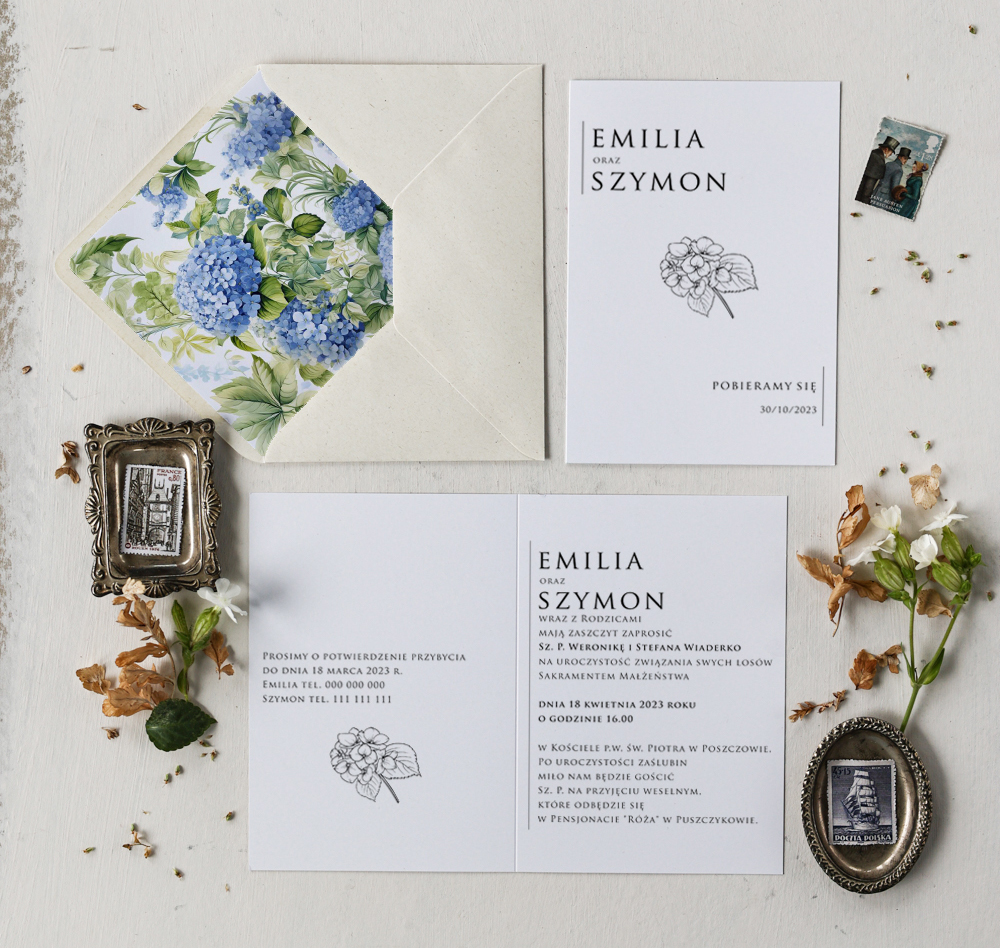
Wedding invitations are not just a simple means of communication, but a carefully crafted business card for the bride and groom. They represent the style, theme, and character of the entire event. In Poland, as in many other countries, invitations have become not only an informational tool but also a decorative and collectible item. Many guests keep them as a memento of this special day. Choosing the right design, paper, or font says a lot about the couple's personalities and what to expect during the celebration.
Invitation traditions: From handwritten letters to modern e-invites
In Poland, invitation traditions have deep roots. In the past, when technology for mass printing was unavailable, invitations were handwritten, often by people specifically hired for the task. This was intended not only to inform guests about the upcoming event but also to show respect and the importance of the ceremony. While modern traditions move away from handwriting, they still emphasize the importance of a personal approach. Contemporary invitations, although often printed, focus on individualism, uniqueness, and creativity. In the digital age, e-invites are also appearing, which, while convenient and eco-friendly, for many people will not replace the traditional paper form.
Wedding invitation etiquette: The key to elegance and the right message
Wedding invitation etiquette is not just about social rules, but primarily about the ability to convey key information in an elegant way. What elements should an invitation contain? First and foremost, the names of the future spouses, the date, the venue, and the time of the ceremony. It is also important to indicate whether it concerns just the wedding ceremony or the reception as well. In Poland, special attention is also paid to the form of the invitation. Is it a formal, official invitation, or perhaps something more casual and informal? The right choice of words, font, and color scheme can say a lot about the tone of the entire event.
The importance of invitations in Polish wedding culture
Wedding invitations play a key role in Polish wedding culture. They are not only the guest's first contact with the upcoming event but also an important element of wedding preparations. In many cases, invitations are the first element the couple considers together, making choices regarding style, color, and theme. In Poland, invitations are also an important element of tradition and etiquette. Sending them at the right time, paying attention to detail, and including all necessary information demonstrates respect for the invited guests and professionalism in organizing the entire event.
Table of Contents
Deciding on the guest list
Deciding who to invite to your wedding is one of the most crucial and often stressful stages of planning this special day. The wedding guest list not only affects the atmosphere of the entire celebration but also determines many other aspects, such as the choice of venue, costs, or how the event is organized.
First steps in creating a wedding guest list
Before you sit down to create a specific list, it is worth thinking about general criteria. Key questions to ask are: How big do we want our wedding to be? Do we want an intimate atmosphere, or on the contrary, do we dream of a big wedding with hundreds of guests? The answers to these questions will help set the framework for your wedding guest list.
Next, it is worth establishing a budget per person. You might find that you would like to invite many people, but your financial means are limited. In such a situation, you will have to make difficult choices and think about who to invite to the wedding and who, unfortunately, to leave out.
How to choose wedding guests: key criteria
Choosing wedding guests is not just a matter of sympathy and closeness of the relationship, but also certain rules of etiquette and practical considerations. In Poland, as in many countries, there are certain unwritten rules about who is traditionally invited to a wedding. Close family and friends are often joined by extended relatives, coworkers, or long-lost acquaintances of the parents.
However, in today's times, more and more couples are opting for more intimate weddings, focusing on their closest people. A key question you can ask yourself is: "Would I like to spend a nice evening at dinner with this person?". If the answer is "no," perhaps it is worth considering the sense of sending an invitation.
Another criterion may be the frequency of contact with a given person. If you haven't had contact with someone for the last few years, perhaps it makes no sense to invite that person to the wedding. Of course, there are exceptions, e.g., long-lost relatives from abroad, but that is an individual matter.
The importance of the guest list in the context of Polish wedding traditions
In Poland, a wedding and reception are not just an opportunity to celebrate the love of two people, but also an important social event. Traditionally, Polish weddings were large parties to which entire families, neighbors, friends, and acquaintances were invited. Therefore, the wedding guest list in Poland is often long and covers a wide spectrum of people.
However, tradition does not always have to be the benchmark. More and more young couples in Poland are opting for small, intimate weddings, focusing on the quality of time spent with loved ones rather than the number of guests. This approach allows for deeper contact with guests, and often a more relaxed and informal atmosphere.
Practical tips for creating a guest list
Creating a wedding guest list is a process that is worth starting early. It can be helpful to create an "A" list and a "B" list. The "A" list consists of people you definitely want to invite, while the "B" list consists of people you would like to invite if space and budget allow.
It is always worth leaving a margin for unforeseen circumstances. It may turn out that someone from your list will not be able to come, and you would like to invite someone else in their place.
Also, remember that not all invited guests will always be able to attend. In Poland, this is often about 10-20% of invited guests. Keeping this in mind, you can better plan the number of seats and prepare for various eventualities.
Invitations should be sent with sufficient lead time, preferably several months before the planned wedding date. This gives guests time to respond and potentially plan travel or purchase an outfit. In Poland, it is traditionally expected to confirm attendance, which is also helpful in further preparations.
Designing wedding invitations
Wedding invitations are the guests' first contact with the upcoming celebration. Choosing the right design, content, and style of the invitation allows you to introduce guests to the specific atmosphere of this special day before it even begins. Wedding invitation designs evolve along with trends in the design world, so it is worth keeping up to date with what is popular. The year 2023 brings many interesting solutions in this regard.
Wedding invitation designs – classics with a modern twist
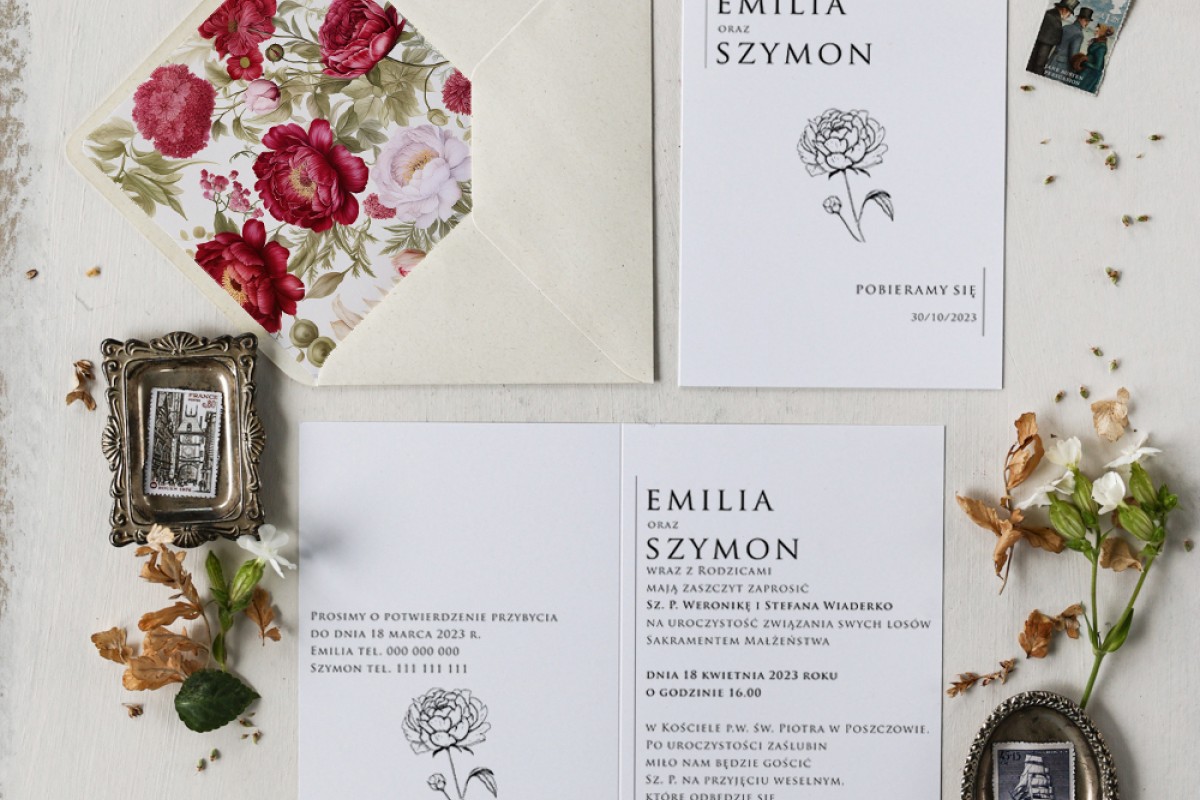
Classic wedding invitations are usually characterized by elegant fonts, delicate decorations, and muted colors. However, even classics can be renewed! In 2023, many couples are opting for classic designs combined with modern elements.
Openwork cutouts, subtle gold details, or delicate embossing give traditional invitations a whole new dimension. What is particularly striking in wedding invitation designs this year is the balance between minimalism and luxury. Clean lines and simple compositions are complemented by small but distinct accents that make the invitation unforgettable.
Personalized invitations - Your wedding in your style
No two couples are identical, which is why many future spouses opt for personalized invitations. Thanks to them, you can subtly convey your story, interests, or simply give the invitation a more personal touch.
Illustrations depicting the couple, maps with places that are important to them, or even quotes that reflect their relationship are becoming an increasingly popular choice. Moreover, technology now allows for the creation of 3D invitations or those with augmented reality elements, which are sure to impress every guest.
2023 invitation trends - what's hot?
In the world of 2023 invitation trends, eco-friendly solutions dominate. Many young people want their wedding to be eco-friendly, and this starts with the invitations. Choosing recycled paper, biodegradable materials, or even electronic invitations are some of the most popular trends this year.
Another important trend is the return to nature – floral motifs, especially those endemic to a given region, adorn many invitations. Elements such as dried flowers, handmade illustrations, or hand-written calligraphy add charm and warmth to these special cards.
How to choose the perfect invitation for you?
Choosing an invitation is like choosing a wedding dress – it must perfectly fit the couple and reflect their character. First of all, it is worth thinking about what you want to convey to your guests. Is it elegance and classicism, or perhaps modernity and unconventionality?
After establishing the general direction, it is worth thinking about the details. The choice of materials, font type, or additional elements such as ribbons or seals should be consistent with the rest of the wedding elements.
Regardless of the choice, it is important that the invitation is a reflection of your love and the emotions that accompany you during this special time. After all, they are what will make guests feel the magic of your wedding from the moment they receive the invitation.
How to include all necessary information
Preparing a wedding invitation is not just about choosing aesthetics and design, but primarily about including all necessary information. For many guests, the content of the wedding invitation is a key source of knowledge about how this special day will unfold. So how do you include everything important without exceeding the standard size of the invitation while maintaining an elegant style? Here are some practical tips.
Basic elements of wedding invitation content
When we start thinking about what to write in an invitation, it's worth starting with the basics. There are several key pieces of information that must be included:
- Names of the future spouses: This is the foundation. Guests must know who the celebration is for.
- Date, time, and place of the wedding: This is key information that will allow guests to plan their time.
- Place of the wedding reception: If it takes place in a different location than the wedding ceremony.
- Dress code information: If applicable, it is worth giving guests guidelines on what outfits they should wear.
- RSVP: Information on when and how to confirm their attendance.
Additional information for guests – how to include it?
Often, future spouses want to provide their guests with additional information that is not a standard part of the wedding invitation content. These could be, for example, directions, information about nearby accommodation, or special wishes regarding wedding gifts. How to include them?
- Maps and directions: If the wedding and reception take place in a hard-to-reach location, it is worth adding a map with directions.
- Accommodation: If you know of good hotels or guesthouses in the area, it is worth providing this information.
- Wedding gifts: If you have special wishes or have decided to forgo gifts in favor of donations to a specific cause, it is worth writing about it.
How to maintain consistency and elegance of content?
Although information for guests is key, it is equally important that the invitation is elegant and consistent. Here are some tips on how to achieve this:
- Maintain a specific structure: When deciding what to write in the invitation, make sure all information is presented in a logical order.
- Use a consistent font style: Choose one or two fonts and stick to them throughout the invitation.
- Avoid too many details: Focus on minimalism. If certain information can be conveyed in another way (e.g., through a separate card in the invitation set), it is worth using that option.
When is it worth adding a separate card with additional information?
Sometimes the amount of information we want to convey to guests is too large to fit on a standard invitation. In such situations, it is worth considering adding an extra card. It could contain, for example, the wedding menu, a detailed schedule of the day, or information about attractions for children. Such a card will allow for clarity and readability of the main invitation, while providing all necessary information.
Remember that the key to success is maintaining a balance between aesthetics and practicality. A wedding invitation is intended not only to inform but also to delight and introduce the magical atmosphere of this special day.
Electronic vs. traditional invitations
In the era of the digital revolution, many aspects of our lives have moved to the online world, and weddings are no exception. One of the most discussed topics among young couples is the choice between electronic wedding invitations and their traditional counterparts. Both solutions have their advantages and disadvantages, and the choice depends on the individual preferences of the couple and the expectations of their guests. Let's take a closer look at both options to help you make an informed decision.
Electronic wedding invitations: modernity and ecology in one
Electronic wedding invitations are a solution that is gaining popularity, especially among young couples who want to be up to date with modern ways of inviting.
- Eco-friendly approach: By sending invitations electronically, you avoid the use of paper and other materials, which is important for eco-conscious couples.
- Speed and convenience: E-invites can be sent within minutes, and confirming attendance is just as simple.
- Interactivity: You can include links to a map with directions, a wedding website, or other important resources.
- Costs: E-invites are usually cheaper than traditional ones, especially when you are inviting a large number of guests.
Advantages of traditional invitations: the timeless classic
Despite the digital revolution, many couples still opt for classic, paper wedding invitations. Why?
- Sentimentality: A physical invitation can be kept as a memento, which is important for many guests and the spouses themselves.
- Personal approach: Hand-delivering or mailing a traditional invitation is a more personal gesture.
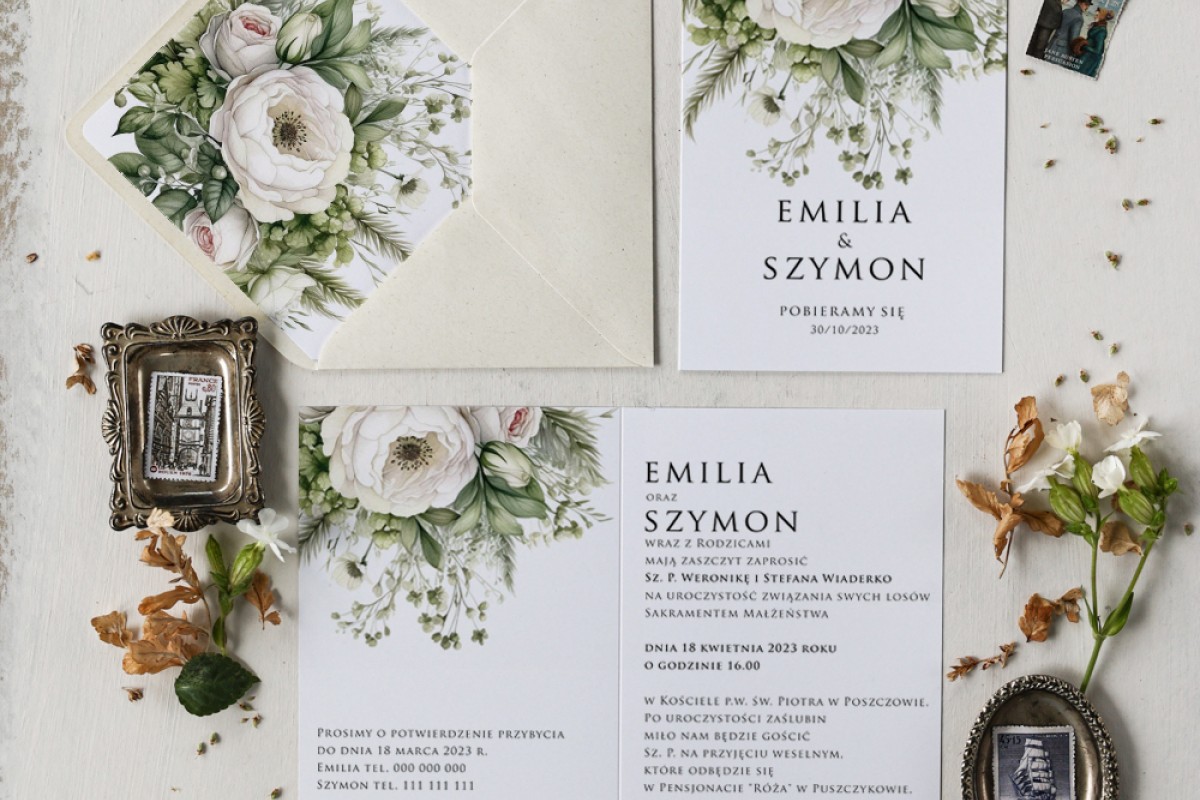
- Aesthetics: Paper invitations offer greater artistic possibilities, such as embossing, varnishing, or using different types of paper.
- No technological barriers: Not all guests may be proficient in using technology. For some, a traditional invitation will be a simpler and more understandable solution.
How to decide? Key issues to consider
The choice between electronic wedding invitations and traditional invitations depends on several key factors.
- Budget: If you are more financially constrained, e-invites may be a more cost-effective choice.
- Number of guests: For large weddings, the cost of printing and mailing traditional invitations can add up.
- Guest profile: If most of your guests are older people who may have difficulty using technology, traditional invitations may be a better choice.
- Personal preferences: Don't forget about what is important to you. If you dream of beautiful, handmade invitations, perhaps it is worth investing in a traditional solution.
Can you have the best of both worlds?
For those who cannot decide, combining both forms can be the perfect solution. You can, for example, send traditional invitations to close family and friends, while the rest of the guests receive an electronic version. Alternatively, an e-invite can serve as a "save the date" for all guests, with a traditional invitation sent later.
There is no single answer to the question of which invitation is better. The most important thing is that they reflect your character and are consistent with the overall climate and theme of the wedding. It is also important to remember your guests and their needs. The final choice is yours!
When to send invitations
A wedding invitation is not just an elegant way to inform guests about an upcoming event, but also a key element of the logistics of the entire ceremony. The decision of when to send wedding invitations can affect the number of people who will come to the wedding, as well as your plans and budget. Here are some tips that will help you determine the best moment to send these important invitations.
Traditional rules for sending invitations
Although we live in fast-changing times, there are certain traditional rules that many couples find helpful in planning the mailing of invitations.
-
Advance notice: Many wedding industry experts recommend sending invitations 6 to 8 weeks before the wedding date. This gives guests enough time to make a decision and plan their attendance.
-
Destination weddings: If you are planning a wedding abroad or in a popular tourist destination, it is recommended to send invitations even 3 months in advance. This gives guests more time to plan their travel.
-
Waiting for a response: It is usually recommended that guests confirm their attendance 2-3 weeks before the wedding. This allows for adjusting plans and finalizing the number of participants.
Challenges of modern times
Although traditional rules are helpful, modern couples often face new challenges that affect the decision of how long to wait for a response.
-
Busy guest schedules: Nowadays, many of us lead busier schedules. By sending an invitation too late, you risk that many guests will already have other plans.
-
Digital communication: Thanks to e-invites and social media communication, information spreads faster. This can affect when you decide to send the official invitation.
-
Unforeseeable circumstances: Pandemics, crises, or other unexpected events can affect wedding plans. In such situations, it is important to be flexible and adapt to changing circumstances.
Key factors to consider
Choosing the perfect date to send invitations requires considering several key factors.
-
Size and location of the wedding: A small wedding in your hometown requires a different approach than a big wedding in an exotic location.
-
Complexity of logistics: If your wedding requires guests to make complicated preparations, such as booking a hotel or renting a car, give them more time to organize.
-
Style and formality of the wedding: An elegant, formal wedding may require notifying guests earlier compared to a more relaxed, informal ceremony.
Communication is key
Regardless of when you decide to send the invitations, it is important to be flexible and maintain open communication with your guests. If you notice that many people are not responding in the expected time, don't hesitate to send a reminder or ask directly. It is important that you feel comfortable with your choice of date and that you are sure that guests have enough time to respond and prepare for your big event.
After all, wedding invitations are not just a matter of logistics, but also an opportunity to share joy with loved ones. Choosing the right moment to send them is the key to the success of the entire ceremony.
How to handle a lack of response
A wedding is a unique event that requires careful planning and preparation. One of the key aspects of organizing this important day is getting responses from invited guests. However, not all responses always arrive in the expected time. What to do when you are faced with the challenge of a lack of reaction to sent invitations? Here are some proven ways that will help you manage this process.
Why are responses so important?
Understanding why responses are key will help you better predict and manage this aspect of wedding planning.
-
Budget: Knowing the exact number of guests allows us to more accurately plan costs related to the reception - from catering to decorations.
-
Venue: Responses allow you to adjust the space to the number of participants, which affects the comfort and overall atmosphere of the wedding.
-
Personalization: The more accurately we know the guest list, the easier it is to adjust various elements of the ceremony to them, such as guest favors or a special menu.
RSVP reminders - when and how to send them?
If you are not receiving responses in the expected time, it is worth reminding guests of the need to confirm their attendance.
-
Choose the right moment: It is ideal to send RSVP reminders 2-3 weeks before the final confirmation date. This gives guests enough time to make a decision, but not so much that they forget about it again.
-
Personalize reminders: An individual approach can be more effective than general messages. A short message expressing your desire to see that person at the wedding can make them more likely to respond.
-
Use various communication channels: If you sent traditional invitations, reminders can be sent electronically - via email, SMS, or social media. However, it is important not to be intrusive and to respect the guests' privacy.
How to encourage confirmation of attendance?
-
Simplify the process: Simplify the process of confirming attendance. If you use an online system to collect responses, make sure it is intuitive and accessible to all guests.
-
Emphasize the importance of the response: In communication with guests, emphasize how important it is for you to receive a confirmation. Explain that it helps in planning and organizing the wedding.
-
Give a small incentive: Small gestures, such as personalized thank-you notes for those who have confirmed their attendance, can be an effective incentive.
Managing invitation responses
When you collect responses, it is important to have a system that will help you manage them effectively.
-
Electronic management systems: There are many applications and platforms dedicated to wedding organization that allow for easy collection and viewing of guest responses.
-
Regular review: Don't wait until the last minute to review responses. Regularly check who has confirmed their attendance and who has not yet responded.
-
Be ready for surprises: Despite your best efforts, there can always be surprises in the form of guests who haven't confirmed their attendance but will show up at the wedding. Be prepared for this and be flexible in such situations.
Remember that every wedding is a unique event, and guest responses are just one of many aspects that need to be considered. It is important that you remain calm, patient, and flexible throughout the entire planning process.
Special invitations for the wedding party
When we think about wedding invitations, our first thought usually focuses on family and friends whom we want to have by our side on this important day. However, the wedding party - witnesses, groomsmen, and bridesmaids - plays a key role in the entire wedding process. Inviting them in a unique and personal way is therefore not only a nice gesture but also a way to emphasize their importance on this important day.
Why are special invitations for the wedding party important?
Invitations for the wedding party are not the typical invitation we receive every day. It is a symbolic gesture that emphasizes the special role that a given person will play on the wedding day.
-
Emphasizing their role: Groomsmen, bridesmaids, and witnesses play key roles during the wedding ceremony. Therefore, it is worth emphasizing their special position through special invitations.
-
Building bonds: The process of preparing for a wedding is a time full of stress, but also an opportunity to build deeper bonds with loved ones. Special invitations for the wedding party are an opportunity to share emotions and build relationships.
-
Unique character: Working together on wedding preparations requires many hours spent together. Sending a special invitation is a way to thank them for their time and effort.
How to design invitations for the wedding party?
-
Individual approach: Every member of the wedding party is unique. It is therefore worth tailoring invitations for witnesses and other members of the party to their individual character traits.
-
Add a personal note: Handwritten notes or personalized messages can make the invitation more meaningful. A few sincere words about why you chose that person for the role can make a lasting impression.
-
Creative approach: Think of original ways to invite them. It could be a specially prepared package with small gifts, a video invitation, or even a themed party.
Special thanks for the wedding party
Besides the invitation, it is equally important to thank the wedding party for their support and commitment.
-
Written thanks: A personal note in which you thank them for their support and emphasize the importance of that person in your life is always well-received.
-
Gifts: Many couples decide to give small gifts to members of the wedding party. These can be personalized items, such as jewelry, cufflinks, or specially selected spirits.
-
Shared moments: Organizing a day or weekend together with the wedding party before the event itself is a great opportunity to strengthen bonds and thank them for their support.
Tips for future newlyweds
When inviting the wedding party, it is worth remembering that it is not just about formality, but primarily about feelings and building memories. In this context, it is important to:
-
Communicate sincerely: Explain to members of the wedding party why you chose them and how important they are to you.
-
Be grateful: Planning a wedding is a stressful time, but it is worth remembering that your wedding party is there to help you. Show them how much you appreciate their support.
-
Pay attention to details: There is power in small gestures. An individual approach, tailored gifts, and personal thanks are small elements that will make your wedding party feel special.
Invitations for people not on the list
Planning a wedding is a process full of surprises. Often, despite the best intentions and advanced preparations, we may encounter situations where we have to invite people who were not originally on the guest list. It could be a long-lost family member, a friend with whom we have reconnected after years, or even a newly met person who has become important to us in a short time. How to invite people who were not on the list? The key is a flexible approach to the situation and the ability to plan flexibly. Below are some tips on how to handle such situations.
Why is it worth being flexible in planning?
Flexibility in planning is a skill that will be useful not only during wedding organization but in many other aspects of life. In the context of a wedding, it allows you to adapt to unforeseen circumstances, such as the need to add new guests.
-
Unpredictability of life: Even if your guest list was carefully planned, there can always be surprises. Perhaps someone from your family will bring a partner you didn't know about, or your best friend will reconnect with a long-lost acquaintance.
-
Building relationships: A wedding is a special time when it is worth nurturing relationships. Therefore, it is worth being open to inviting new people who can enrich your life.
-
Ensuring a positive atmosphere: Flexibility in planning can contribute to creating a positive atmosphere during the wedding. Guests will appreciate that they are welcome and important to you, regardless of when they were invited.
How to handle last-minute invitations?
-
Communicate clearly: If you decide to invite someone at the last minute, it is important that you clearly communicate your intentions. Make sure the person knows that their presence is important to you and that their invitation is not the result of neglect or forgetfulness.
-
Digital invitations: In the age of technology, last-minute invitations can be sent electronically. E-invites are a fast and effective way to reach a guest in a short time.
-
Personal approach: If time allows, it is worth delivering the invitation in person. This will not only emphasize its uniqueness but also allow for a moment spent together before the wedding.
Think about priorities
Although it is important to be flexible, it is also worth thinking about your priorities. If adding new guests will exceed the budget or exceed the number of seats at the chosen venue, it is worth reconsidering.
-
Consider seat availability: Before inviting additional people, make sure you have seats available at the chosen venue.
-
Budget: Inviting additional people can affect wedding costs. Make sure you are able to meet these additional costs.
-
Comfort of other guests: Also remember the comfort of other invited people. If adding new guests will make others feel less comfortable, it is worth reconsidering.
Key aspects of flexible planning
-
Planning in advance: Even if you are open to changes, it is worth having a plan of action. Think about how many more people you can invite before you reach the maximum number of guests.
-
Ensuring proper communication: Make sure all your guests are up to date with information regarding the wedding. This may require more frequent updates or sending additional reminders.
-
Remember other aspects of the wedding: Flexibility in planning doesn't just apply to the guest list. It can also include changes to the menu, decorations, or the wedding day schedule.
In wedding planning, the key is to maintain a balance between flexibility and consistency. Although it is worth being open to surprises and unforeseen circumstances, it is equally important to stick to your priorities and ensure that the entire process is as smooth as possible for all parties involved.
Summary
Invitations as the foundation of the wedding ceremony
A wedding invitation is not just a simple piece of paper with information about the date and place of the ceremony. It is the first taste of what guests can expect on your big day. The role of invitations in wedding planning is fundamental; they act as a bridge connecting the future spouses with their guests, and they also emphasize the tone and style of the entire celebration.
Key aspects of inviting: more than just information
The invitation is the first element that introduces guests to the atmosphere of the wedding. The choice of design, colors, font, or material says a lot about what the ceremony and reception will be like. Will it be a traditional wedding, a modern ceremony, or perhaps an intimate boho-style reception? Key aspects of inviting can also indicate what traditions will be included in the ceremony and what accents will be most important to the couple.
The importance of tradition in wedding invitations
Tradition plays a key role in wedding culture. In Poland, we have many beautiful customs related to the wedding ceremony. That is why many couples decide to emphasize their roots and culture by integrating traditional elements into their invitations. This could be traditional Polish ornamentation, literary quotes, or even folk motifs. The importance of tradition in invitations emphasizes the couple's bond with their ancestors, culture, and history, making their wedding even more special.
Invitations as a preview of an unforgettable celebration
While every aspect of wedding planning is important, invitations are what start the whole magic. They are a foretaste of what is to come, giving guests a glimpse of what they can expect. A well-planned and designed invitation can spark emotions, bring a smile, and even move people. An invitation is not just information; it is a preview of time spent together, joy, and love that they will witness.
If you have been inspired by this perspective on wedding invitations and want to learn more about traditions, etiquette, and other aspects of wedding preparations, we encourage you to check out other articles on our blog:
- Traditional wedding games and activities
- How to engage guests in the wedding and reception?
- In what order should you invite people to the wedding?
- How to write place cards for children?
- Elegance and shine: Why glamour invitations are perfect for your wedding?
Discover the world of wedding traditions, trends, and tips with us!