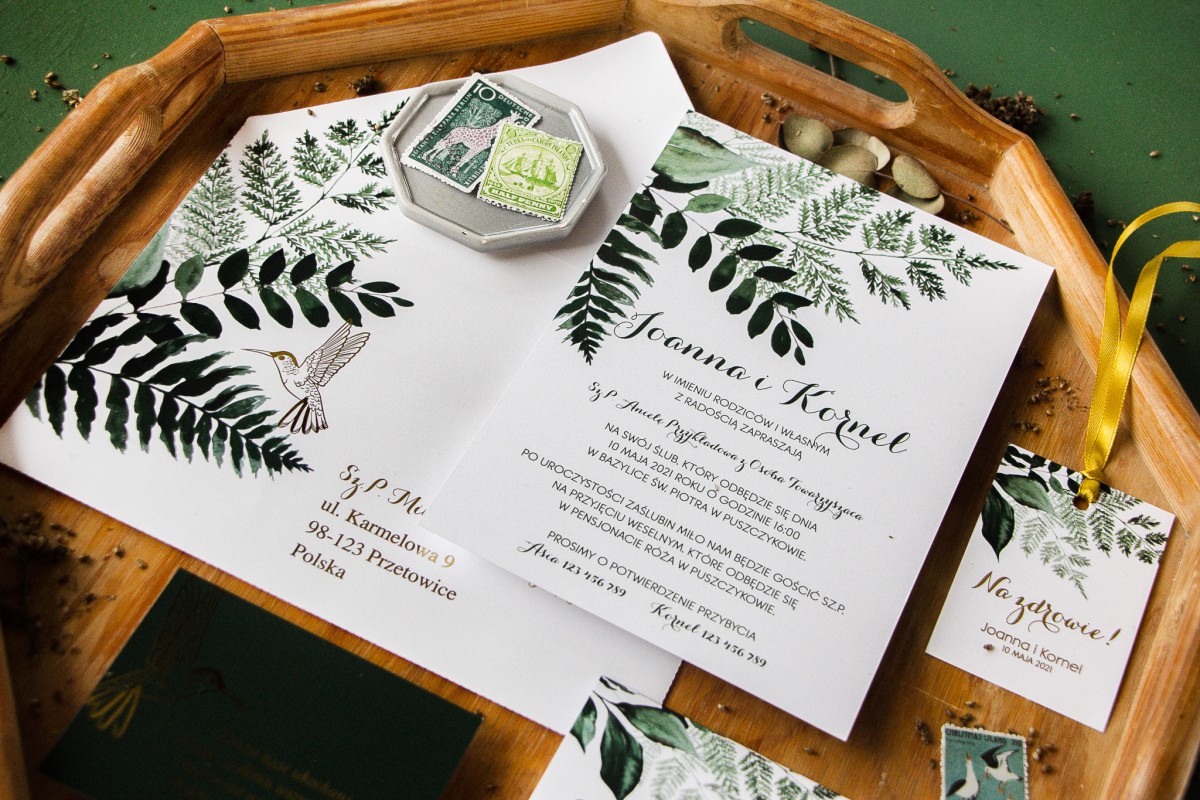
How to decline surnames on wedding invitations
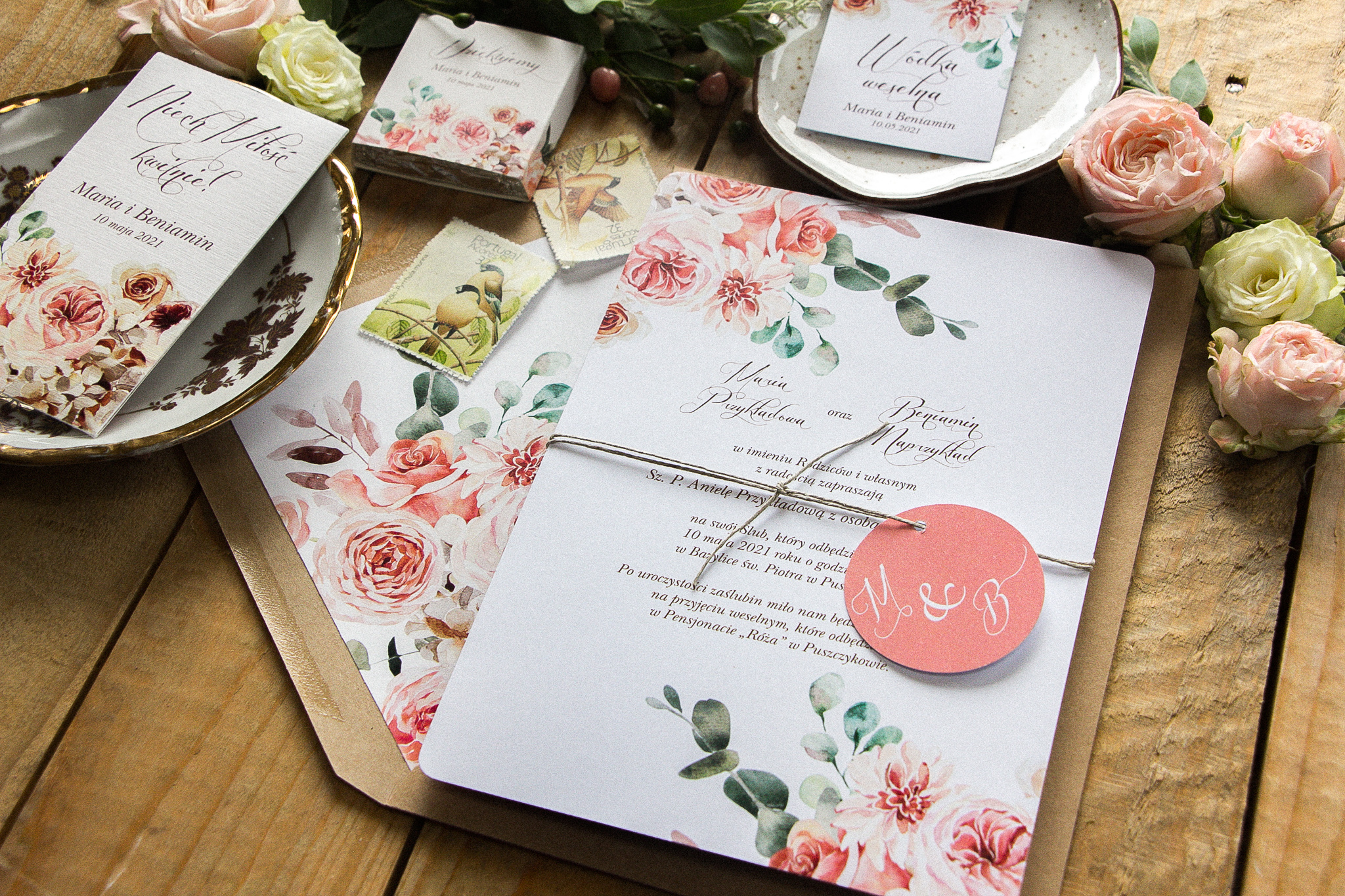
Both wedding invitations and stationery accessories are an incredibly important part of wedding preparations. Many guests keep invitations as a keepsake, so it is worth ensuring not only the beautiful design of these invitations but also, and perhaps most importantly, their grammatical correctness. One of the most frequently asked questions is "how to decline surnames on wedding invitations" or "should surnames be declined on wedding invitations at all?". The answer to the second question is a short "yes," and you will find the answer to the first one in the article below.
The most important rule is that all Polish surnames are subject to declension. In wedding invitations, this is most often the accusative case, which answers the questions "whom?" or "what?". Of course, you may often hear the claim that a particular surname does not change, but this is not true, even if it is sometimes difficult to change someone's habits in this regard. However, the grammar of the Polish language is relentless, and there are strict rules for the declension of surnames. You should stick to them if you don't want to appear linguistically ignorant.
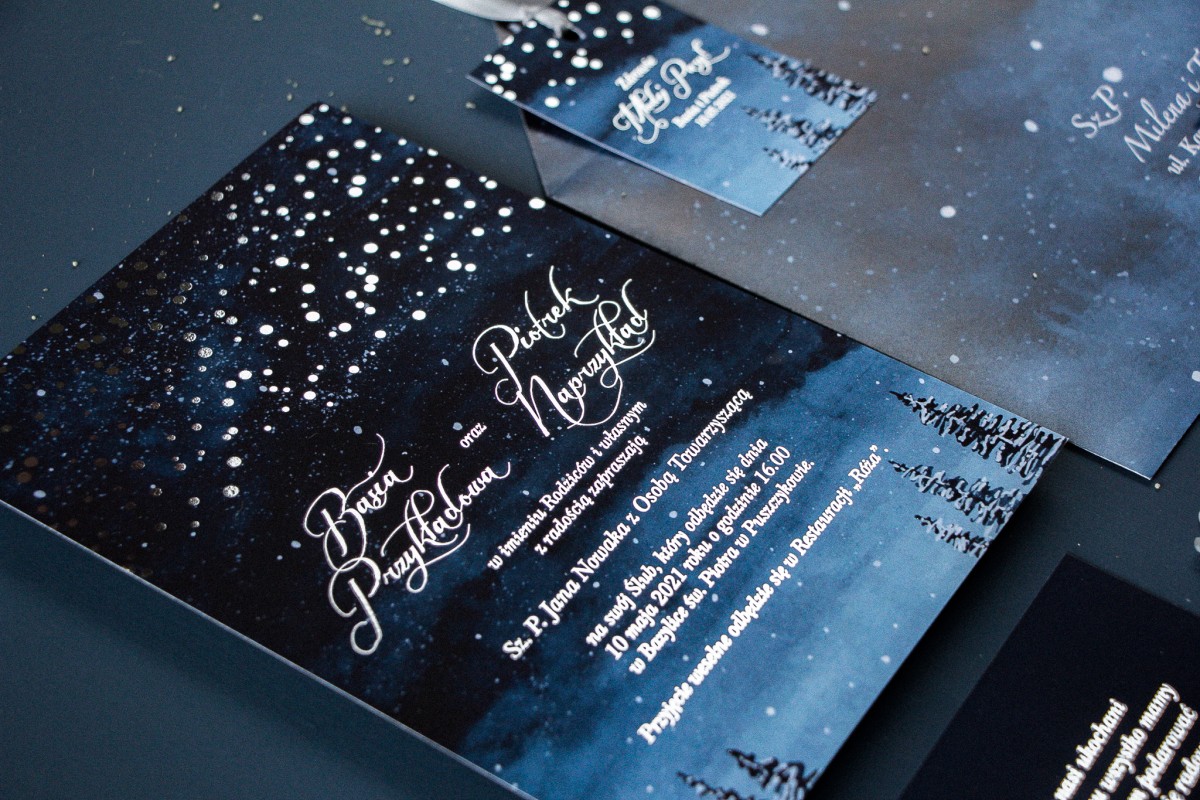
Contrary to appearances, declining surnames is not complicated; you just need to learn a few basic rules that are quite intuitive. Of course, much depends on gender, the inflectional ending, and the form, but every surname can be assigned to one of the following rules.
Regardless of gender, we always decline surnames ending in a vowel (most often "a" or "i"). A few examples below will better illustrate this rule:
- Kowalska/Kowalski becomes Kowalską/Kowalskiego in the accusative case,
- Góra becomes Górę in the accusative case,
- Kostrzycka/Kostrzycki becomes Kostrzycką/Kostrzyckiego in the accusative case.
The situation is slightly different when a surname ends in a consonant. In this case, we decline men's surnames, but the female form remains the same. The example below explains this issue:
- Kinga Kowalczyk takes the form Kingę Kowalczyk on the invitation,
- Jan Kowalczyk takes the form Jana Kowalczyka on the invitation.
It cannot be said that the female form of surnames is indeclinable in such cases, as that would contradict the aforementioned rule that all surnames are subject to declension. However, female surnames ending in a consonant do not have an inflectional ending, which is why their form does not change.
Double-barrelled surnames are a common case, which can occur for both women and men, and their correct declension largely depends on gender. For example, in female double-barrelled surnames ending twice in the vowel "a", both parts are declined. If only one of the surnames ends in a vowel, then only that one is subject to declension:
- Buda-Kostrzewska becomes Budę-Kostrzewską in the accusative case,
- Biela-Bąk becomes Bielę-Bąk in the accusative case.
In the case of men, we decline both parts, regardless of their ending:
- Boy-Żeleński becomes Boya-Żeleńskiego in the accusative case,
- Komarnicki-Dyrcz becomes Komarnickiego-Dyrcza in the accusative case.
A common practice is to invite married couples, and in this case, the surname must also be declined. The singular form of the surname is taken into account, and if it ends in a consonant or a vowel ("a", "e", "o"), the plural form receives the ending "owie" and is declined like nouns:
- Nowak in the plural accusative case becomes Nowaków,
- Bajdo in the plural accusative case becomes Bajdów.
In turn, surnames ending in the vowels "i" and "y" are declined like adjectives:
- Kowalski becomes Kowalskich in the plural accusative case,
- Kowalsky becomes Kowalskych in the plural accusative case.
When filling out wedding invitations, we may encounter surnames that are difficult to fit into any of the above rules. Of course, these are rare cases, but they do happen. It is worth checking the declension of that specific surname online or even asking the person who bears it. This is certainly a much better solution than leaving the surname in an undeclined form.
Preparing a list for wedding invitations can be quite difficult, however, preparing a list of place cards is much easier - here, the list should be in the nominative (undeclined) form. You can also place guest personalization in the form of undeclined names and surnames on wedding favors - such as honey jars or candles.
If this post was helpful to you, we encourage you to explore the topic of How to write a wedding invitation