Is it cheaper to buy wedding invitations or make them yourself?
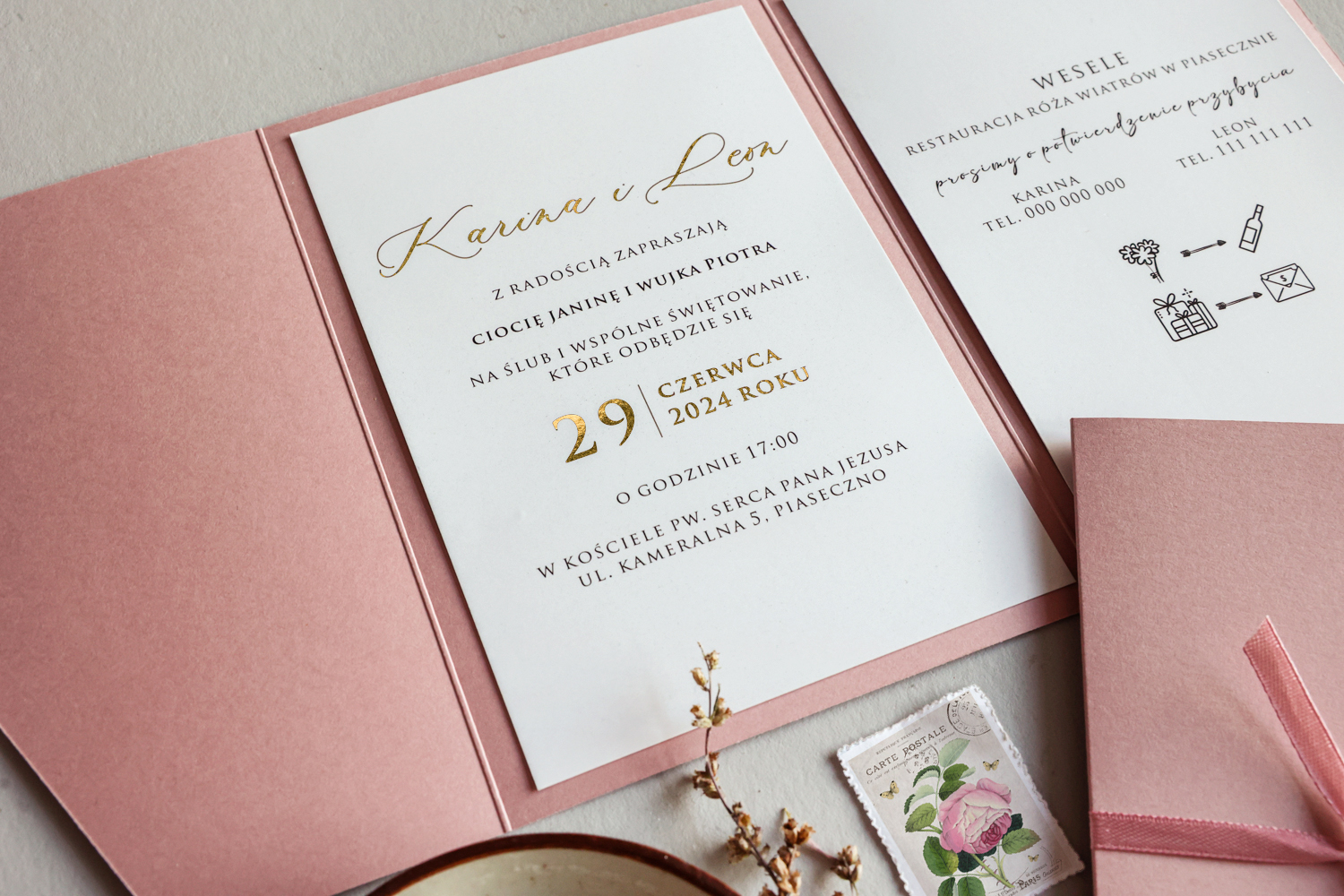
Is it cheaper to buy wedding invitations or make them yourself?
Planning a wedding involves not just choosing a venue and menu, but also making dozens of smaller decisions – including how to notify your guests about the upcoming celebration. Many couples wonder whether it is cheaper to buy wedding invitations or make them yourself. On one hand, DIY wedding invitations offer the temptation of saving money and adding a personal touch to your stationery. On the other hand, the market offers a huge selection of ready-made designs that can be ordered effortlessly – from simple, affordable patterns to premium wedding invitations offered by professionals (e.g., at Amelia-Wedding.pl). So, how do you find the answer to this key question? In this article, we provide a detailed analysis of both options. We will look at costs, time and effort, quality of workmanship, as well as personalization and convenience to see which option is more cost-effective. The goal is an objective comparison – though we can already reveal that purchasing ready-made invitations (especially from a trusted supplier) often proves to be a more beneficial solution in many respects. We invite you to read on and find the best solution for your wedding together!
Wedding invitation costs – DIY vs. ready-made solutions
Materials and tools needed for DIY invitations
At first glance, it might seem that making invitations yourself will save you money. However, it is worth carefully analyzing the expenses associated with preparing wedding invitations by hand. The foundation is art and stationery supplies. To create elegant invitations, you will need, among other things:
- Paper – preferably high-quality decorative cardstock with the right weight. This could be smooth, pearlescent, eco-kraft, or textured paper (which is more expensive). Purchasing paper sheets is often only possible in larger packs or reams, so you will end up buying more than you actually need.
- Envelopes – color-matched and sized to fit the invitations. Their cost can be significant, especially if you choose a non-standard color or embellishments.
- Printer and ink or toner – if you plan to print invitations at home, you need a printer (inkjet or laser) capable of handling thick paper, as well as the appropriate ink/toner. Printing dozens of colorful cards on home equipment will consume a lot of ink, which means an additional cost for ink purchases. An alternative is to have them printed at a print shop, which also generates costs.
- Cutting and decorating tools – sharp scissors, a paper guillotine, or perhaps a utility knife for precise cuts. Then there are potential dies or decorative punches if you want to cut intricate patterns. Buying these tools specifically for one project may not be very cost-effective.
- Glues, tapes, decorations – double-sided tape for aesthetic bonding, bookbinding glue, and decorations: ribbons, lace, dried flowers, crystals, wax seals, etc. Individually, each trifle costs little, but in total, they can significantly increase the cost of a DIY set.
As you can see, assembling a full set of materials for DIY invitations is not limited to buying paper and printing the text. Often, it is only during the work that you realize you are missing, for example, the right glue or extra envelopes – which means more trips to the store and more expenses. Many of these items (e.g., a guillotine or punches) will then sit on your shelf, perhaps useless for any other occasion.
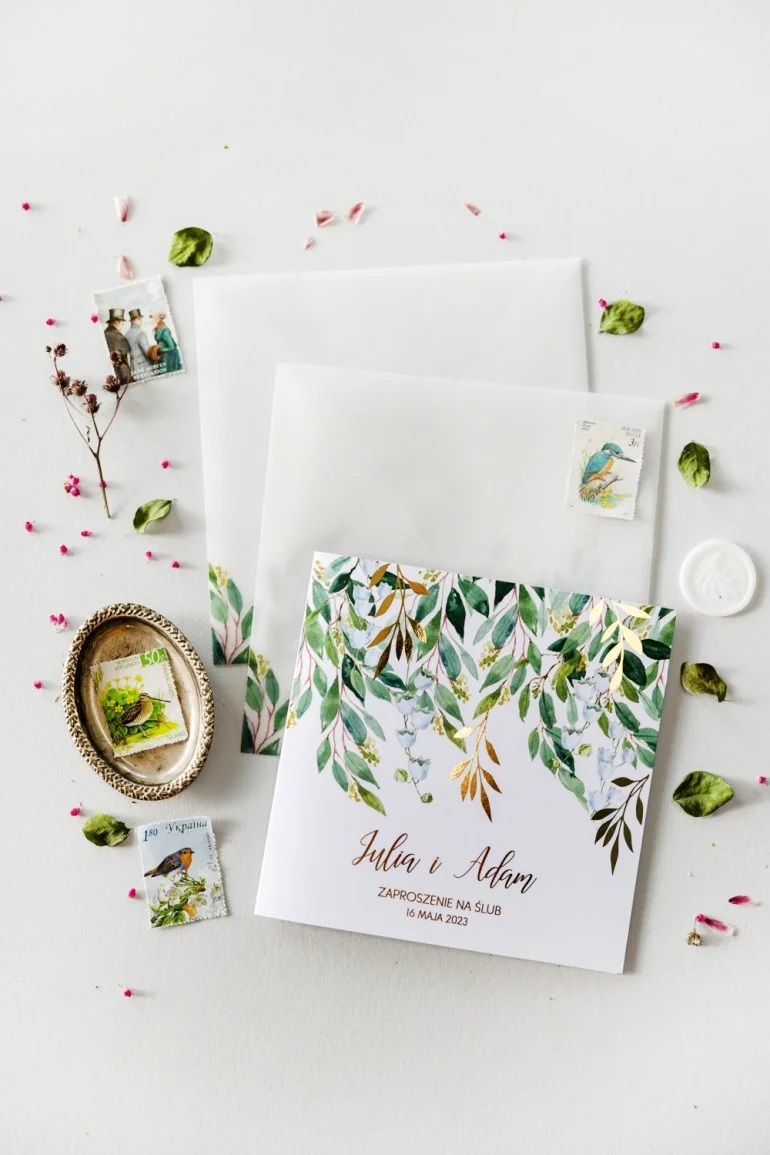
Wedding invitations with green leaves motif, gold accents, classic | Gold-foiled wedding invitations | Rubin no. 4
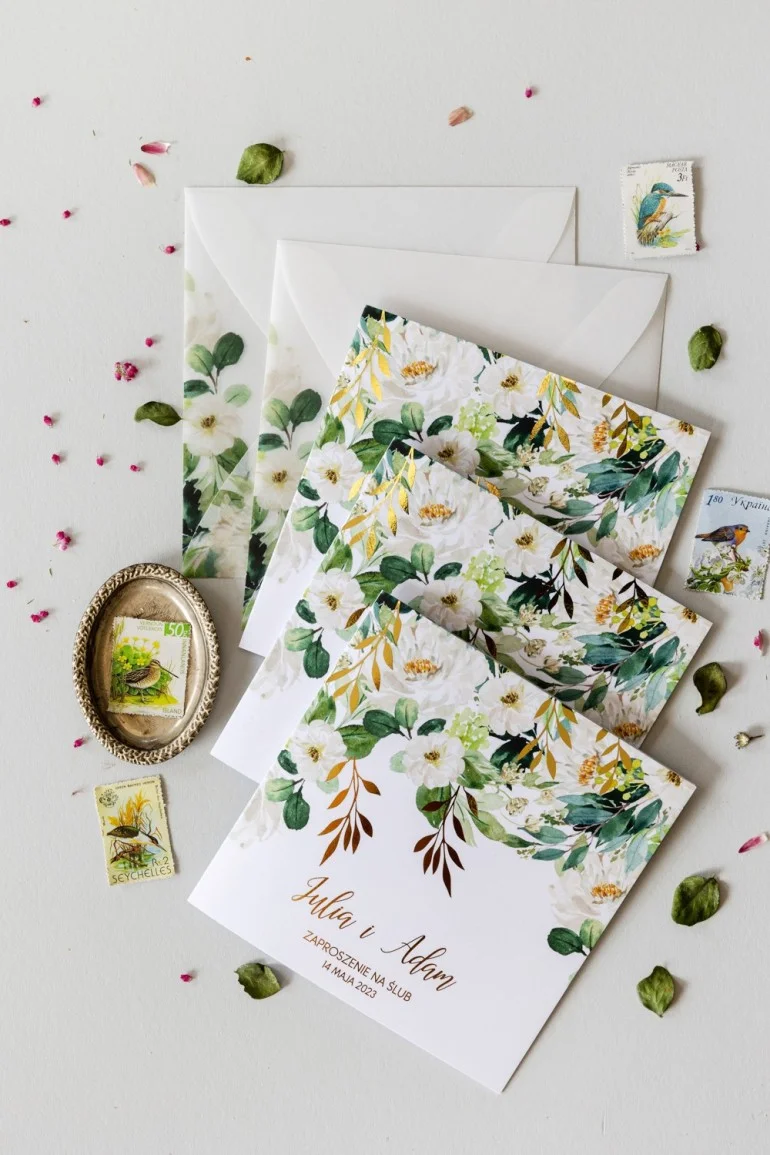
Stylish Wedding Invitations with Gold Accents, Watercolor Flowers | Exclusive Wedding Invitations | Rubin no. 1
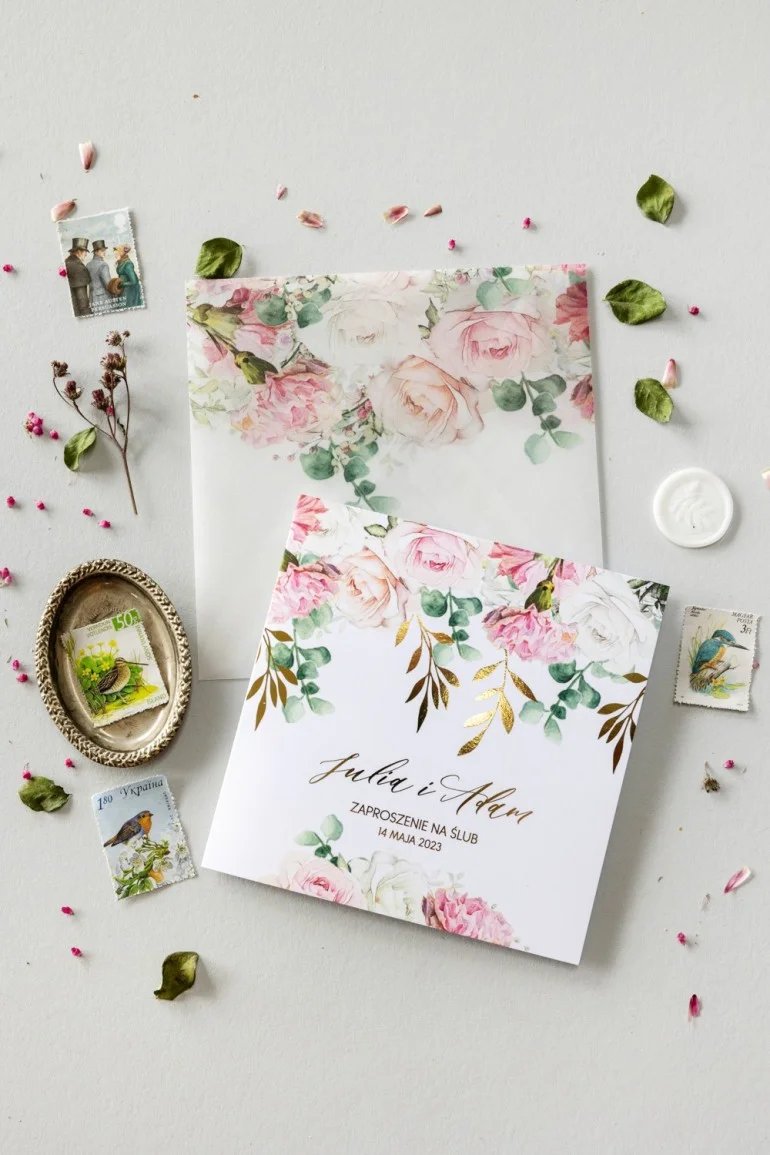
Wedding invitations with pink roses and gold foil, transparent envelope | glamour style wedding invitations | Rubin no. 9
Hidden expenses and unforeseen DIY costs
When planning a budget for handmade invitations, it is worth considering hidden costs that are easy to overlook. First, there may be errors and material waste. When printing invitations yourself, you often waste several sheets on test prints or due to color mismatch. Similarly, when cutting – one moment of inattention and several sheets go into the trash due to crooked cuts. These losses mean you have to buy more materials than planned, which costs extra.
Second, equipment cost: if you don't own a printer, a guillotine, or a high-quality utility knife, you might need to buy or rent them. Even if you have a printer, printing on thick textured paper can be a challenge for it – many home devices cannot handle high-weight paper. You might find it necessary to print the invitations at a professional print shop, which in turn will add a fee for preparing the project for printing and for each order. Moreover, not every print shop will agree to print on paper provided by the customer – sometimes you have to use their paper, which can be more expensive.
Finally, unforeseen expenses can arise from corrections. Suppose that after printing 100 invitations, you suddenly realize there is a typo in the text or the wedding time has changed. If you are doing everything yourself, the entire correction is on you – you have to buy more paper and print that batch again. When you use a company's services, you usually have the opportunity to receive a project for approval beforehand or purchase a few extra invitations in case of a mistake, often with a small margin.
Worth remembering: DIY seems cheaper at first glance, but hidden costs can surprise you and negate potential savings. A few extra trips to the stationery store and corrections can make the DIY budget approach the cost of ready-made invitations – and sometimes even exceed it.
How much do ready-made wedding invitations actually cost?
To fairly compare costs, let's look at the prices of purchasing invitations from professionals. Prices of wedding invitations in stores and print shops vary greatly – everything depends on the style, complexity of the project, and the print run (number of pieces). Simple, minimalist wedding invitations ordered online can be found for as little as about 1–3 PLN per piece, often even including an envelope. This amount is comparable to or lower than the unit cost of materials for a DIY invitation of a similarly simple form! More decorative invitations, with extra ribbons, inserts, or personalized ornaments, usually cost in the range of 4–7 PLN per piece. Meanwhile, luxurious, unique projects created on individual order can reach prices of 8–10 PLN per piece and more.
Importantly, when ordering ready-made invitations, the economy of scale often applies – the more pieces you order, the lower the unit price. Wedding stationery stores offer packages and sets where, for example, when ordering over 50 pieces, the price per invitation drops by a dozen or so percent. When making invitations yourself, it is harder to achieve this economy of scale effect – the cost of materials per invitation does not necessarily decrease significantly with a larger number, and your labor time actually increases with each additional copy.
Summarizing financial issues: is DIY cheaper? Only in some cases. If you are planning super minimalist invitations, already own most of the necessary materials, and are truly satisfied with a very simple design – you might save a certain amount. However, many analyses and reports from young couples show that potential savings rarely exceed 100–200 PLN compared to ordering ready-made cards. This amount is just a fraction of wedding costs (see, for example, our article on costs of a wedding for 30 people), and you have to "earn" it with your own time and effort. Often, a better financial (and not just financial) solution is to order ready-made invitations – especially since you can find options for every budget on the market.
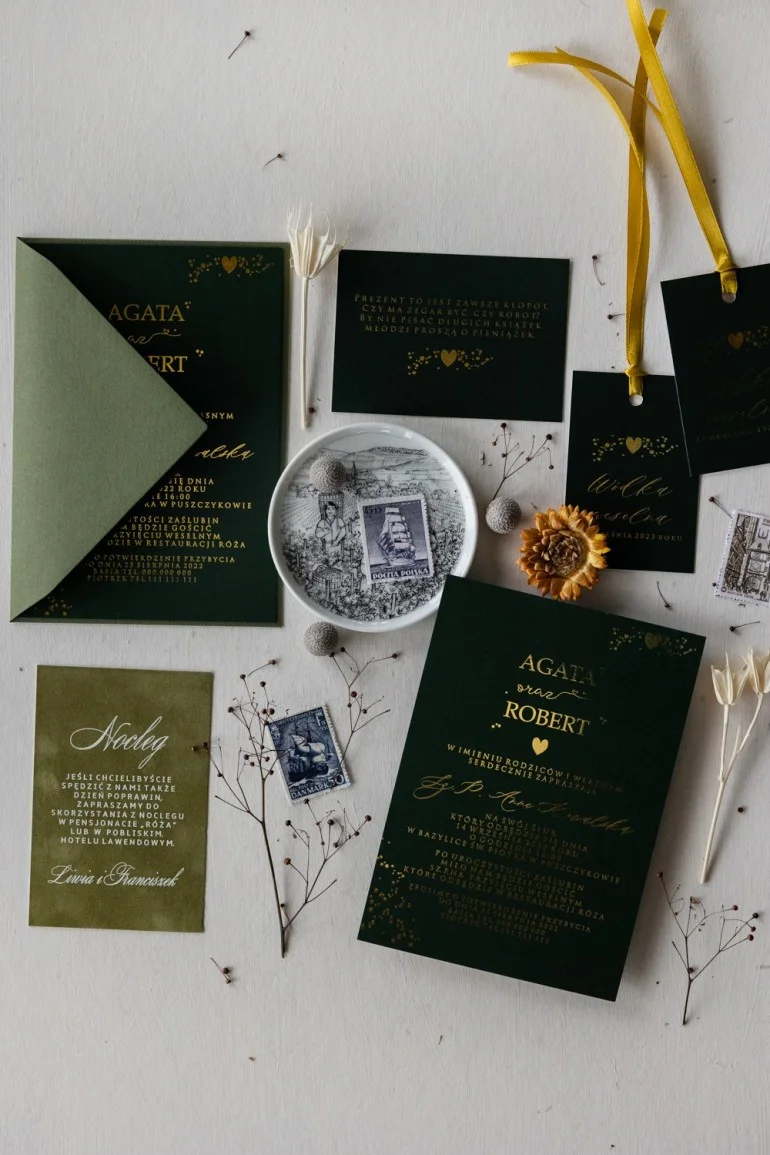
Single-card Wedding Invitations with gold foil | Simple no. 2
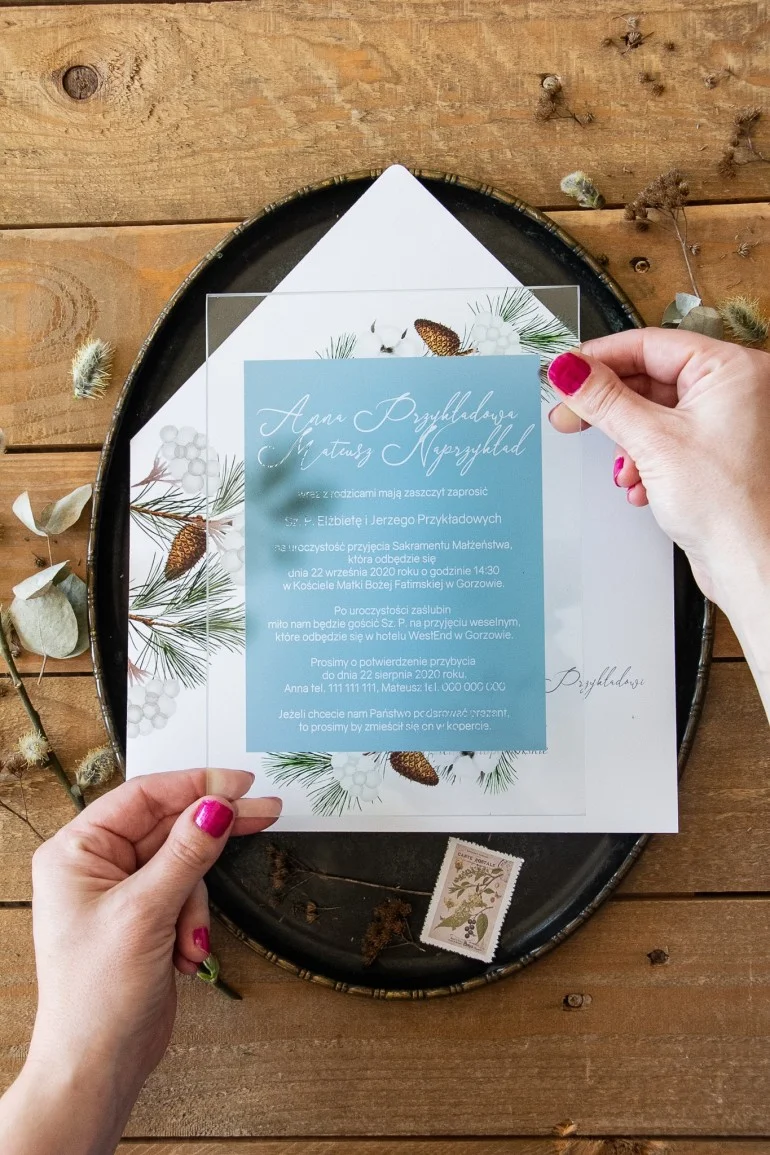
Extravagant Wedding Invitations on Glass | Glass Winter Accent | Cotton & Pine | Korani no. 8
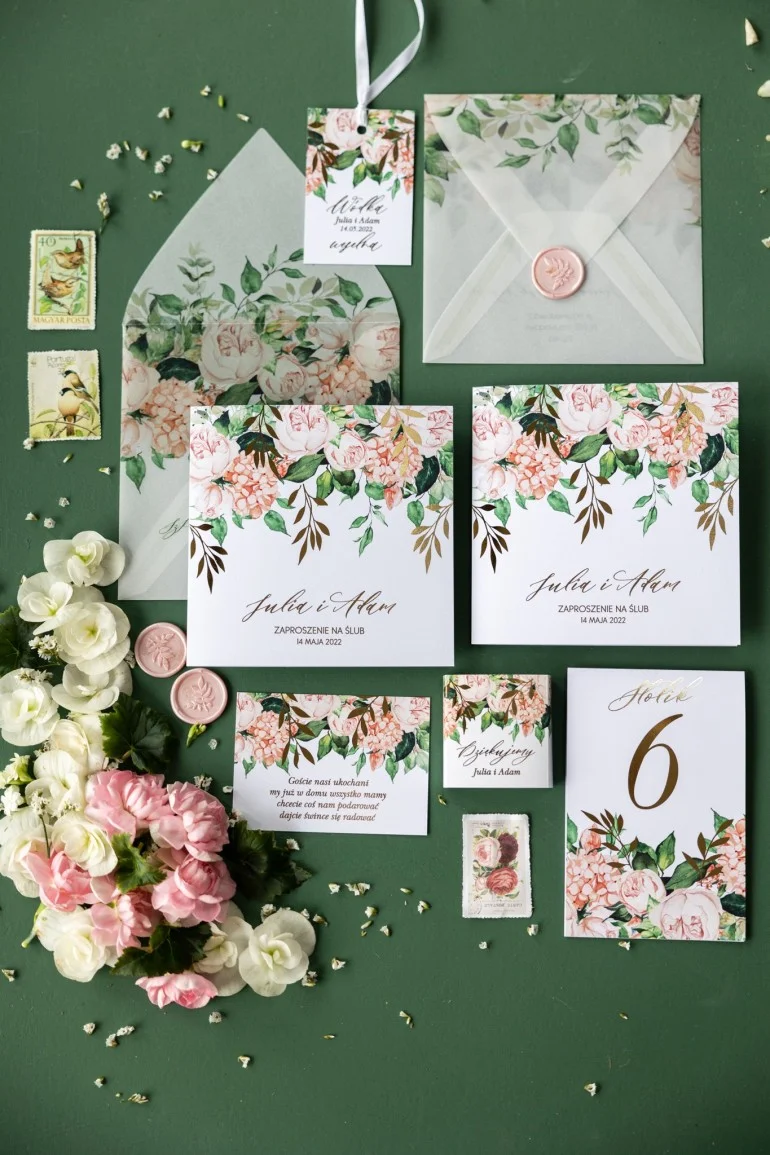
Unique Wedding Invitation with Gold Foil, Pink Peonies and Vellum Envelope | Unusual Wedding Invitations | Rubin no. 10
Time is money – how much work does making invitations yourself require?
Designing and planning DIY invitations
Costs are one side of the coin, but the time and commitment needed for DIY invitation preparation are equally important factors. In the heat of wedding preparations, every hour is valuable, and a DIY project can consume a lot of those hours. At the beginning, there is the design phase: before the first physical copy of the invitation is created, you have to come up with its look. You might have an initial concept in your head, but it's still worth browsing hundreds of photos online for inspiration – boho, rustic, glamour, minimalist... the possibilities are endless, and the decision can be difficult. Sites like Pinterest or Instagram are full of ideas, which helps on one hand, but can take a lot of time on the other. Creating a graphic design is the next stage: if you know graphic design software, you will try to design the text layout, choose fonts, ornaments, and backgrounds yourself. If you don't feel confident with graphics, you can use ready-made templates or ask someone for help, but that also requires coordination. Often, it takes several days or even weeks of corrections and testing different versions before you reach a satisfying invitation design.
Simultaneously, it is worth planning logistics: how many invitations do we need (we write about creating a guest list here), whether we send them by mail or hand them out personally, what text to include (see our article on texts for wedding invitations!), and when we want them ready for mailing. With DIY, the term "ready on time" depends solely on us, which means we must start work well in advance to finish before the date we plan to distribute invitations to guests.
Stages and labor intensity of making invitations step by step
Once you have the materials and the design, the execution time comes, i.e., the physical production of the invitations. It is worth realizing how many steps go into this process. Here is a simplified example DIY work schedule for a series of wedding invitations:
- Preparing prints: printing invitations (text + any graphics) on selected paper. You have to set print parameters correctly, ensure each sheet prints centered and in good quality. For, say, 100 invitations, this can take a few hours, counting checks every few copies or refilling ink.
- Cutting and creasing: most invitations are printed several per A4 or A3 sheet, so then they must be cut into individual cards. You have to cut each copy evenly (with a guillotine or manually with a knife and ruler). If the invitation is folded (like an opening card), creasing is necessary, i.e., making an even fold – this also requires precision so the paper doesn't crack at the fold.
- Decorating and folding: when the base cards are ready, we move on to decorating. This could be gluing a ribbon, bow, or lace, placing crystals, tying a string, or stamping a wax seal. Each such element is done manually on every invitation. If, for example, we tie the card with a ribbon and glue on a small dried flower, multiply this action by the number of invitations – it's easy to calculate that 100 invitations mean 100 ribbons to cut and tie and 100 flowers to glue... and that's already hours of monotonous work.
- Personalization and writing: if the invitations are to include guests' names, they must be written or printed. For computer printing, you must include space for names in the design beforehand and enter them into the template – this is another task to do at the design or additional printing stage. If you decide to write names by hand (for a personal touch or lack of time for printing), you face calligraphing dozens of names. It must be done carefully, preferably with nice handwriting or a calligraphy marker – which also takes a lot of time. You can read about the rules for writing names and surnames here.
- Packing and addressing: it is worth putting finished invitations into envelopes immediately with prepared inserts (e.g., with a request for RSVP, a map, or perhaps a note with information instead of flowers). Then we seal the envelopes and write names or addresses on them. Mailing requires buying stamps and going to the post office.
Each of these stages seems prosaic, but together they add up to dozens of hours of work. Many people only realize after the fact that preparing, for example, 80–100 invitations by themselves consumed several full days or a dozen evenings spent cutting, gluing, and writing. You often hear opinions: "We thought making invitations was nothing, but when we spent consecutive weekends on them, we regretted not ordering ready-made ones". Such reflection appears especially when other duties arise or something goes wrong – e.g., the printer breaks down in the middle of the work, and the deadline is looming.
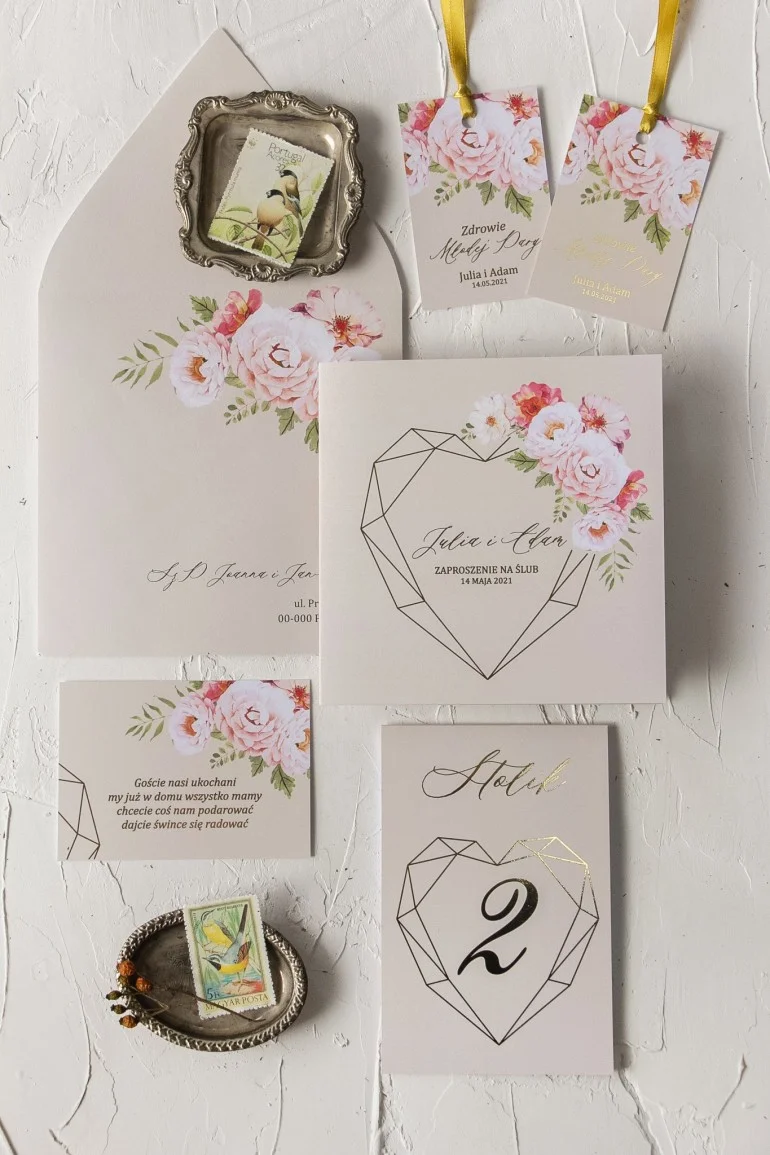
Wedding Invitations with Gold Heart and Floral Motif | Modern and Stylish | Sapphire no. 8
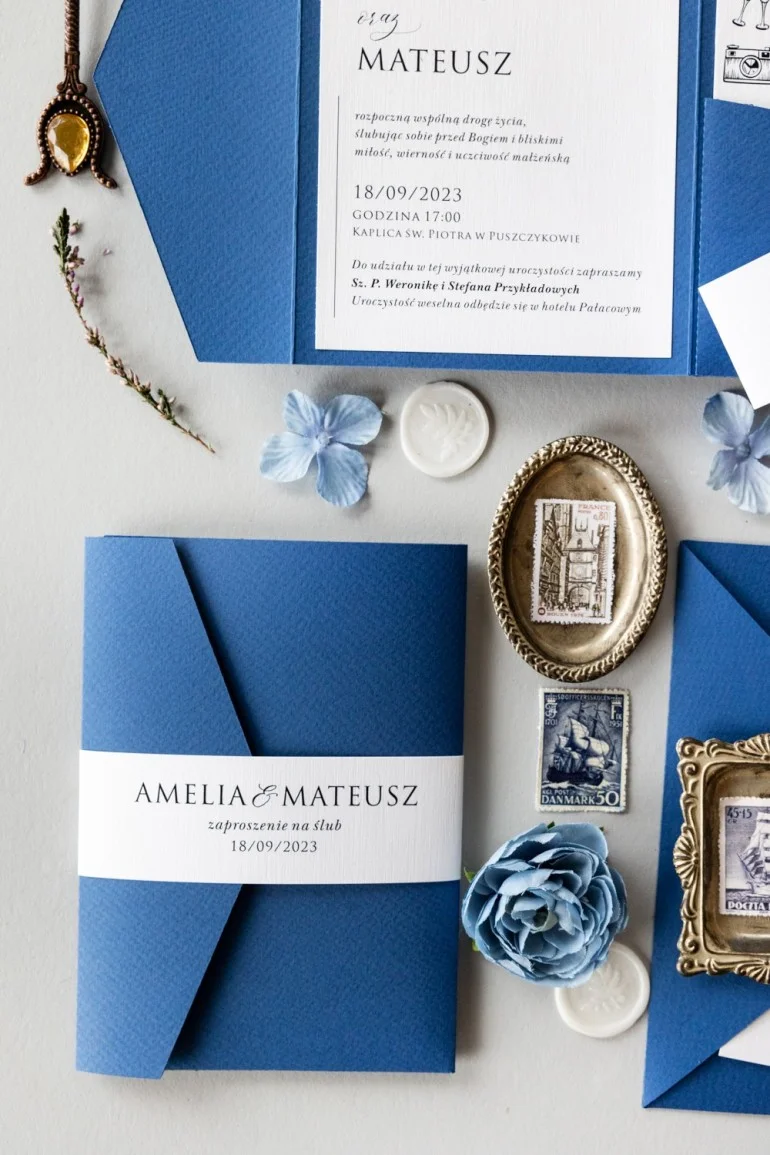
Blue, Elegant Wedding Invitation with Pocket and Personalization | Kraft no. 7
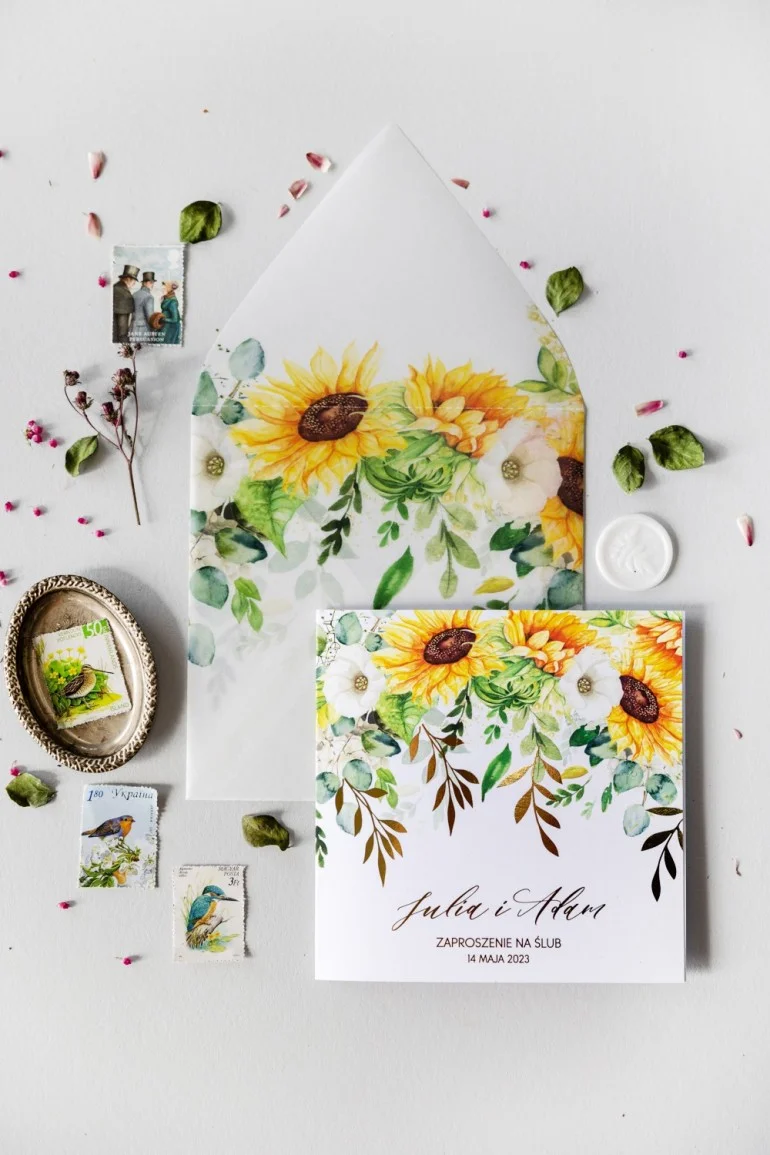
Wedding Invitations with Sunflowers and Gold Foil | Modern and Original | Rubin no. 7
Time saved when purchasing ready-made invitations
If you decide to buy ready-made invitations, the bulk of these tasks disappears from your shoulders. Your time investment is then limited mainly to choosing the design and providing data for printing (list of guest names, invitation text, dates, places, etc.). Good wedding stationery companies – such as Amelia-Wedding.pl – often offer help at every stage: they have ready-made text templates, advise on how to correctly phrase the invitation text, and send a visualization for approval before printing so that we can check everything. After placing the order, we just wait for the delivery of beautifully made invitations to our door. The whole process – from choosing the pattern to receiving the package – usually takes a few days to a few weeks, depending on the company and order size. Importantly, however, this is time during which we personally do not have to work; we can take care of other matters or simply rest.
In terms of hours, purchasing ready-made invitations can save dozens of hours of our work. This is time that we can spend refining other aspects of the wedding: searching for the perfect dress, arranging the seating plan, choosing the menu, or learning the first dance. Or simply – catching a breath in the rush of duties. Wedding planning can be stressful and time-consuming, so every task taken off your mind is worth its weight in gold. A good wedding day schedule can help with this, which we write about here.
Remember that time is money. Dozens of hours spent on tedious DIY is a resource that also has its value. Even if handmade invitations save you that proverbial 100 PLN, at the cost of, say, 30 hours of work, it's easy to calculate that our "hourly rate" for this work will be about 3 PLN. Is it really worth it? Instead of that time, we can have ready-made invitations and peace of mind that everything will be done professionally and on time.
Quality and final effect – DIY vs. professional invitations
The look of DIY invitations vs. guest expectations
A wedding invitation is the first element of the wedding that reaches the guests' hands – it sets the tone for the celebration and says a lot about the character of the party. It's no wonder that most couples want their invitations to look perfect, elegant, and make a good impression. With the DIY approach, there is unfortunately a risk that the final result will not meet our expectations. Perhaps in our imagination, we had an image of a beautiful, hand-decorated invitation, but making it ourselves turned out to be more difficult than we thought. Certain shortcomings – slightly uneven cutting, a crookedly glued decoration, a small spot of glue on the paper – are details that can catch the eye, especially if we strive for perfection.
Guests will, of course, primarily appreciate the gesture of the invitation itself, but aesthetics also matter. An elegant, carefully crafted invitation will delight and build a solemn mood of anticipation for the ceremony. If the invitations are made in a homemade way and show a lack of skill, they may be perceived as charming, but somewhat amateurish. Let's consider what effect we want to have on the recipients: do we care about a professional impression and consistent style, or do we prioritize the personal charm of DIY, accepting certain imperfections? This is an important question, because not everyone has the manual or artistic skills to achieve a catalog-level effect by hand.
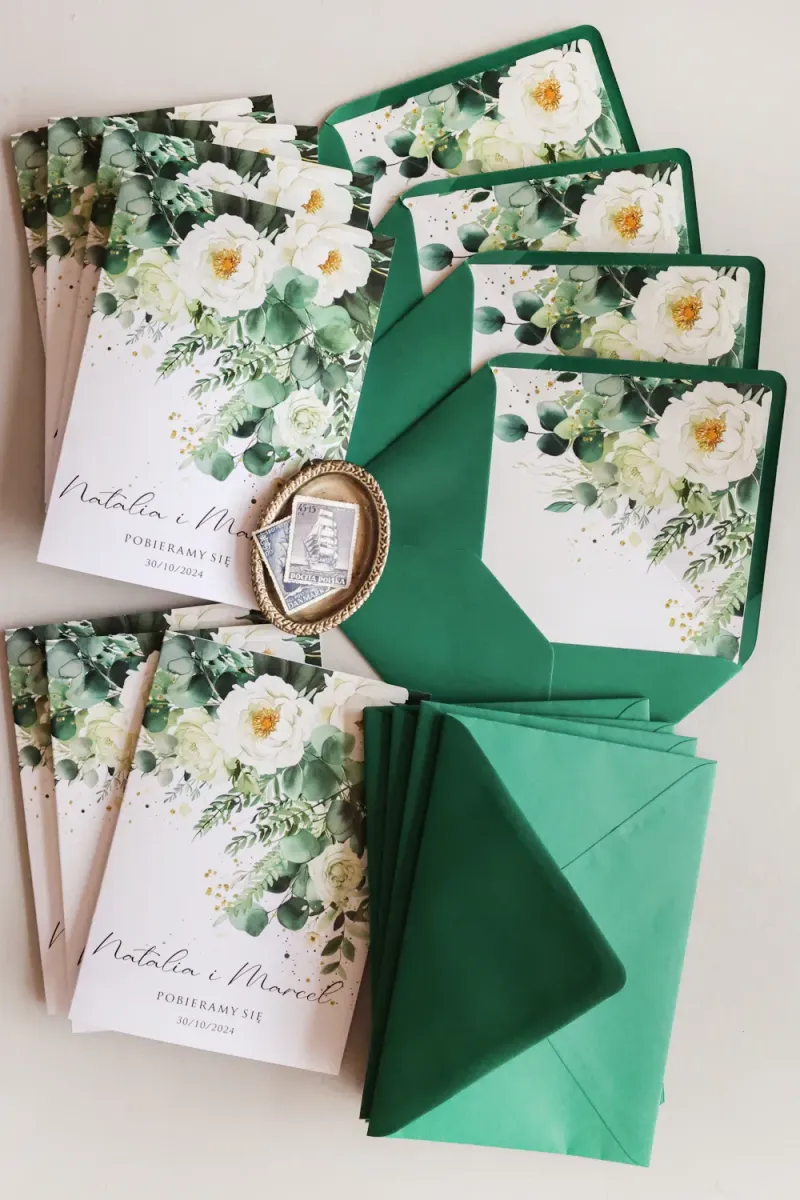
Wedding Invitations with white flowers and green accents | minimalist invitations with personalization | Impresja no. 9
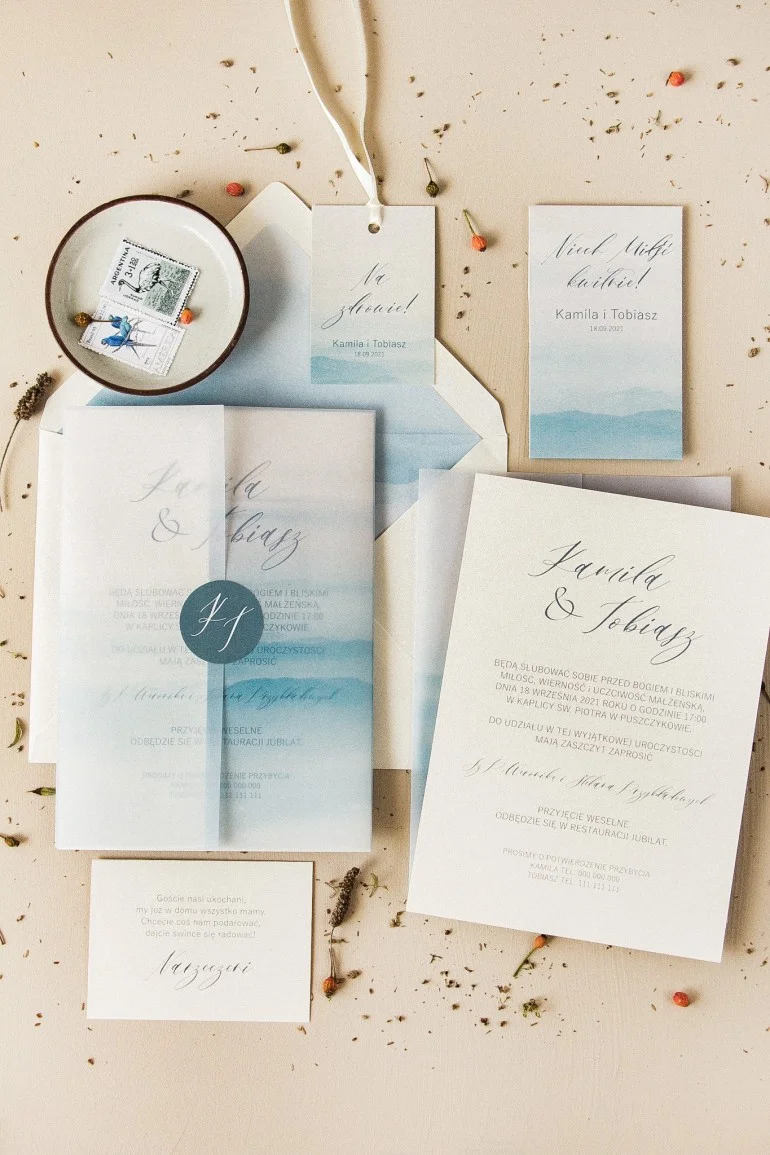
Elegant Wedding Invitations with Vellum | Watercolor and Pearlescent | Opal no. 4
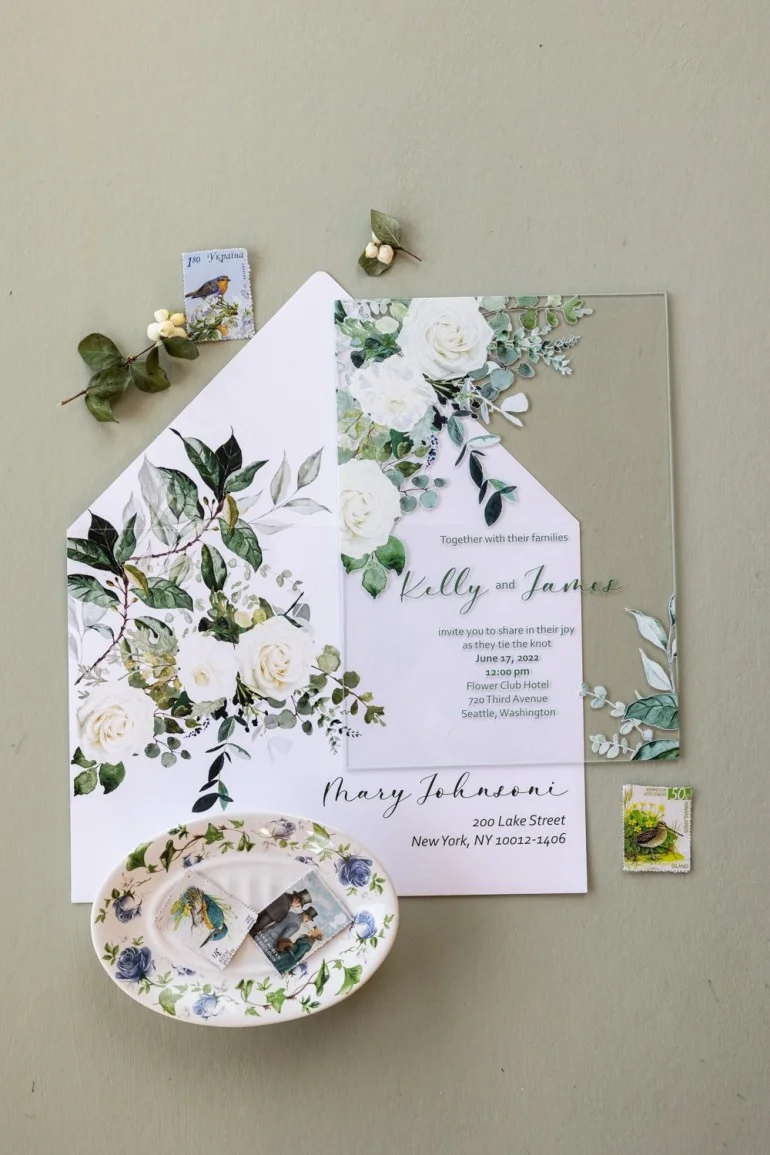
Floral Elegance Wedding Invitations on Glass with White Roses and Greenery Envelope | Korani no. 12
Professional materials and techniques unavailable at home
Another aspect of quality is the type of materials and printing/decorating techniques used in the production of invitations. Professional companies usually have equipment and raw materials that a private individual does not have access to or that are not cost-effective on a small scale. Examples? High-quality offset or laser printing, which guarantees sharp, saturated colors and print durability – a home inkjet printer will not provide such quality, and the ink can smudge when exposed to moisture. Print finishing, such as gold foil, silver foil, embossing, or spot UV varnish, gives invitations a luxurious look (see, for example, invitations with gold foil). At home, it is impossible to gold-foil lettering or emboss a texture – and many ready-made invitations offered in stores have such elements. The same goes for laser cutting – intricately cut openwork patterns on invitation covers are made with a laser plotter with great precision. Recreating this by hand is practically impossible (or would consume a gigantic amount of time cutting with a scalpel).
Also, the quality of paper used by professionals often exceeds what we can buy at retail. Stationery stores order their cardstock from the best manufacturers, have access to papers with unique textures, pearlescent sheens, and even eco-friendly ones that we won't find in a regular stationery store (more about choosing paper here). Moreover, print shops know how to print on a given type of paper to get the best effect – e.g., on textured paper, appropriate techniques are used so that the ink covers it evenly. At home, we may not have this knowledge or the ability to test different methods.
Decorations and finishes by specialists also maintain a higher level: bows are tied evenly, each invitation copy is identical because experienced employees or precise machines work on them. Quality control in companies ensures that defective copies are rejected – we as customers receive a product without flaws. With DIY, we may not even notice a minor defect, and then one of the cards for guests will turn out, for example, less legible due to poor printing.
Errors, misprints, and other risks lowering quality
When making invitations yourself, we are only human – it's easy to make a mistake that will affect the final look. Typos or errors in the text are a fairly common occurrence, especially when we compose the invitation content ourselves. Professional companies usually ask for approval of the project before printing, which allows catching and correcting errors. In DIY conditions, it's easy to overlook something, and then dozens of cards have the same flaw. Another risk is incorrect colors – what we saw on the screen may print darker or with a slightly different shade. Without experience in preparing files for printing, it's hard to predict this. Many couples have been disappointed that the chosen shade of pink on the invitations came out differently than they planned. We wrote about the most common mistakes in invitation design here.
Even something as prosaic as folding invitations can be a source of errors – uneven pressure during creasing will mean half the invitations will fold perfectly in half, and the rest a bit crookedly. Gluing elements also causes problems: the wrong glue can discolor the paper or not hold heavier decorations (e.g., wooden hearts or thick ribbons) strongly enough. Worse, if we use too much glue, it can leak to the edge and leave a mark. All these trifles add up to the overall presentation of the invitation.
In the case of professionally ordered invitations, these risks do not apply to us – it is the supplier who takes care of quality and is responsible for any errors in printing or execution. If a defective batch were to happen, the company would simply correct it, often without even informing us of the problem, because the customer receives the correct version. This is another aspect of peace of mind that choosing a ready-made product provides us.
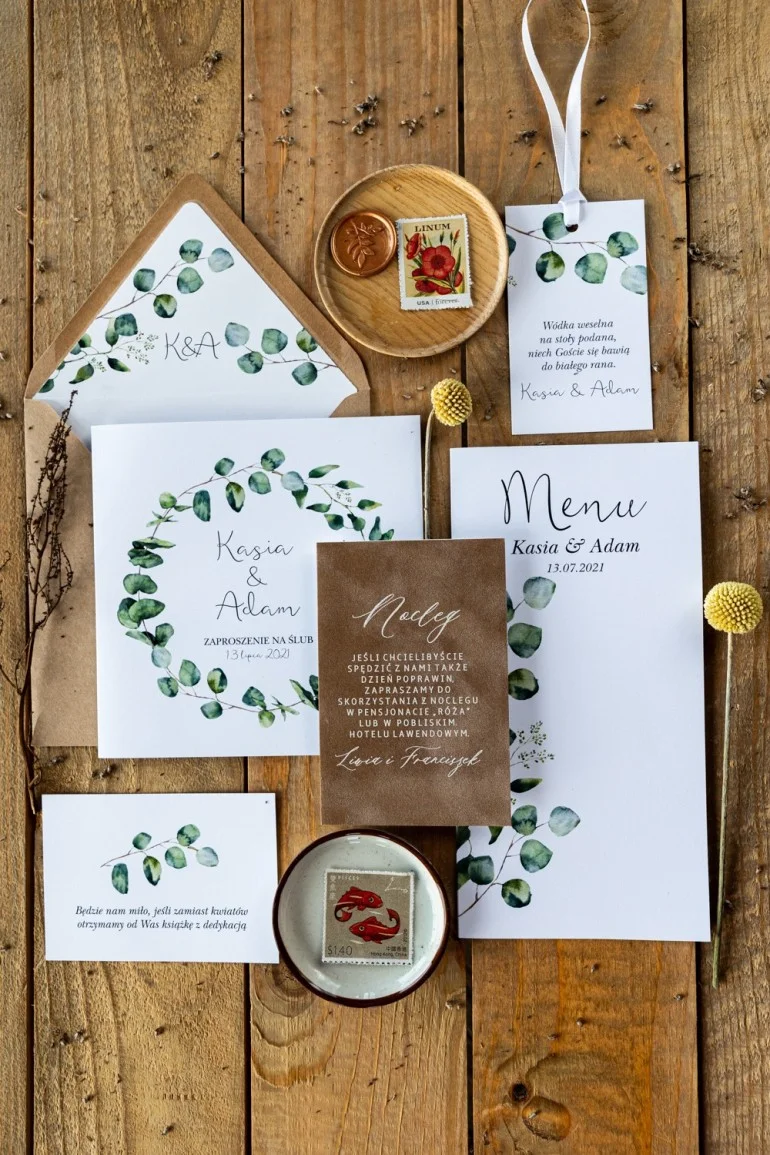
Eco-friendly Invitation with Greenery Styling | Wedding Invitations in eco-friendly envelope | Kalia no. 2
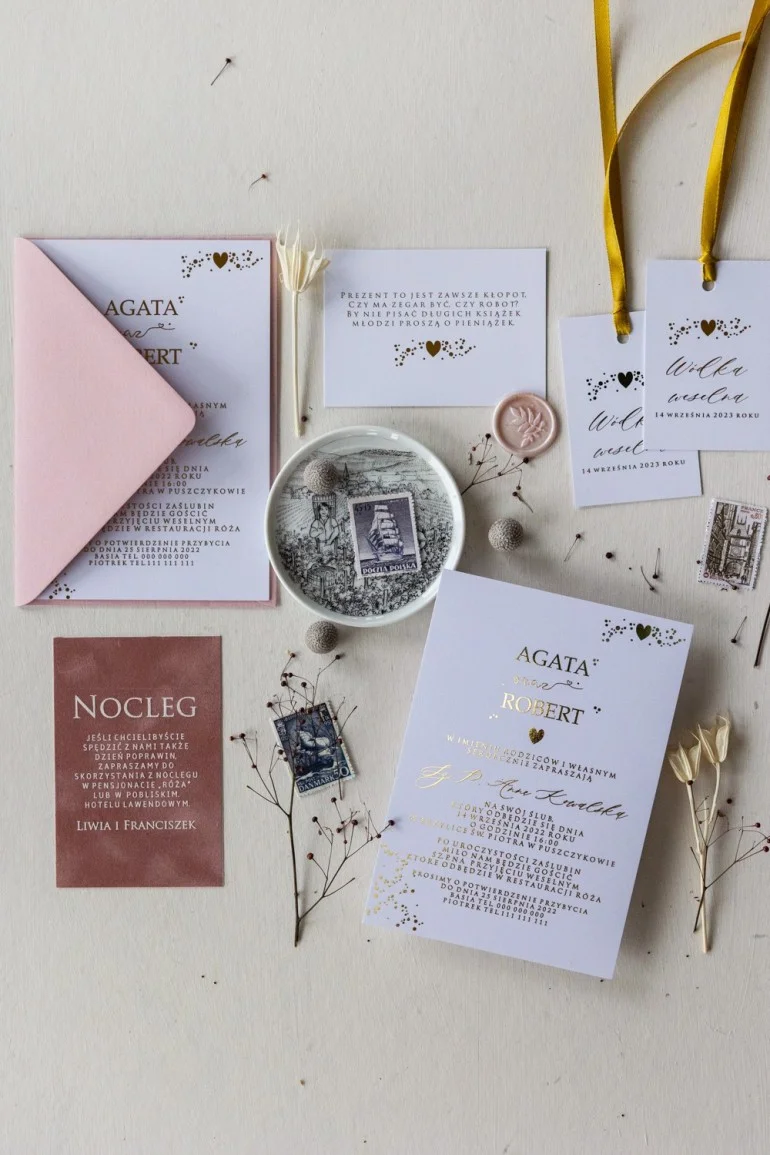
Subtle Wedding Invitations, Minimalist Design with Gold Elements | Simple no. 3
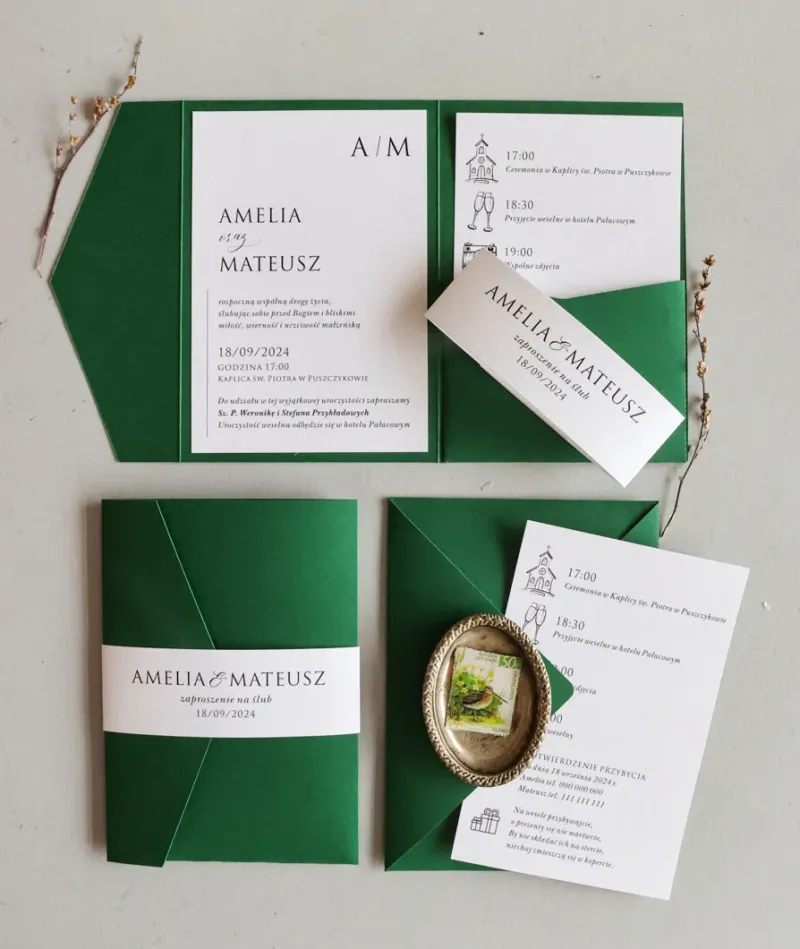
Elegant Wedding Invitations in Bottle Green Shades | Minimalist Design and Modernity | Kraft no. 10
First impression – the importance of a perfect invitation
Perfectly crafted wedding invitations are pleasing to the eye and make an impression on everyone who receives them. Guests often praise beautiful invitations, and some people even keep them as a souvenir. By investing in professional invitations, we have a great chance that this will be the case – that our cards will delight with quality and style, and will be a consistent part of the entire wedding concept (learn how to ensure consistency of invitation style with wedding decoration). Handmade invitations can also be beautiful, especially if someone has artistic talent, but objectively speaking, it is difficult to achieve such a level of workmanship at home as a professional stationery studio guarantees.
It is worth asking yourself: how much do we care about the quality of invitations? If this is an important element of the wedding setting for us, which is meant to delight guests and ourselves – we lean towards entrusting its execution to professionals. If, on the other hand, our priority is personal character and the contribution of our own hands, and potential small shortcomings don't bother us – then DIY can bring satisfaction. However, we must remember that guests don't always know how much heart we put into handmade crafts; they will judge the effect they see. Therefore, couples who care about the most elegant image often choose ready-made invitations, having certainty about their quality.
Personalization and style selection – DIY vs. ready-made invitation offers
Creativity vs. limitations – what does DIY really offer?
One of the arguments for DIY supporters is the possibility of unlimited personalization of invitations. In theory, by doing everything yourself, we can create exactly the design we dream of – choose any colors, fonts, texts, decorations, and even the form of the invitation. This is a tempting vision, but in practice, there are limitations. First, we are limited by our own skills. Not everyone has the talent of a graphic designer or manual skills at a level that will allow them to realize their dream vision. Often, you have to compromise – simplify the design if we don't know how to do certain things. Second, we can be limited by available materials. Perhaps we dream of an invitation with an exotic motif or on unusual material, but we won't find suitable semi-finished products in retail. DIY gives a lot of freedom, but only within the scope of what we are able to do ourselves and what we manage to buy.
It is also worth mentioning that full personalization of each invitation individually (e.g., individual graphics for each guest, different colors for different families, etc.) is very time-consuming and rarely practiced, because the bride and groom usually want all invitations to look the same. So, in the end, we still make a repeatable set of identical cards – and since that's the case, maybe it's better to outsource it professionally? DIY can give a unique style if we really have an unusual idea and can execute it. However, for most couples, this "unlimited creativity" ends with choosing one of the popular styles (e.g., boho with watercolor flowers, rustic with jute string, or elegant with a gold frame) – and such styles can easily be found in the offer of ready-made invitations. We write more about invitation personalization here.
Wealth of patterns available in wedding stationery stores
Professional companies dealing with wedding stationery have catalogs full of diverse invitation patterns. The wealth of styles, motifs, and colors can surprise – from boho invitations with floral motifs, through minimalist black and white typographic cards, romantic lace and pastel watercolors, to modern geometric patterns or eco-friendly invitations on kraft paper. Such a wide selection means that almost every couple will find something for themselves, without the need to design from scratch. Moreover, many companies allow making minor modifications to existing patterns – e.g., changing the ribbon color, paper type, or text layout – thanks to which we receive a product tailored to our preferences.
Content personalization is standard – of course, on each invitation there will be your surname, guests' names, date, and place, exactly as you provide. Often you can also add your own quote, change the gift poem, decide whether you want full formal phrases or a more casual tone. All this makes purchased invitations not necessarily impersonal. On the contrary, good companies try to make their designs customizable so that the bride and groom feel that these are "their" invitations. In comparison, DIY theoretically gives full freedom, but for the reasons mentioned above, we will often end up with a design that resembles one of the popular schemes anyway. Only achieved with more of our own labor.
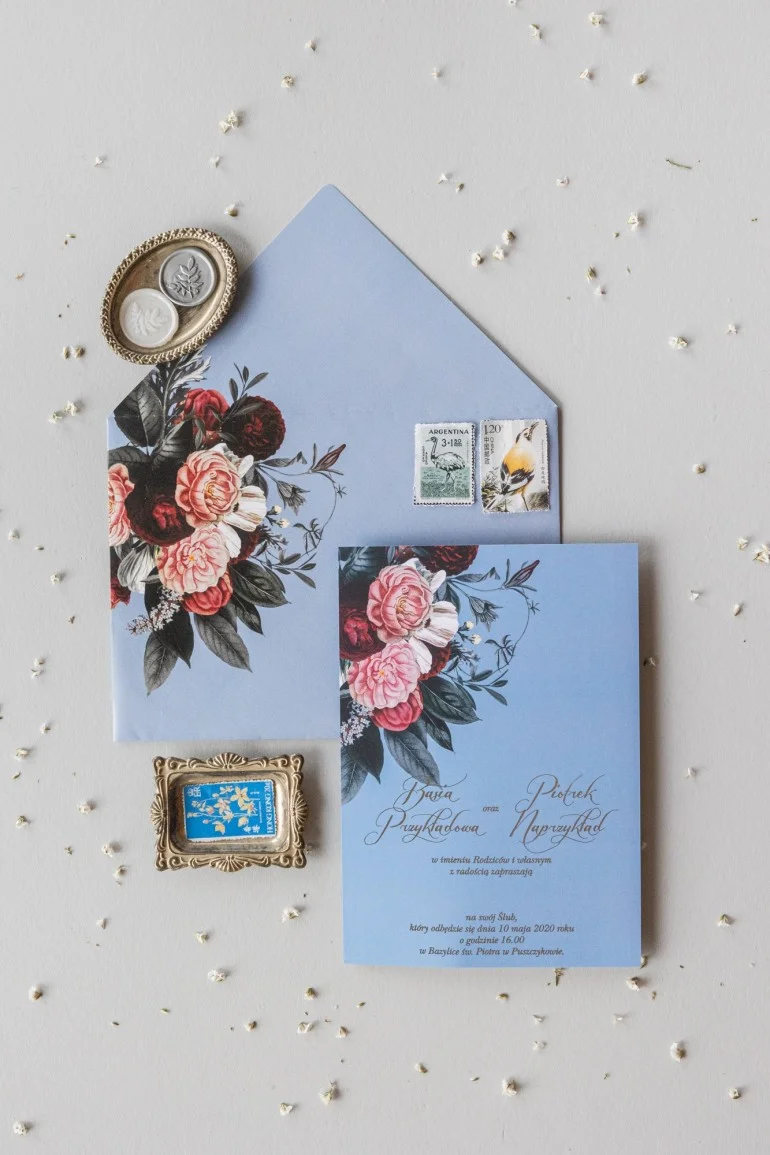
Glamour Invitations with Silver text and burgundy-pink bouquet | Elegant wedding invitations | Pastel no. 1
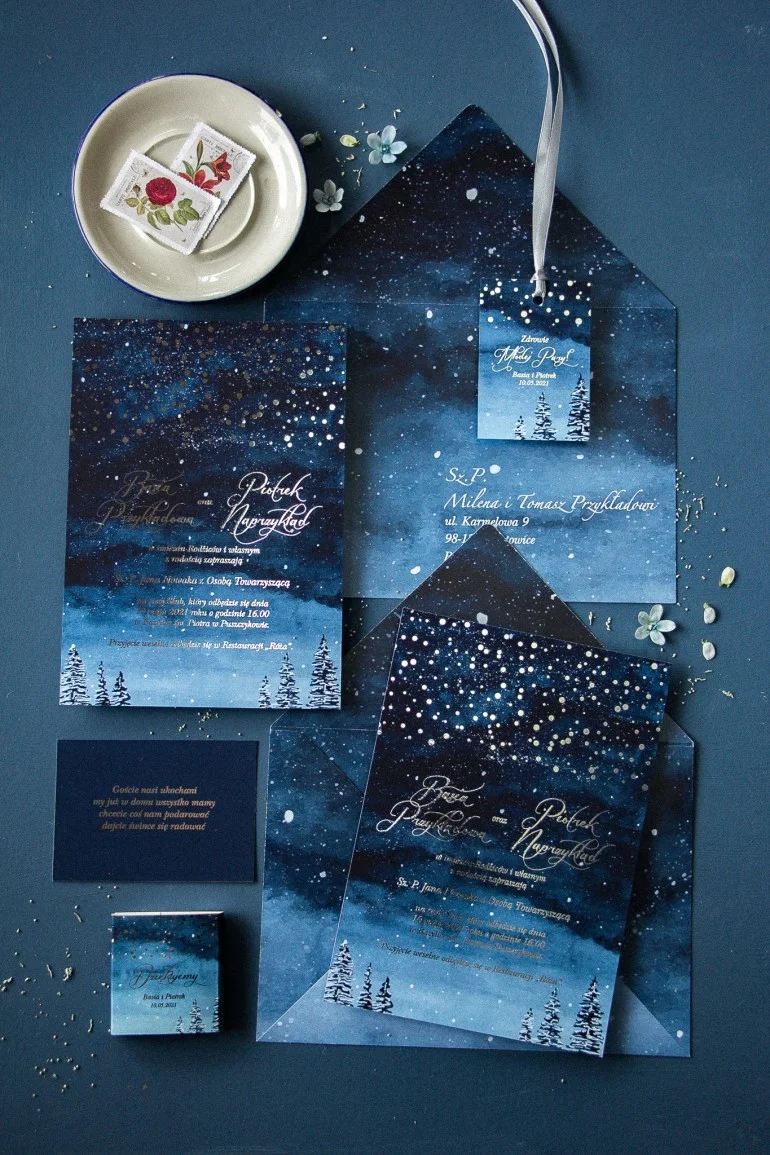
Winter Themed Wedding Invitations with Silver Foil | Pastel no. 6
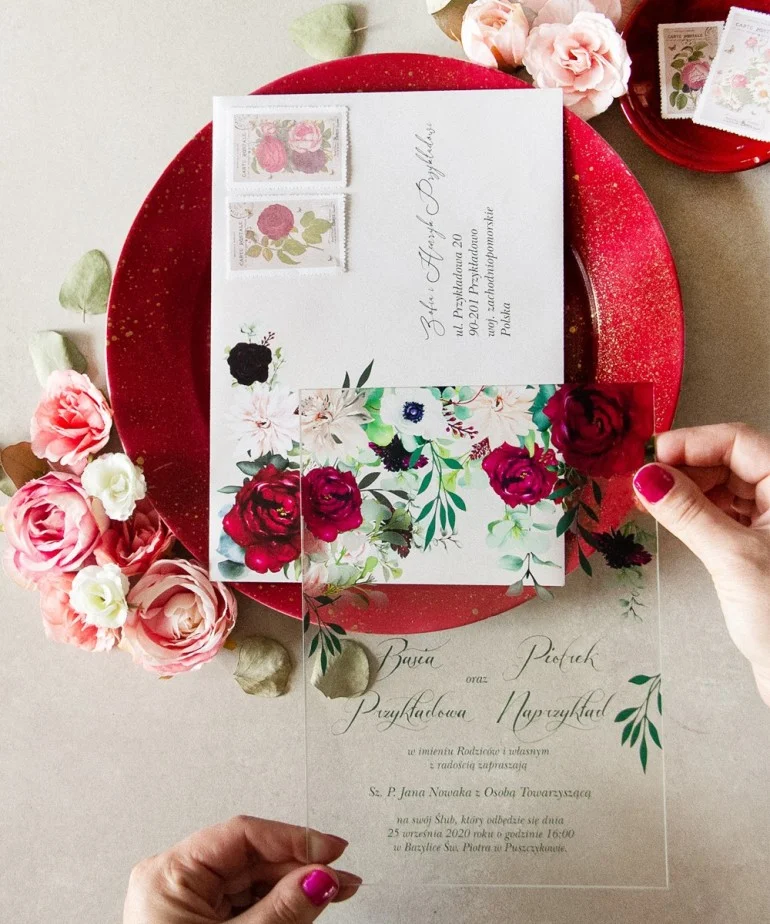
Elegant Wedding Invitations on Glass with Floral Motif | Korani no. 4
Consistent wedding stationery: invitations, place cards and thank you gifts for guests
When we think about wedding stationery, invitations most often come to mind. However, it doesn't end there – wedding stationery also includes other printed (or handmade) elements that appear during the wedding. These include place cards (i.e., cards with guests' names on tables, about whether place cards are a good idea, we write in another article), menu cards, table numbers, seating plan, guest book, alcohol labels, or small thank-you cards. Small gifts for party participants have also become increasingly popular, so-called thank you gifts for guests – often small presents with an attached label or a thank-you note (see ideas for sweet gifts).
If we care about a consistent style for all these elements, we face another challenge: matching invitations to the rest of the wedding accessories. Companies offering invitations usually have a whole range of matching products in their offer – you can order place cards, menus, alcohol stickers, thank-you gifts for guests, and many other accessories in the identical style as the invitations. Thanks to this, the entire graphic setting of the wedding is consistent, from the first contact (invitations) to the last (e.g., a thank-you note handed out at departure).
By making invitations using the DIY method, we would have to prepare all these accessories ourselves if we want to maintain a uniform style. And that's a huge amount of work – imagine that besides 80 invitations, you also have to make, for example, 80 place cards and 80 thank-you notes, and to that, e.g., 10 table number signs and a table plan. Suddenly our DIY project grows to several hundred small elements to make! Of course, you can limit the scope – e.g., make only invitations yourself, and give up personalized place cards or other things. But do we want to give up such accessories, which after all perform important organizational and aesthetic functions at the wedding?
By deciding to buy ready-made invitations from a wedding company, we open up the possibility of easily ordering matching elements. For example, at Amelia-Wedding.pl, for most invitation collections, you can immediately choose matching place cards, menus, tags, table plans, guest books, and even small presents for loved ones. Everything will be made from the same materials, in the same colors and style, creating a beautiful, harmonious whole. Achieving such consistency by hand is difficult – especially if certain elements (e.g., a large-format table plan) have to be sent for printing anyway, because we won't print them at home. Therefore, couples who care about a comprehensive and refined graphic setting for the wedding eagerly use the offer of specialists. It is also a saving of money – often a complete order (invitations + accessories) from one seller involves discounts or at least savings on shipping, as well as a saving of time, because we don't have to look for each element separately.
Convenience, certainty, and support – the benefits of buying wedding invitations
Less stress and more time for other preparations
Organizing a wedding and reception can be stressful. The closer to the ceremony, the more things are on the bride and groom's mind – finalizing the guest list, dress fittings, church rehearsals, arrangements with the photographer, hall decorations... In all this, additional stress related to the production of invitations is the last thing we need. By deciding to order invitations from professionals, we eliminate a large DIY project from the schedule that could keep us awake at night. We don't have to worry about whether we'll make it on time, whether we'll break something, whether the invitations will turn out nice – we entrust this task to someone else, and we relieve our nerves.
The convenience of such a solution is invaluable. Just think: instead of driving around stores in search of the perfect paper or spending consecutive evenings with glue on the carpet, we can take care of other organizational matters during this time or simply spend time together, relaxing before the big day. Time before the wedding should be joyful, not filled to the brim with nervousness that something isn't working out for us. By ordering ready-made invitations, we gain peace of mind because we know that this element of preparations is under the control of specialists.
Many couples who decided on such a step recall later that "they can't imagine how they would have found time to hand-make invitations". In the rush of organizational matters, it's easy to miscalculate free moments, and the pressure of time grows with each day. By commissioning the execution of invitations, we gain valuable slack in the schedule – we can, for example, start distributing them earlier because we will receive them faster than if we were to finish them ourselves (see when to start distributing invitations).
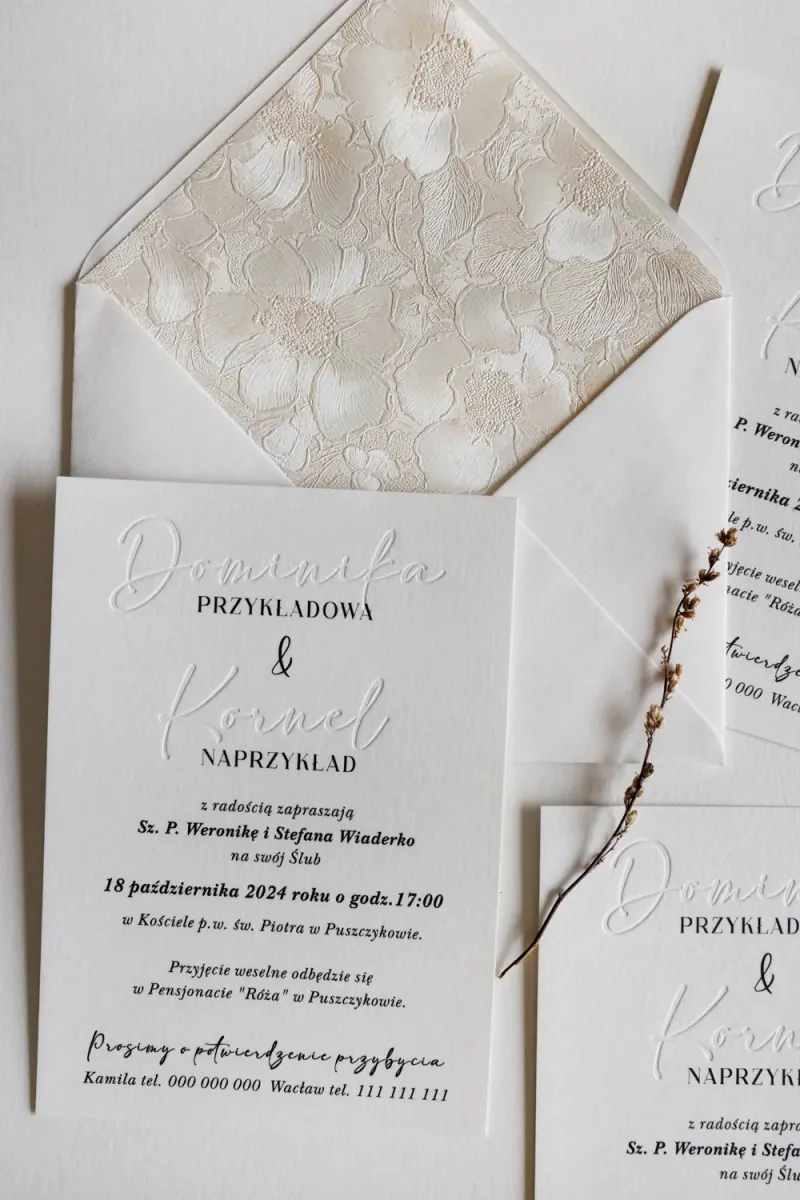
Elegant Wedding Invitations with Embossing | Wedding Invitations | Karmen no. 4
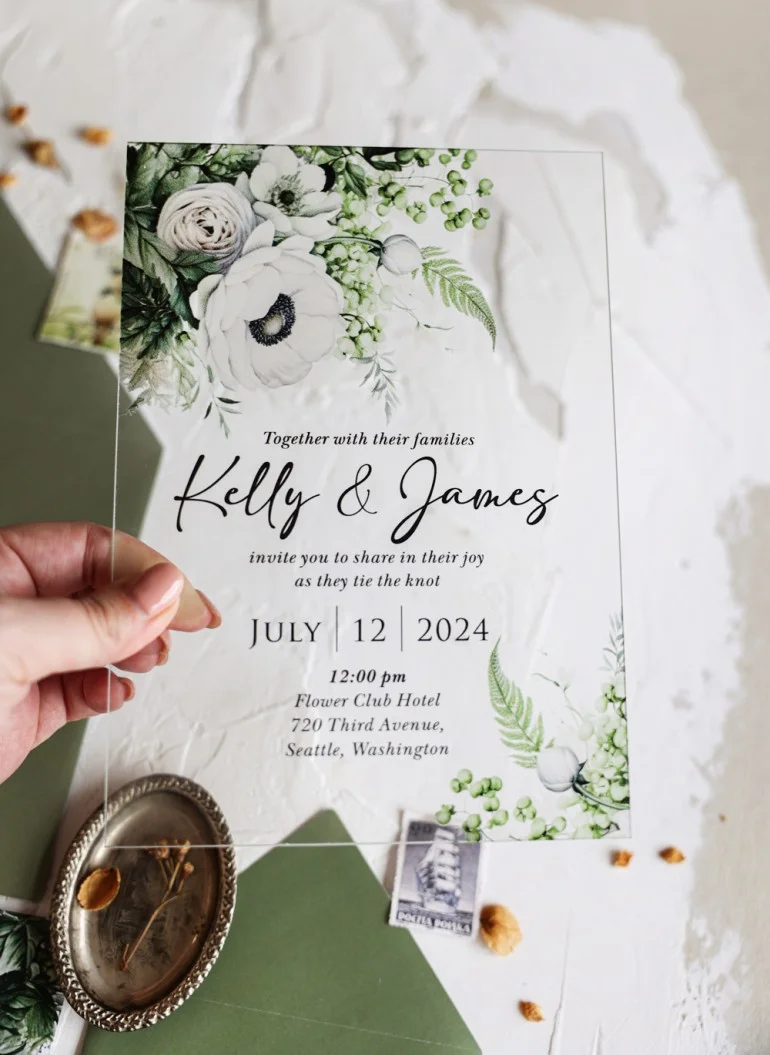
Subtle Wedding Invitations on Glass with Floral Motif in Shades of White and Green | Korani no. 15
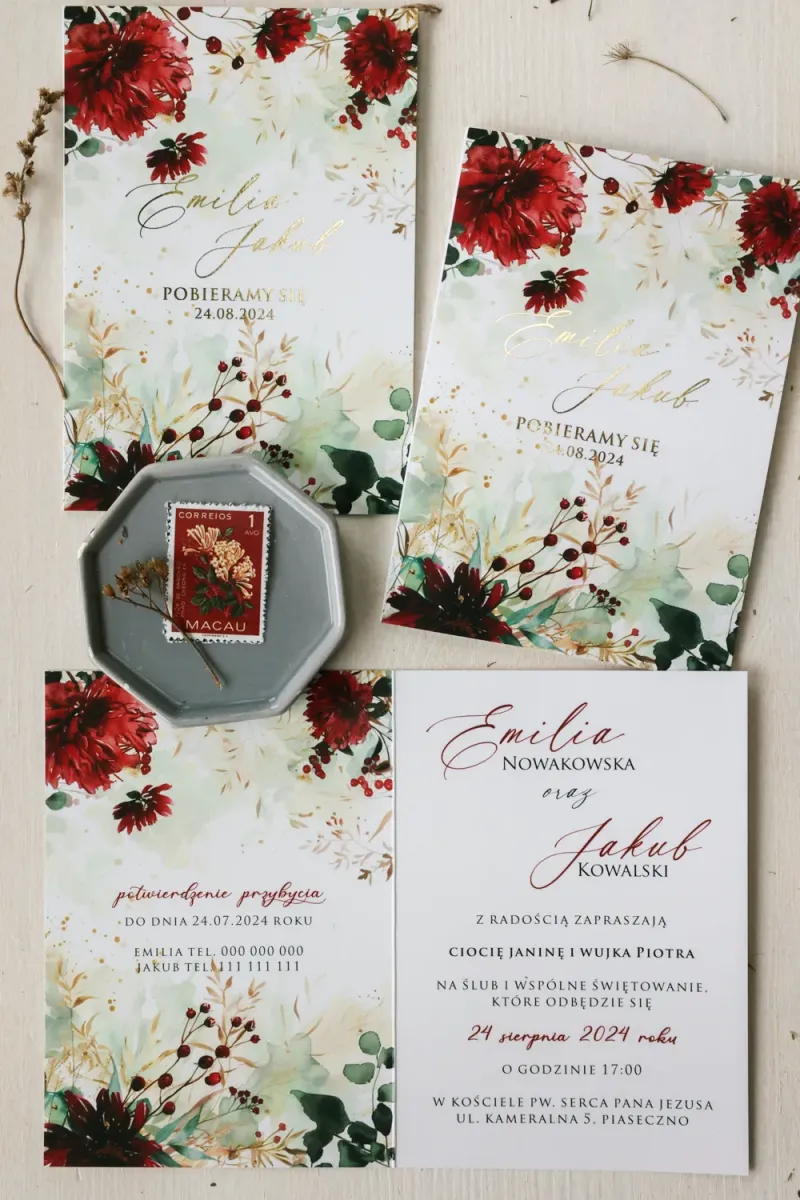
Wedding Invitation with Gold Accent and Red Flowers | Glamour and Boho Wedding Invitations | Ruskus no. 1
Expert advice and help at every stage
By choosing a professional company (such as Amelia-Wedding.pl) to prepare invitations, we gain not only a product but also expert support. For many people who are organizing such a huge celebration for the first time, stationery issues can be a bit overwhelming. What text to include? How to phrase the request for RSVP or information about gifts? Is it appropriate to invite someone with a plus-one in a specific way? Such questions multiply, and experienced wedding consultants know the answers to them. Companies dealing with invitations often provide sample content to choose from or offer advice so that the text is elegant and complete.
Furthermore, experts will help choose the appropriate style of invitations for the character of the wedding. If you describe your vision of the party to them (e.g., that it will be a rustic garden party or an elegant ball in a palace), they will suggest which stationery patterns can best reflect this atmosphere. Such consultations are usually free and non-binding, and can save a lot of doubts.
We also cannot forget about quality control and details, which professional service ensures. Before printing, we will get a project for approval – so we have a chance to correct potential typos, check the layout. This is an additional safeguard against mistakes. If we dream of a minor change (e.g., a different font color than in the basic pattern) – just ask, it is often possible to realize. Instead of racking our brains "whether this shade of gold will match", we can rely on the experience of people who have cut their teeth on wedding stationery and know what works.
Finally, in case of unforeseen circumstances – e.g., we suddenly have to order a dozen extra invitations because the guest list has grown – a professional company will likely handle this quickly and efficiently. Having our project in the database, they will reprint the missing pieces without a problem. If, however, we were doing everything ourselves and we ran out of materials or time for extra copies, finding a solution would be much more difficult. Support from the supplier gives a sense of security: we know that we won't be left alone with a potential problem.
Certainty of deadline and quality guarantee
Deadlines are key when organizing a wedding. Invitations should be handed out to guests well in advance – usually about 2-3 months before the wedding they should reach the hands of the invited people (more about deadlines here). Deciding on DIY, we must watch out ourselves to finish the work by this time. Life, however, likes to surprise: illness, sudden professional duties, or other unforeseen situations can cause our handicraft to be delayed. On the other hand, professional companies guarantee meeting established deadlines – if they promise shipping within two weeks, we can rely on that. Of course, it is worth ordering invitations with some advance notice, but after placing the order and approving the project, it is no longer us who worry about time, but the contractor.
Good companies care about their reputation, so they attach huge importance to quality. In practice, this means that if something were to go wrong (e.g., the print shop delivers incorrectly cut cards), the company reacts quickly – often the customer doesn't even find out about the problem because they receive a perfect final product, and potential errors were corrected "quietly" by reprinting. Moreover, if the customer finds a defect in the received invitations, a reputable company usually offers compensation: reprinting correct pieces, a discount, or another solution so that the bride and groom are satisfied. This is a guarantee that is missing in the case of DIY – if we break something ourselves, we can only blame ourselves.
By buying invitations, we receive exactly as many copies as we need (usually even a few extras as a gift). There is no risk that we will suddenly "run out of paper" for 5 invitations before the end of the guest list. Everything is calculated and delivered according to the order. This is another level of hassle-free experience that we gain – we don't have to plan with a surplus "just in case".
It is worth mentioning that currently most such orders can be realized online, without leaving home. Choosing a pattern, entering data, approving the project – everything happens via email or forms. A courier will bring ready-made invitations to your door. This is a huge convenience, especially appreciated when living in a smaller town without access to stores with creative supplies or when you simply have little time to run around the city.
Summarizing this point: by deciding on professional invitations, we choose certainty and quality. Certainty that the invitations will reach us on time, that they will look exactly as we wished, and that in case of any problems, we have a partner who will help solve them. For many Brides and Grooms, this guarantee of peace of mind is invaluable – it is something not worth saving on, because stress and sleepless nights are hard to convert into money.
Summary: is it cheaper to buy or make them yourself? Conclusions for future newlyweds
Is DIY worth it? When is it worth it, and when is it better to give up
Asking the question, whether it is cheaper to buy wedding invitations or make them yourself, we expect a simple answer. As follows from the above analysis, making invitations yourself is only seemingly a cheaper option. After adding up all the costs of materials, tools, and above all time, it turns out that financial savings can be small or none. Of course, there are situations where DIY makes sense. If someone is exceptionally artistically gifted, has access to cheap materials (e.g., works in a print shop or paper warehouse), or simply wants to have completely unique invitations and is willing to devote their time to it – then handmade execution can bring satisfaction and fulfillment of creative ambitions. Such people treat it not so much as a way to save money, but as an art project and a personal accent in the wedding.
For most couples, however, the priority is efficient organization and reasonable budget management. In their case, what matters is that the invitations are beautiful, elegant, personalized, and at the same time inexpensive and easily accessible. All these conditions are met by purchasing ready-made invitations from a good supplier. DIY, on the other hand, carries the risk that it will consume more money and nerves than assumed. If the main motive for considering DIY is the desire to save money, it is worth seriously calculating the costs and wondering if the game is worth the candle. As examples show, it is hard to hand-make invitations significantly cheaper than those available in stores, especially when we consider the prices of the cheapest options on the market.
Purchasing invitations – an investment in peace, time, and quality
By buying wedding invitations, we make a certain investment – not only in the product itself but also in our own free time and peace. We save ourselves dozens of hours of work, potential frustrations, and stress. These "emotional costs" are hard to measure but real. Couples who chose ready-made invitations often emphasize that thanks to this, they could focus on other aspects of preparations or simply worried less before the big day. In the heat of wedding affairs, the lack of one worry really makes a difference.
Instead of worrying about every technical detail of the invitations, we entrust this task to people who do it every day with success. In return, we receive high-quality stationery that will become a beautiful calling card for our wedding. By sending such invitations to family and friends, we can be proud of the effect – and at the same time be aware that we managed to rationally balance the budget and time. The cost-effectiveness of purchasing invitations manifests itself precisely in this comprehensive perspective: for a reasonable price, we gain a great product, save time and nerves, and often also use additional services (such as advice or the possibility of ordering other stationery elements at a discount).
It is worth remembering that a wedding is a large financial undertaking, and in this context, the amount spent on invitations (whether 200 PLN or 500 PLN, depending on the choice) constitutes a small fraction of the total budget. If even DIY would allow cutting this sum by a few dozen zlotys, but at the cost of quality or our own comfort – is it really worth saving on it? Often it is wiser to look for savings elsewhere (e.g., limit decorations slightly, choose cheaper flowers, give up an expensive wedding car, see how to create an atmosphere of luxury with a small budget) than to give up professional invitations, which are a souvenir and the first impression for guests.
Our recommendation – bet on convenience and professionalism
After considering all the pros and cons, one can venture a clear conclusion: purchasing ready-made wedding invitations is more cost-effective than preparing them yourself when we look at the full picture of the situation. Of course, the decision always belongs to the Bride and Groom and should depend on their individual priorities. If, however, you care about saving time, quality guarantee, and reducing pre-wedding stress, using the offer of specialists will be the best choice.
By choosing a proven wedding stationery store – such as the mentioned Amelia-Wedding.pl – you can count on beautiful invitations refined in every detail, and at the same time on affordable prices and expert support. Instead of facing the challenge yourself, you can breathe a sigh of relief, knowing that the invitations are in good hands. Your time and peace are invaluable during the preparation period, and ready-made invitations will allow you to enjoy them without aesthetic compromises.
Summarizing: is it cheaper (and better) to buy wedding invitations or make them yourself? It is definitely cheaper in a broad sense to buy ready-made invitations. It is a saving not only of money in the sense of spending efficiency, but also a saving of time, nerves, and energy that you can use to celebrate the joy of the approaching wedding. Let's leave handmade projects to passionate artists or those who actually love it – all other future Newlyweds with a clear conscience can bet on a convenient, cost-effective solution, which is purchasing wedding invitations from professionals. Thanks to this, you will take another step in organizing the wedding with a smile and certainty that everything will go according to plan. Good luck with the preparations and choosing the perfect invitations!
Recommended articles
- When to start planning a wedding?
- How to choose wedding invitations? 10 key steps
- What texts to include on wedding invitations?
- Guest list and wedding guest seating – how to create the perfect table plan?
- Are place cards a good idea?
- What wedding thank you gifts to choose?
- How to ensure consistency of invitation style with wedding decoration?
- Wedding budget planning – tips on how to effectively plan expenses
- Small big things – details that create the wedding atmosphere
- Top 10 mistakes made by Brides and Grooms during wedding organization