Guide: How to organize an international wedding – step by step
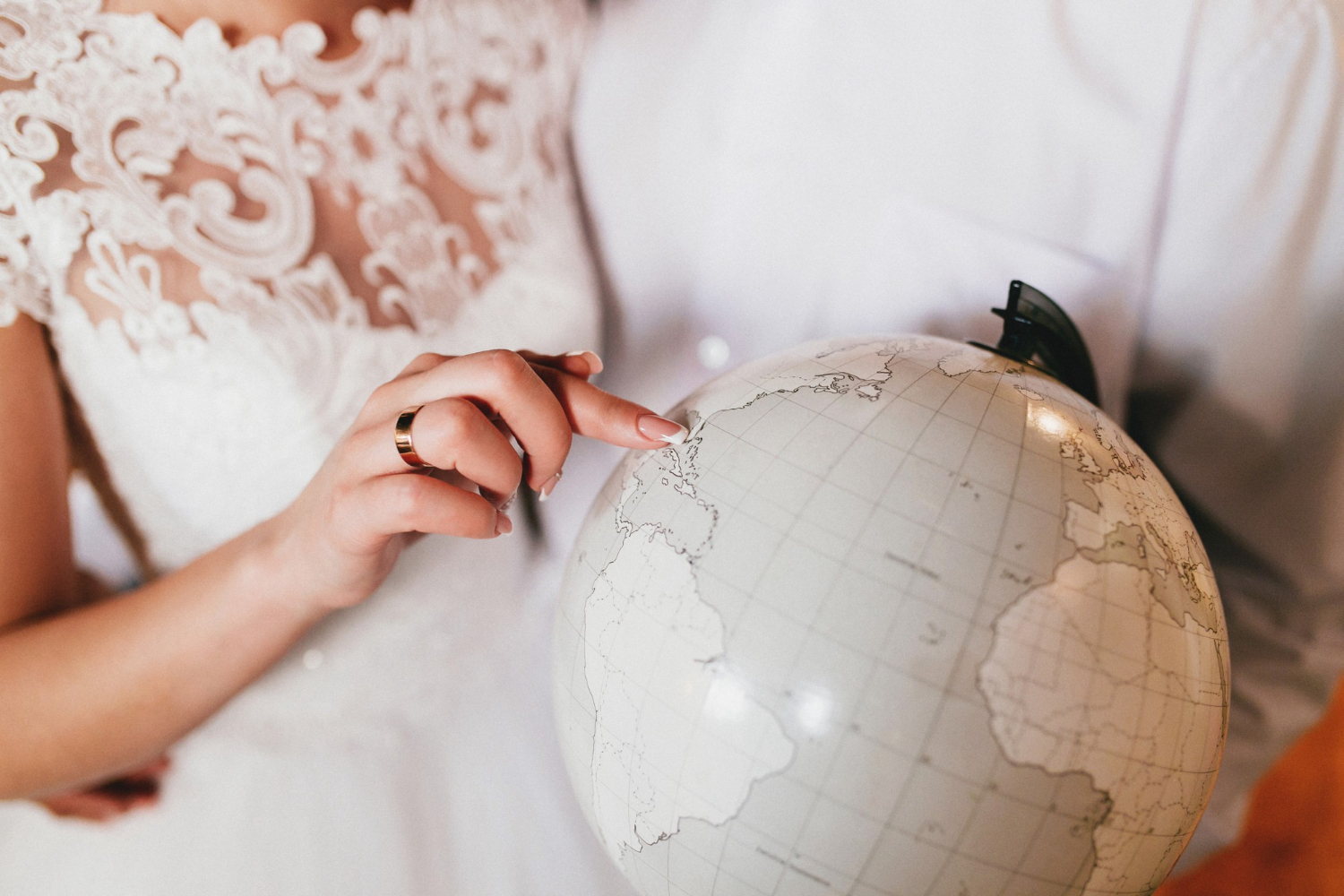
Planning an international wedding can be quite a challenge, but at the same time, it can become an incredible adventure. When the couple and their families come from different countries or speak different languages, the wedding day takes on an extra intercultural dimension. In such cases, you need to take care not only of typical organizational matters but also of overcoming language barriers and merging two traditions into a coherent, joyful whole.
In this comprehensive guide, we will walk you through all the stages of organizing an international wedding. You will learn how to prepare a bilingual wedding ceremony, how to integrate two cultures during the reception, what formalities await mixed couples in Poland, and how to take care of bilingual wedding stationery. Finally, we will present practical organizational tips, interesting examples of traditions from different cultures, as well as an FAQ section answering the most common questions of future newlyweds.
Ready? Let's start planning your international wedding! 🥂
Table of Contents
- 1. Bilingual Wedding Ceremony
- 2. Integrating Two Cultures into the Wedding
- 3. Formalities for Marrying a Foreigner in Poland
- 4. Bilingual Wedding Stationery and Its Importance
- 5. Organizing an International Wedding – Practical Tips
- Examples of Wedding Traditions from Different Cultures
- FAQ – Frequently Asked Questions about International Weddings
1. Bilingual Wedding Ceremony
The wedding ceremony is the most important moment of your big day. If your guests speak different languages, it's worth ensuring at the planning stage that everyone can fully participate in the celebration. Here’s what to look for when organizing a bilingual wedding ceremony:
Choosing the Type of Ceremony and Celebrant
First, decide what type of wedding you will have: civil, religious (concordat), or humanist. In each of these cases, it is possible to conduct the ceremony in more than one language, but the approach will differ slightly:
- Civil Wedding at the Registry Office (USC) – The ceremony is led by a civil registrar. Normally, it takes place in Polish. If one of you (or the witnesses) does not speak Polish, it is mandatory to provide a sworn translator during the ceremony. Such a translator literally translates the registrar's words and your vows, so the foreigner fully understands the content of the marriage contract. Note: you must organize the translator on your own – the office is not obliged to provide one. It's worth ensuring beforehand that the translator is certified for sworn translations in both directions, especially if your chosen language is not common in Poland.
- Concordat or Religious Wedding – If you are planning a religious ceremony, check if the priest or celebrant agrees to conduct the mass/ceremony in two languages. More and more clergy know foreign languages, especially English, so there is a chance that, for example, part of the sermon or vows will be delivered in the second language. You can also ask for bilingual liturgical materials (e.g., Polish readings with translations next to them). If it's not possible to include a foreign language in the liturgy, consider hiring a simultaneous translator who can provide whispered interpreting for the most important parts for those who don't understand the ceremony's language.
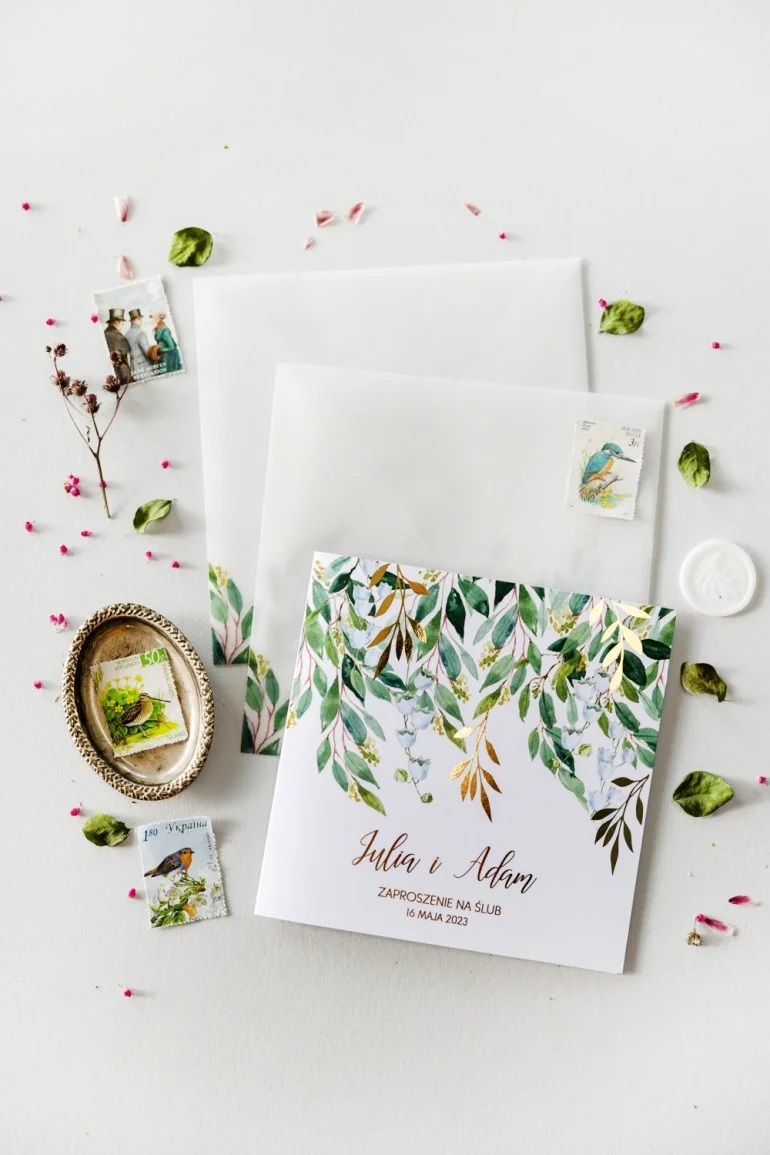
Wedding invitations with green leaves motif, gilded accents, classic | Gilded wedding invitations | Rubin no. 4
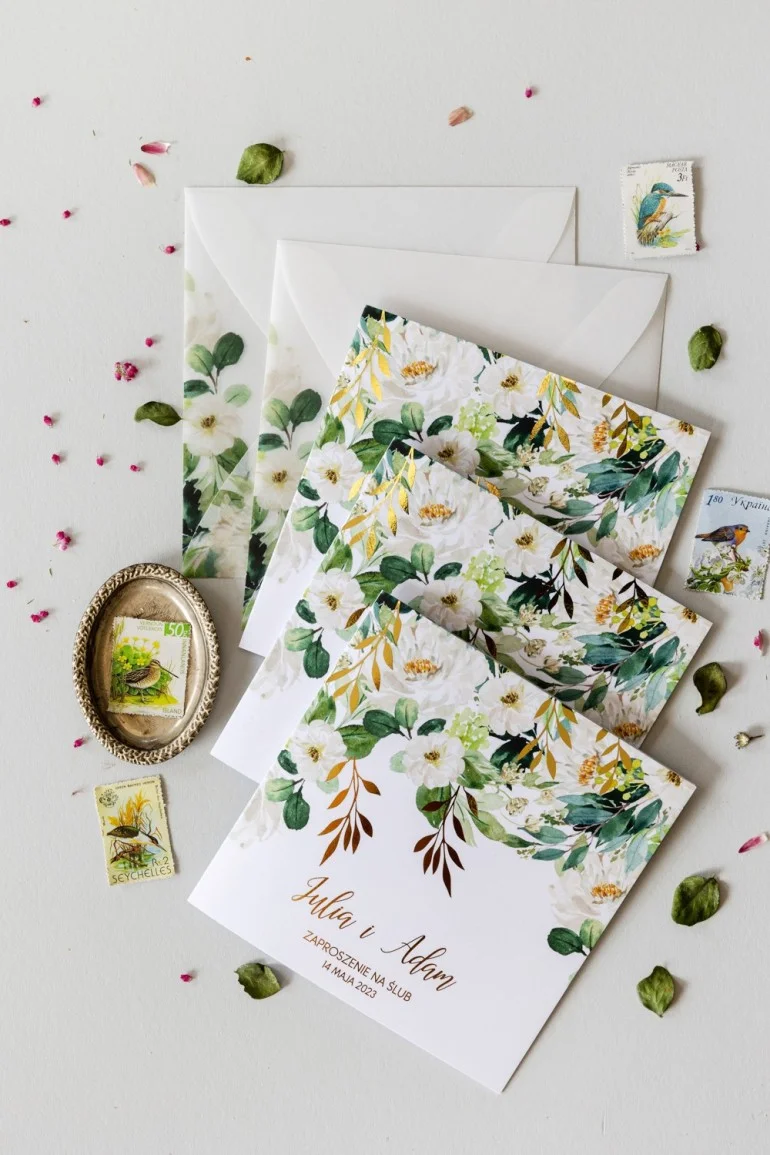
Stylish Wedding Invitations with Gold Accents, Watercolor Flowers | Exclusive Wedding Invitations | Rubin no. 1
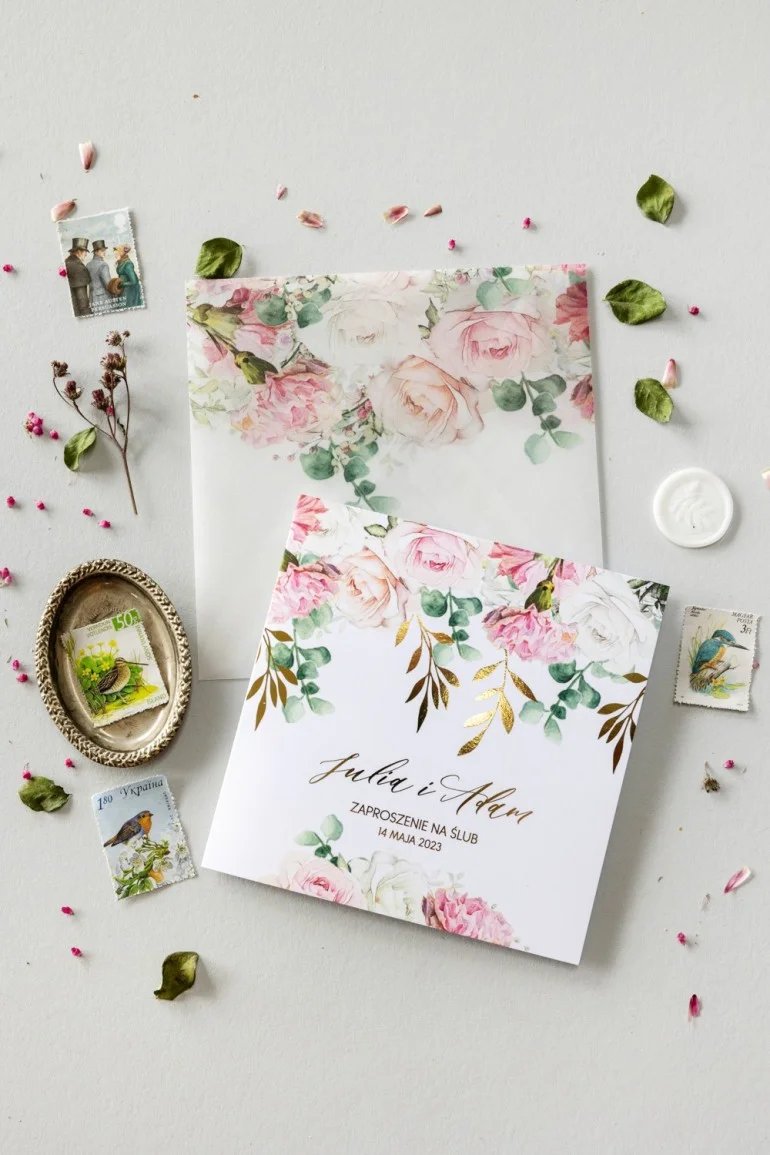
Wedding invitations with pink roses and gilding, transparent envelope | glamour style wedding invitations | Rubin no. 9
- Humanist or Symbolic Ceremony – You have complete freedom here, as such a ceremony is created from scratch according to your wishes (it has no legal power but often serves as an addition to a civil wedding). You can hire a celebrant who is fluent in both languages and will conduct the ceremony bilingually, weaving the languages together or repeating key phrases. Such a scenario can be very attractive and personalized – e.g., welcoming guests first in Polish, then in the second language; bilingual celebrant speeches; and your wedding vows delivered in each person's native language. There are many possibilities; the important thing is that every part of the ceremony is understandable for both families.
Sworn Translator at a Civil Wedding
If you have decided on a civil wedding with a foreigner in Poland, remember the statutory requirement to provide a translator if there is a language barrier. A few practical tips:
- Choosing a Translator – It is best to hire a sworn translator because the translation of the vows is official. You can find a list of sworn translators on the Ministry of Justice website or at the local Registry Office. Make sure the person has experience in translating wedding ceremonies – it's a specific event, and it's good if the translator knows the related vocabulary and the course of the ceremony.
- Formalities with the Translator – Contact the translator in advance, set the date, time, and place of the wedding. Often, the translator will want to know the wedding vow text or other planned elements to prepare appropriate translations beforehand (especially when personalized vows are involved). Also, ask about the service cost – sworn translators have hourly rates or a flat fee for the whole ceremony; some add travel costs if the wedding is outside their place of residence.
- The Ceremony with a Translator – Discuss with the registrar and translator how the translation will technically work. Usually, the registrar says a few sentences and then pauses for the translation. When making vows – one of you can repeat the words after the registrar in Polish, and the foreigner can repeat in their language (via the translator). It's important that both parties consciously utter the marriage formula. Don't worry that the ceremony will take a bit longer – guests will appreciate that they didn't miss anything and everyone could participate in the solemn moment.
Bilingual Materials for Guests
To make the ceremony fully understandable and comfortable, it's worth preparing certain materials for guests in two languages:
- Invitations and Wedding Information – We will talk more about invitations in Section 4, but already at the stage of inviting guests, ensure that the content is clear for both families. You can prepare separate versions of invitations in each language (e.g., Polish for Polish guests, English for foreign guests) or bilingual wedding invitations (e.g., Polish text with a translation next to it). Similarly, inform guests about details: ceremony time, address, include a map – all in both languages. Foreign guests will feel welcome from the very beginning.
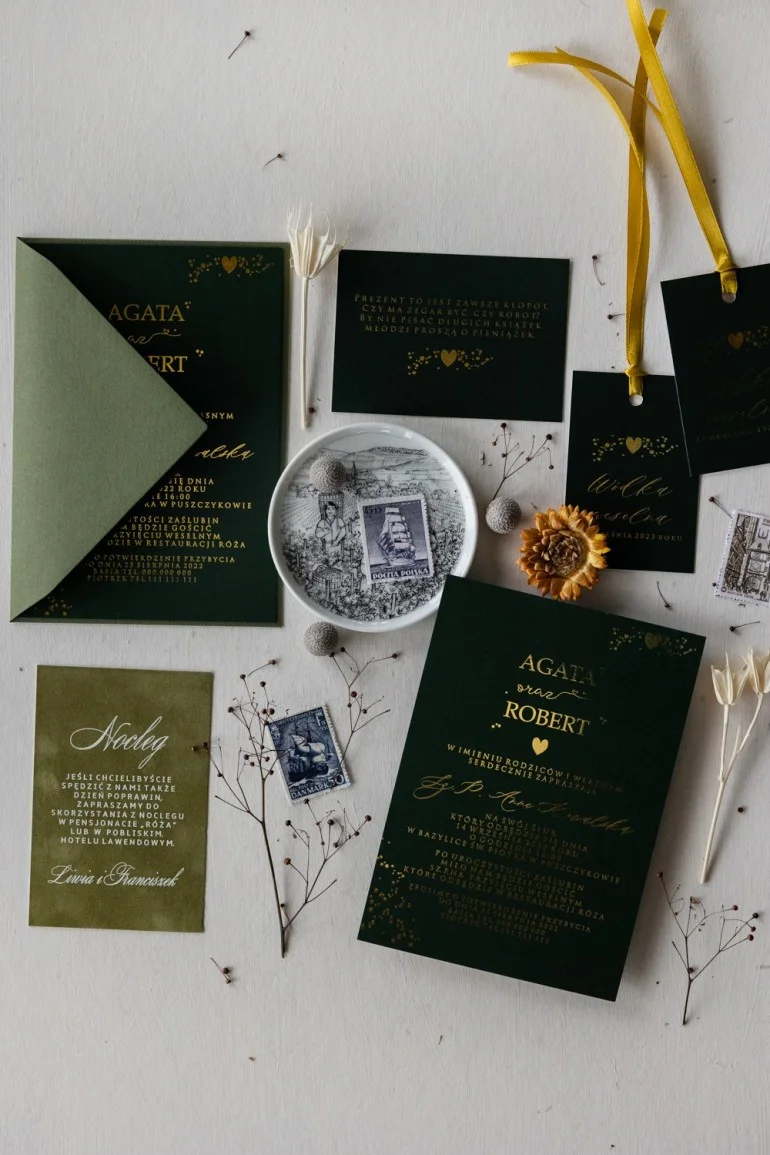
Single-card Wedding Invitations with gilding | Simple no. 2
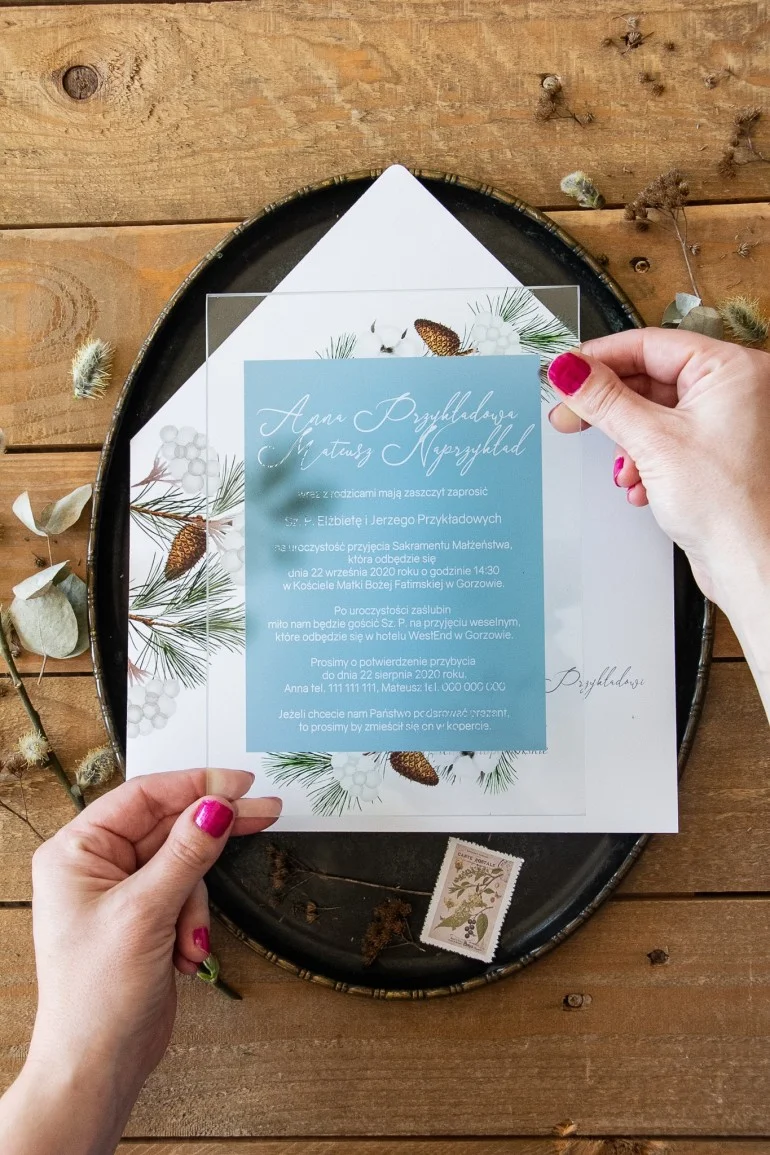
Extravagant Glass Wedding Invitations | Glass Winter Accent | Cotton & Pine | Korani no. 8
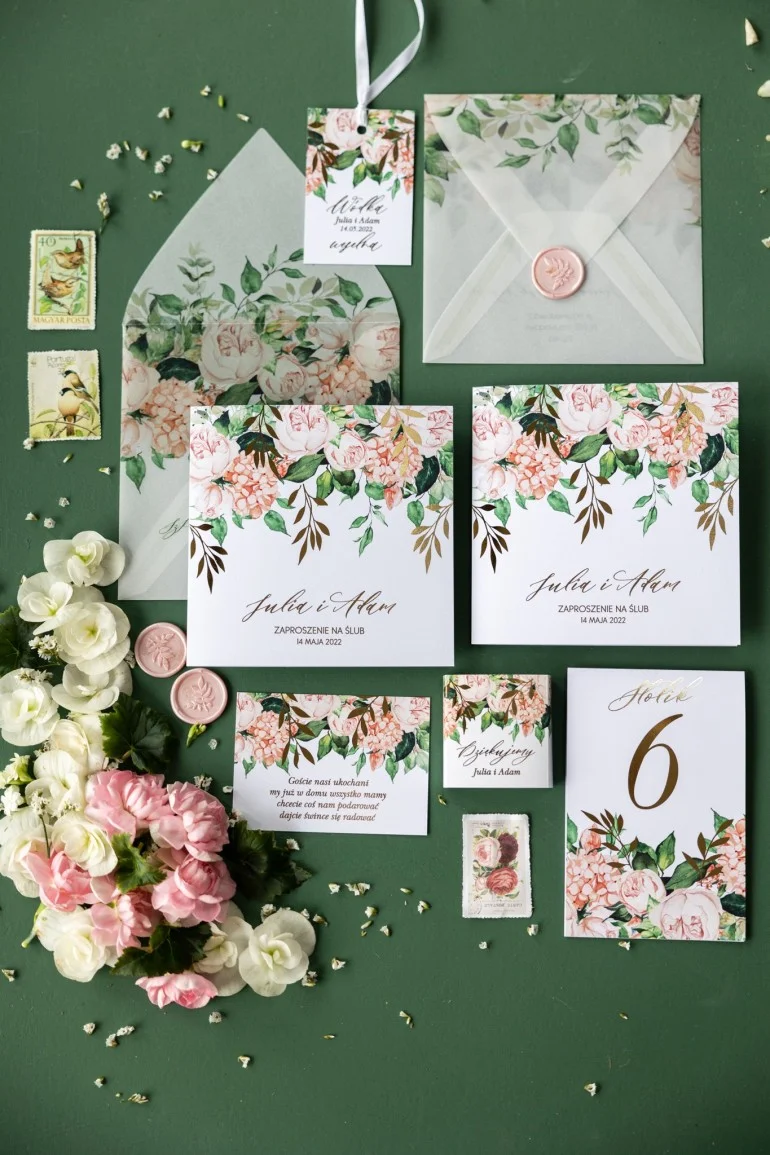
Unique Wedding Invitation with Gilding, Pink Peonies and Vellum Envelope | Unusual Wedding Invitations | Rubin no. 10
- Order of Service – It is becoming increasingly popular to distribute printed programs or small booklets before the ceremony, describing the course of the event (especially for religious ceremonies with liturgy or humanist ones with various points). For an international wedding, this is a bullseye! Prepare a bilingual program – e.g., Polish on the left page, the same in the second language on the right. In the program, you can explain what will happen (e.g., the order of rituals, songs, the meaning of certain rites). Even if something isn't translated live, guests can read the description and understand the meaning.
- Bilingual Vows and Readings – If you plan readings, poems, or personal speeches during the ceremony, think about translating them. You can, for example, weave both languages into the performance itself (one person reads a passage in Polish, another the same passage in the second language) or include a printed translation (an insert in the ceremony program or subtitles displayed on a screen if you use multimedia). This approach ensures that none of the important moments are missed by part of the audience.
Communication During the Ceremony
Regardless of how bilingual your ceremony is, remember that the language of love is universal ❤️. Emotions, smiles, tears of joy – everyone understands these, regardless of nationality. Nevertheless, it's worth taking care of a few details:
- Welcome in Two Languages – Ask the person leading the ceremony (registrar, priest, celebrant) to welcome guests in both languages at the very beginning. It's a simple gesture, and it immediately makes both the Polish and foreign parts of the family feel noticed. A few sentences like: "Drodzy Państwo, Ladies and Gentlemen, welcome to the wedding ceremony..." will make a good impression and break the ice.
- "Welcome" Sign – If you plan a welcome element for the couple or guests (e.g., a sign at the entrance, a roll-up, a welcome screen), put the text in both languages, e.g., „Witamy na naszym ślubie / Welcome to our wedding”. It's a small detail that emphasizes the international character of the celebration.
- Symbols Instead of Words – Consider using symbolic elements that are understood without words. Example: a unity ceremony, popular at humanist weddings, where the couple lights a candle together, pours colored sand into a vessel, or ties a ribbon. You can describe such a ritual in the program in both languages, but it will be visually clear to everyone. It's a beautiful way to express the unity of two people (and cultures!) beyond language barriers.
Organizing a bilingual ceremony requires a bit of extra effort and coordination, but the result will be a celebration where all guests feel comfortable and engaged. When both the grandmother from Poland and the grandfather from another country understand your "I do," that moment becomes even more touching for the whole family.

Gaja No. 2 Wedding Invitation – Sage Green with Letterpress Embossing

Glamour Wedding Invitation with Gilded Branch and Velvet Paper – Ruskus No. 14

Kraft Wedding Invitation No. 12 – Forest Style with Pine Forest Graphic
2. Integrating Two Cultures into the Wedding
After the ceremony comes the time for the wedding reception. An international wedding is a unique opportunity to combine two (and sometimes more) cultures into one, unique party. Thanks to this, both you and your guests will be able to get to know each other's traditions and create new memories together. How to integrate two worlds on the dance floor and at the wedding table? Here are some ideas:
Wedding Menu with Accents of Different Cuisines
The way to the heart is through the stomach – this rule also applies to intercultural weddings! When choosing the menu, include dishes characteristic of both countries:
- Traditional Polish and Foreign Dishes – If one of you is Polish and the other comes from, say, Italy, France, or another country, try to ensure that the wedding cuisine is not one-sided. Of course, you can serve classic broth and cutlets for a Polish dinner, but maybe Italian lasagna or French onion soup will appear alongside as a nod to the other family? 🍲 This way, foreign guests will try Polish specialties (borscht, bigos, pierogi – why not!), and Poles will discover the flavors loved by your other half.
- Themed Buffet – A good idea is to organize a snack buffet from the home country of one of the spouses. For example, an Italian table with antipasti (olives, prosciutto, cheeses, bruschettas), a Mexican table with tacos and guacamole, or an Asian corner with sushi or dim sum dumplings. Such a culinary corner is pleasing to the eye and palate, and guests are happy to approach, try, and talk about new flavors – which integrates the company brilliantly.
- National Drinks and Spirits – If you plan to have alcohol at the wedding, you can also mark both cultures in the glass. Polish weddings are famous for vodka – you can serve it traditionally, but for foreign guests, prepare local spirits from their country (e.g., Spanish sangria, Italian Prosecco, Scotch whisky, Mexican tequila for a special toast, etc.). Another solution is to create a drink menu with cocktails inspired by both cultures. E.g., a signature cocktail named after the Bride with a Polish accent and the Groom's cocktail with an accent from his homeland.
Remember to describe the menu bilingually – not everyone has to know all the dishes, so a small card or elegant wedding menu (in the form of a card on the table, bilingual of course) will explain what is being served. Guests will feel more confident trying new dishes when they know what they are.

Glamour Wedding Place Cards with Pearls – Pearls No. 1 White

Lauren No. 3 Wedding Place Cards – Classic Calligraphy Name Cards

Minimalist Wedding Place Cards – Glare No. 1 with Embossed Border
Music that Unites Instead of Divides
Music is the soul of every wedding. For an international wedding, it's good to ensure that the playlist and musical setting take into account the tastes and traditions of both nationalities:
- Bilingual Band or DJ – Consider hiring a musical band or DJ who communicates freely in both languages (or at least in English as a universal language). An MC announcing games and encouraging dancing in two languages will immediately liven up any international crowd. If only one person from the music service speaks the second language – make sure they are the one responsible for announcements (e.g., they will announce the first dance in Polish and English, and announce the cake cutting clearly for everyone).
- Musical Repertoire – When establishing the song list with the band/DJ, ensure diversity. Let hits from both countries' charts appear, as well as traditional melodies characteristic of each culture. Examples? At a Polish wedding, classics that our compatriots enjoy cannot be missing ("Jedzie pociąg z daleka", "Sto lat" sung for the couple, or traditional folk songs). For foreign guests, you can include songs that will evoke nostalgia or get them dancing – e.g., the Italian tarantella (a lively Italian folk dance, great for group fun), the Spanish classic "Macarena," or popular American rock & roll if you have guests from the USA. A good idea is also to play favorite family songs – maybe the best man from Spain has his favorite track he always dances to? Or in the Groom's family, there is a custom to dance a specific dance – include it.
- Themed Blocks – An interesting solution is to divide the fun into musical blocks. E.g., after dinner, a block of Polish folk music or disco-polo (if you like it, and foreign guests will surely be curious 😉), then a block of international music. You can also interweave styles – a few songs from one culture, then a few from the other. This way, no one will wait long for "their" vibes, and at the same time, everyone will get to know each other's musical traditions. Imagine: first everyone dances the polonaise or waltz to a Polish melody, and a moment later the dance floor turns into a hot fiesta with the rhythms of salsa or a Bollywood hit. Such contrasts can really heat up the atmosphere!
Traditional Wedding Rituals from Both Sides
Weddings around the world are full of interesting customs. An international wedding is the perfect opportunity to show the other family "how we do it here" – of course, in the form of fun and with mutual respect. Weave traditional elements from both cultures into the wedding program:
- Polish Wedding Accents – If one of you is from Poland, our native rites cannot be missing. The welcome with bread and salt is a beautiful custom at the start of the reception – parents welcome the newlyweds with bread (a symbol of prosperity) and salt (a symbol of hospitality and the hardships of life that the couple will overcome together). Explain the meaning of this gesture to foreign guests beforehand (e.g., in the bilingual reception program). Wedding gates (Bramy) – funny "blockades" on the way to the venue organized by friends or neighbors – is another tradition that can be staged if circumstances allow. Foreign guests will be delighted to see local friends dressed as bandits demanding a ransom (usually a bottle of vodka) for the couple's passage. And of course, Oczepiny at midnight – the tradition of removing the veil and throwing it to the bridesmaids, and the bowtie or tie to the groomsmen. You can conduct oczepiny in an international version – e.g., explaining the rules in English and choosing games that don't require fluent language skills (e.g., throwing the bouquet is universal). It's important that the other side knows what's going on – you can ask the MC to explain in a few sentences the history of the custom before it begins.
- Customs from the Partner's Country – Now it's time for elements of the other half's culture. The possibilities are huge and depend on where your chosen one comes from. A few examples: If your wedding combines Poland and Italy, consider Italian traditions – e.g., breaking a glass together (some regions of Italy believe the number of shards predicts the number of happy years together), or simply dancing the Tarantella, a traditional dance in which all guests can participate, spinning in a circle at an increasing tempo. In a Polish-Spanish combination, you can plan La Hora Loca, the "crazy hour" from Spanish-speaking weddings – at a certain time (often after oczepiny), the DJ hands out colorful props: hats, masks, balloons, and the music changes to a crazy mix of Latin hits, disco, and everything energetic. For this hour, everyone is just supposed to goof off and dance without restraint – it's great fun and integrates guests, even if they were a bit shy to move on the dance floor before! Another idea: at a Polish-Jewish wedding, you can weave in the Hava Nagila dance, with guests lifting the couple on chairs. In the case of an Asian mix – e.g., a Chinese tea ceremony during the wedding (the couple serves tea to the eldest family members as a sign of respect). For every country, there is something special – look for inspiration in your partner's family; they will surely be happy to suggest which tradition would be nice to show at your wedding.
- Symbolic Gestures Uniting Cultures – You can also create a new ritual together, symbolizing the connection of your worlds. Example: mixing sands from two bottles into one vessel (the sands can be in the colors of your countries' flags) – this creates a beautiful souvenir and visually shows how two colors form one whole that cannot be separated. Another idea is to prepare a bilingual speech during the thank-you notes for parents – e.g., one of you says a part in Polish, the other the same in their language, thanking both families. These moments of emotion will surely stay in memory for a long time.

Simple No. 3 Soy Candle – Gold Foiling & Elegant Wedding Favours

Golden Fortune Cookies with Personalized Label | Affordable Wedding Favours | Cejla No. 3

Merci Favour with White Flowers, Green Leaves | Elegant Guest Gifts | Impresja No. 10
Language Fun Facts and Games
To relax the atmosphere and help guests get to know each other, you can use language elements as an attraction:
- Learning Phrases in a Foreign Language – Ask the MC or the person leading the games to teach guests a few words in both languages. It could be something simple and fun, like teaching Polish guests the shout "¡Salud!" (Spanish for "cheers") during a toast, and foreign guests the saying "Sto lat!" when singing our traditional song. Conversely – foreigners can teach Poles a toast or saying from their country. There will be plenty of laughter, and such shared learning breaks barriers.
- Bilingual Wedding Games – If you plan integration games, ensure the rules are clear for everyone. Avoid complicated contests requiring long instructions only in Polish. Better to stick to universal movement or dance games. For example: the game "Journey Around the World" – guests dance in a conga line around the room, and when the music stops, you announce a country name and everyone must pair up and show a dance from that country (e.g., you announce: "Italy!" – everyone imitates a tarantella; "USA!" – everyone improvises rock'n'roll). Such games are intuitive and don't require many words, but integrate perfectly.
- Multilingual Karaoke – If you have the conditions and willing participants, karaoke can be the hit of the evening. Prepare songs in both languages (with lyrics on screen). Perhaps the Polish part of the family will try to sing the chorus of your foreign guest's favorite song (even in broken Spanish 😉), and foreigners will tackle a Polish classic. Singing together is great fun and shortens the distance between people.
Integrating cultures at a wedding is a vast topic, but the most important thing is to approach it with an open heart and mind. It's your day – you are connecting not only your lives but, in a sense, also your families and worlds. Show that you are proud of it! Use the most beautiful parts of both traditions and create a unique wedding that guests will talk about for years.
3. Formalities for Marrying a Foreigner in Poland
Love is love, fun is fun, but before an international wedding, a bit of paperwork awaits you. Every couple planning a civil or religious wedding in Poland must complete formalities, and if one of the fiancés is a foreigner, additional documents and official requirements are involved. Don't worry – it's all manageable; you just need to know what, where, and when to settle. Below we present the step-by-step formalities for marrying a foreigner in Poland, as well as issues regarding recognition of the wedding abroad.
What Documents are Needed to Marry a Foreigner?
Start planning formalities well in advance. Ideally, several months before the planned wedding date, find out at the Registry Office (USC) what documents they will require. Standardly, for a civil wedding in Poland, you need:
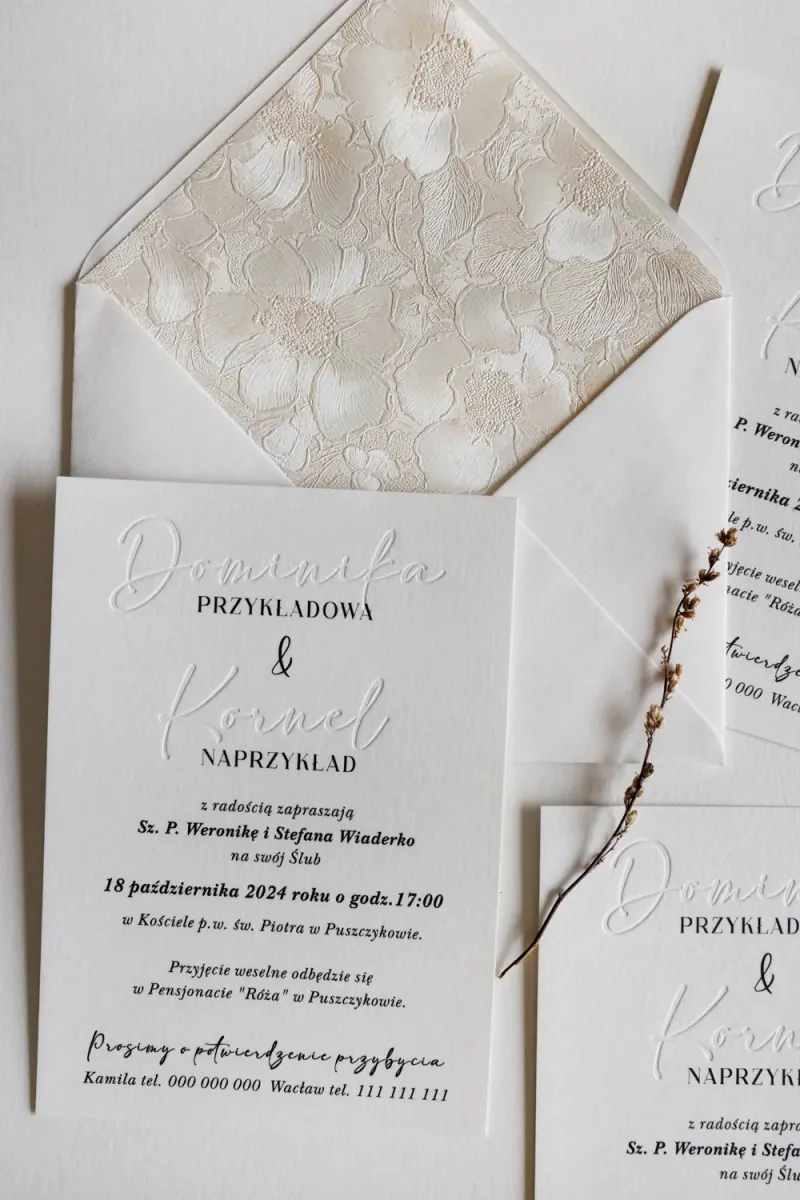
Elegant Wedding Invitations with Embossing | Wedding Invitations | Karmen no. 4
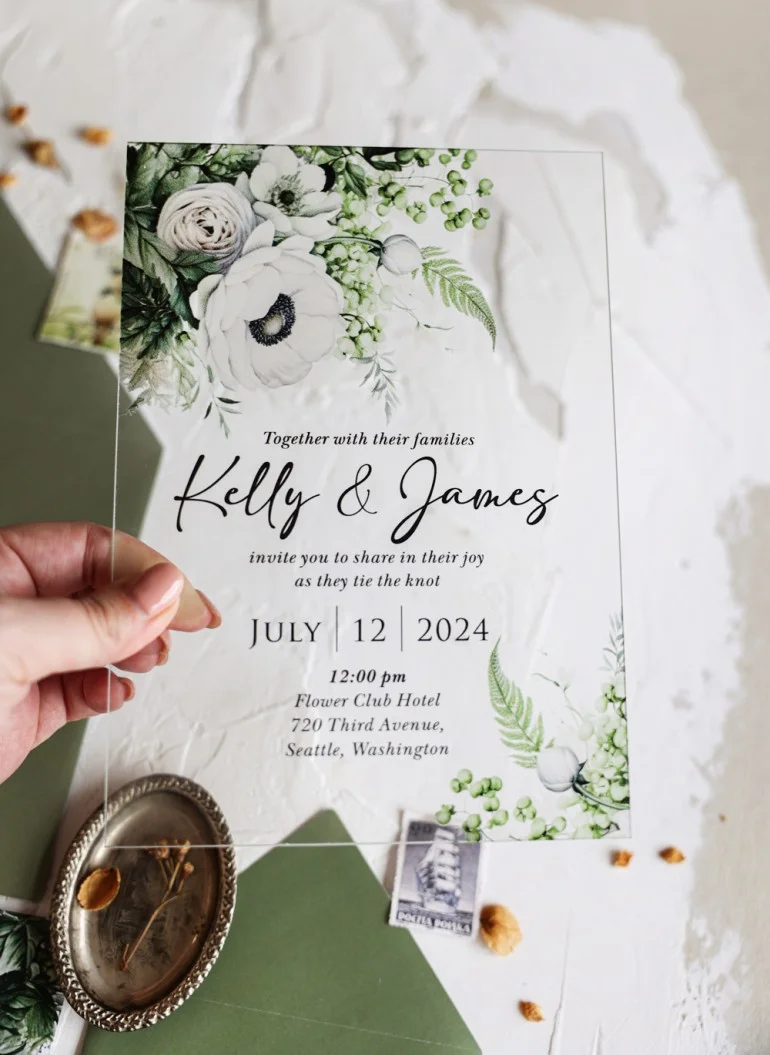
Subtle Glass Wedding Invitations with Floral Motif in Shades of White and Green | Korani no. 15
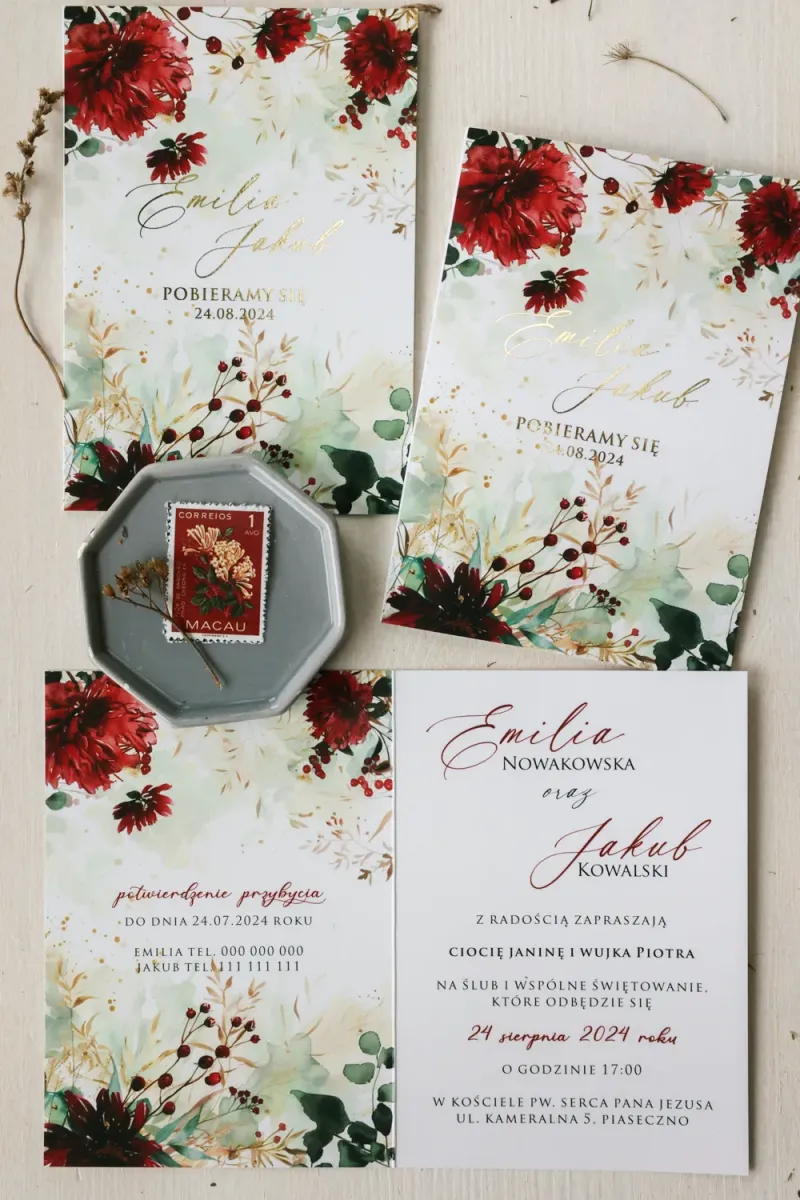
Wedding Invitation with Gold Accent and Red Flowers | Glamour and Boho Wedding Invitations | Ruskus no. 1
- Identity Documents – Both must show a valid ID card (for a Polish citizen) or a passport (for a foreigner). The USC makes notes from your data, so have the originals with you.
- Birth Certificate Copies – A Polish citizen provides a birth certificate copy from a Polish office. A person from abroad should submit the original birth certificate from their country along with a sworn translation into Polish. The translation must be done by a sworn translator or a Polish consul in the country of issue.
- Civil Status Documents – If either of you was previously married, you must provide a document confirming its termination (e.g., divorce decree, death certificate of the spouse) – also translated into Polish if issued abroad. If a Polish citizen married abroad and, for example, divorced abroad, prior registration of these events in the Polish USC (transcription of the foreign marriage/divorce certificate) may be required.
- Certificate of Legal Capacity to Marry – This is the most important additional document for a foreigner. It is a certificate from the country of origin stating that the person can enter into marriage (i.e., that according to their home law there are no obstacles – e.g., they are not already married, they are of age, etc.). This document is called differently in different countries (e.g., Certificate of No Impediment, Certificat de Coutume, etc.), but the principle is the same. It must be obtained from the registry office in the foreigner's country and translated into Polish. Note: if obtaining such a document is very difficult or impossible (e.g., there is a war in the country or no appropriate offices), you can apply to a Polish court for exemption from the obligation to present the certificate. The court in Poland will then assess whether you can marry without this document and issue a relevant order.
- Proof of Stamp Duty – A stamp duty is charged for preparing the marriage certificate (currently approx. 84 PLN). The fee is paid at the office cash desk or by transfer – proof of payment must be shown when submitting documents.
Once you have gathered the above documents, you report to the chosen Registry Office (USC) (in Poland, you can marry in any USC, not necessarily at your place of residence) at least 31 days before the planned wedding date. There you submit an assurance of no circumstances excluding the marriage (this is a sworn statement that there are no legal obstacles to your marriage – e.g., that you are not too closely related, that you are not in another marriage, etc.). The assurance is valid for 6 months, so that's the maximum time in advance you can settle this. Remember that if the foreign fiancé does not speak Polish, you must also bring a sworn translator to this visit at the USC – the head of the USC must be sure that the foreigner understands the content of the assurance they are signing.
After completing the formalities, the office reserves the wedding date. You can also, for an additional fee (1000 PLN), organize a civil ceremony outside the office – e.g., outdoors, in a castle, or palace. If you have a plan for a unique ceremony location and it's a civil wedding, coordinate this with the USC – the presence of a translator outdoors is also necessary if needed.
Wedding Abroad and Polish Formalities
What if you decide to get married abroad and then recognize it in Poland? Or vice versa – you get married in Poland but want it to be valid in the spouse's country of origin? A few tips:
- Marriage Contracted Abroad (e.g., on an exotic beach or in the home country of one of you) – in principle, it is valid in Poland, provided it was legally contracted according to the law of that country. However, to be able to use a foreign marriage certificate in Poland (e.g., when applying for a new ID, passport, changing a surname, etc.), it is worth performing a so-called transcription of the marriage certificate. Transcription is the official entry of a foreign certificate into the civil status register in Poland. For this purpose, you submit an application for transcription to the USC, attaching: the original marriage certificate issued abroad, its sworn translation into Polish, and possibly documents confirming identity and citizenship. After a positive consideration, you will receive a Polish copy of the marriage certificate. Note: if a Polish citizen got married abroad, transcription is mandatory if they want to, for example, replace their ID card after the wedding – otherwise, the office in Poland will have no legal basis for changing the surname. It's better to settle this immediately after returning from the foreign wedding.
- Marriage Contracted in Poland and Recognition Abroad – similarly, your Polish marriage certificate will likely be honored in most countries (especially the EU) after translation and an apostille. However, in many countries, to have full documentation, you can report the fact of contracting a marriage abroad to the local office. E.g., in Italy, citizens register all civil status acts contracted outside the country in their registry office – this requires submitting the Polish certificate (translated) at the consulate or directly at the office in Italy. Check the procedures in the spouse's country of origin. Most often, you will need a marriage certificate copy from Poland, translation, and an apostille (a stamp confirming the document's validity abroad, issued by the Polish Ministry of Foreign Affairs or Voivodeship Office). After completing the formalities, the marriage will be fully recognized in the second country as well.
- Changing a Surname – Remember that the decision on the surname after the wedding applies in Poland and will be entered into the marriage certificate. If, for example, a foreigner takes a Polish surname or vice versa, it's worth paying attention during the transcription of the certificate (one way or the other) whether the surname was recorded correctly in the appropriate form, according to the law of both countries. Sometimes nuances appear, e.g., in Poland you cannot have a double-barreled surname longer than two parts – if someone wanted to have three parts of a surname after the wedding, the Polish system will not allow it. Conversely – Anglo-Saxon countries do not use female forms of surnames (e.g., Kowalska), which may raise questions. It's good to consult this with the office beforehand.
Translations of Documents and Other Formal Advice
For formalities with a foreigner, sworn translations of documents are key. A few practical tips:
- Find a Sworn Translator for the Appropriate Language – In Poland, there are many sworn translators for European languages, but if your other half comes from a more exotic country, the search may take a while. You can find a list of translators on the Ministry of Justice websites. Make sure the person has the right to translate from the given language into Polish and vice versa.
- Check Document Validity – Some foreign documents may have an expiration date (e.g., the mentioned certificate of legal capacity is often valid for 3 or 6 months). Ensure you provide them to the USC while they are current.
- Court Consent for Marriage – We mentioned earlier that in certain situations court consent is required (e.g., when it's impossible to obtain a certificate of legal capacity or when the bride is 16-17 years old). The court procedure can take time, so deal with it well in advance. Once the court issues a positive order, it will become one of the documents submitted to the USC.
- Witnesses – Remember that witnesses at a civil/religious wedding do not have to be Polish citizens, but they must understand what is happening. So if a witness is a foreigner and the ceremony is in Polish, translation will also be needed here (the witness also signs the certificate). Alternatively, you can choose bilingual people as witnesses who will understand everything and help with communication.
- After the Wedding – After contracting the marriage at the USC, you will immediately receive an abridged copy of the marriage certificate. You can immediately ask for several copies (for a small fee for additional copies). If the certificate is needed to settle anything abroad, be sure to obtain an apostille and translation for it – ideally do this right after the wedding so you don't return to the topic at the last minute.
This all sounds quite bureaucratic, but don't be terrified – thousands of mixed couples marry in Poland every year, so the offices are well-versed in the procedures. However, it's good to be aware of the requirements and have a bit of patience. The moment you say your sacramental "I do" (or „yes”, „sí”, „oui” or in whatever language), all this formal effort will become just a distant memory, and a beautiful chapter of shared life will begin.
4. Bilingual Wedding Stationery and Its Importance
In organizing an international wedding, a huge role is played by details that make both Polish and foreign guests feel taken care of. One such detail is wedding materials – from invitations, through stationery on the tables, to gifts for guests. Preparing them in two languages is an expression of your care and hospitality, and at the same time a great opportunity for creative play with convention. Ensure that your wedding stationery is bilingual and stylistically consistent. Here’s what to keep in mind:
Wedding Invitations – The First Step to a Bilingual Wedding
Wedding invitations are the first element your guests will encounter, announcing the character of the celebration. In the case of an international wedding, it is also the first opportunity to communicate to guests that the wedding will be bilingual and multicultural. A few ideas and tips:
- Bilingual Invitation Content – You have several options. You can design one invitation with text in two languages (e.g., Polish text and a mirror version in English next to it, or Polish on one side of a decorative card and English on the other). This form is elegant and practical – the guest immediately sees both versions. The second option is two versions of invitations: part printed only in Polish (for Polish guests), part only in the second language (for foreign guests). If you choose this variant, ensure that both versions look graphically the same, differing only in text – this will maintain style consistency. There are companies specializing in bilingual stationery; for example, amelia-wedding.pl offers wedding invitations with the possibility of personalizing text in any language. You can choose a pattern (e.g., floral, glamour, rustic) and ask for a bilingual design.
- Important Information on the Invitation – Beyond basic data (who is inviting whom, where and when the wedding and reception are), use the invitation to convey essential information for foreign guests. For example: directions, RSVP request with contact details for someone speaking their language (e.g., a witness who speaks English if the couple doesn't feel confident), dress code information if it's unusual, or about the provided translation at the ceremony. You can also mention that the celebration will be bilingual and multicultural – this will intrigue guests and mentally prepare them for the unique character of the event.
- Save the Date and Other Add-ons – If you send Save the Date cards or have a wedding website, ensure they are also bilingual. A website is a genius tool for an international wedding – you can add information on an ongoing basis, describe your story in both languages, post the schedule, and upload a photo gallery after the wedding. Just remember to have the content translated professionally – ideally by someone who knows the style in the given language well so it doesn't sound artificial (avoiding Google Translate is key 😉).
Menu, Place Cards, Table Plan – Aesthetics and Functionality
Table stationery serves two functions: it's a decorative element and helps guests find their way at the reception. For a multilingual wedding, make an effort to ensure it also serves an informational function for everyone. What's worth preparing?
- Wedding Place Cards – These are cards with guests' names placed at their settings. The standard is to put the guest's first and last name. In an international context, however, you may encounter minor challenges, e.g., different spelling of names, courtesy titles (Mr, Mrs vs. Pan, Pani). It's best to stick to simplicity: print names and surnames in the Latin alphabet (if you have guests from countries using a different script – e.g., Cyrillic, Chinese – consider a double-sided place card: original script on one side, phonetic Latin alphabet on the other). It's a nice gesture when a grandmother from a distant country sees her name in her own alphabet. Aesthetically, stick to one style. At amelia-wedding.pl you will find many elegant designs that can be adapted – it's important they are consistent with invitations and the rest of the decorations.
- Wedding Menu – The already mentioned menu should be readable for all guests. Ideally, print menu cards in two languages. This can be solved similarly to invitations: either two versions (e.g., half the cards in Polish, half in English – and you arrange them alternately on the tables), or one bilingual card. A two-column form works great: dish description in Polish on the left, translation on the right. Remember appetizing descriptions – a foreign guest may not know what lies behind the term "krokiety z kapustą i grzybami," but described as “savory crepes filled with sauerkraut and mushrooms” they will sound more inviting. You can design the menu yourself or use templates, e.g., by ordering a menu print stylistically matched to the rest of the stationery.
- Seating Plan – This is a board or several cards set up before the entrance to the room, showing who sits at which table. Here too, it's worth applying bilingualism: e.g., the title “Plan stołów” and “Seating Plan” simultaneously, table names in both languages (or neutral numbers). For guests' names, we don't translate anything (names remain names), but if, for example, you give tables names instead of numbers (e.g., “Stół Wawel” and “Stół Big Ben” at a Polish-English wedding, symbolically), sign both symbols in two languages so no one has any doubt.
- Instructions and Signs – All functional signs like “Guest Book”, “Photo Booth – take photos here”, “Bar”, “Toilets” – it's worth marking with pictograms and captions in two languages (or universal icons). It's a small thing, but especially in a large facility or outdoors, foreign guests will be grateful that they can easily find what they need.
- Wedding Favors – Increasingly, couples prepare small gifts for wedding guests as a farewell or souvenir. It can be a small gift (cookie, jar of honey, magnet, regional mini-alcohol, etc.) with a thank-you note attached. And here, take care of a bilingual version. E.g., a tag with the inscription: "Dziękujemy że świętowaliście z nami – Thank you for celebrating with us!". Personalization of such gifts is available at amelia-wedding.pl, where you can order wedding favors with your own text. Remember that foreign guests will surely also appreciate a gift related to Poland (e.g., a small bottle of liqueur with a label in Polish and English, gingerbread with a folk pattern and translation of wishes). Combining both cultures in this element as well will be a beautiful closing for the whole day.
Personalization and Creative Ideas
Wedding materials give huge scope for creativity. A few inspirations on how you can use them to emphasize the international character of the wedding:
- Travel-related Theme – Many mixed couples met while traveling or come from distant countries, which itself imposes a theme. You can, for example, use a map, airplane, or passport motif in the stationery. An invitation styled like a flight ticket? A table plan in the form of a world map, where tables are the names of cities important to your story? Place cards resembling country flags (Poland and the second country alternately)? Why not! As long as it's tasteful and consistent 😉.
- Language of Love – Since two languages meet, you can mark it graphically. E.g., on the cover of the invitation, place the word "Miłość" and its translation in the second language, artistically painted. Or on the tables, spread cards with different “I love you” phrases in various languages of the world – such accents will become a topic for conversation at the table.
- Polish-Foreign Mix – If your names come from two languages, you can play with letters. E.g., Bride Anna and Groom John – you can create an AJ monogram decorated with folk motifs from both countries. Or if you have two different alphabets (e.g., Polish and Arabic or Chinese), try to present both on the materials – it looks extremely interesting and emphasizes the uniqueness of the couple.
- History in Two Languages – Sometimes couples print fun facts about themselves on separate sheets (a mini-booklet distributed to guests or placed on tables). You can tell bilingually how you met, what connects you, what funny misunderstandings once arose from language differences – guests love it, and especially those from families who know you less will appreciate being able to read your story in their language.
To sum up – bilingual wedding materials are not a whim, but a practical and cordial step towards your loved ones. Thanks to them, every invitee feels welcome and important. In an era when many things can be easily ordered online and personalized, it's really worth investing time (and some budget) in refining stationery and accessories. The “wow” effect is guaranteed, and the souvenirs will be beautiful – both for you (saved invitation or menu) and for the guests, who will take at least a place card as a souvenir of an extraordinary wedding.
5. Organizing an International Wedding – Practical Tips
Since we have already discussed the ceremony, fun, and formalities, it's time for logistics and practice. Organizing a wedding where guests from different countries will arrive requires additional logistics and thinking through many aspects that are not thought of at a standard local wedding. Here are practical tips that will help you get everything ready to the last detail:
Location and Wedding Venue
The choice of venue for an international wedding has several additional criteria:
- Good Communication – If you expect a large group of guests coming from abroad, think of a location that is easy to get to. Proximity to an airport, railway station, or main roads can be a big asset. For example, instead of organizing a wedding in a distant village reached by a winding road without markings (charming, but hard to access), consider a city or its outskirts. It will be simpler for guests to arrive, and you will avoid many calls of the series "Hey, we're in the middle of a field, where is this wedding house?".
- Accommodation for Guests – Providing an accommodation base for people coming from afar is a mandatory point. Ideally, the wedding hall has hotel rooms or there is a hotel/guesthouse nearby. Reserve a pool of rooms in advance, find out about group discounts. Place information about the possibility of accommodation and possibly about covering costs (whether guests pay themselves or you fund it) in invitations or on the wedding website. It's worth preparing a simple instruction for getting from the ceremony site to the hotel (in both languages). If hotels are in different places, you can designate someone from family/friends to coordinate guests on site so no one gets lost.
- Table Plan and Mixing Company – This is a dilemma: mix nationalities at tables or seat them separately? There is no single recipe, but practice shows that it's best to enable communication. If most Polish guests don't know a foreign language, and most foreign ones don't know Polish – a good idea is to seat a mixed group at each table, but so that there is at least 1-2 bilingual people nearby who will help in conversation. You can, for example, ask several bilingual friends to sit rotationally among guests. Avoid situations where one foreign guest sits at a completely Polish table where no one is able to talk to them – such a person will feel alienated. It's better to seat people who speak the same language together, but next to a table with Poles, or even mix half and half at one table. An interesting option is also dividing tables by theme – e.g., a "London" table with a predominance of family from England, next to a "Warsaw" table with Polish, but close between them, and ensure that at each there is someone who acts as a link between groups.
Bilingual Wedding Service
The key to the success of an international wedding is efficient communication during the reception. Besides you (the Couple), the service and the wedding host will inform guests what is happening. Therefore:
- MC/Entertainer – Hire a bilingual MC. It can be a professional entertainer or DJ who will not only play music but lead the party in two languages. Their task will include welcoming guests, announcing individual program points (first dance, serving the cake, oczepiny, etc.), and translating contests and games on an ongoing basis. A good bilingual host can juggle languages in a natural way and with humor – e.g., tell a joke in Polish and immediately paraphrase it in English so everyone gets the punchline. If you don't find a professional, consider asking two people – e.g., the Groom's friend from abroad and a Polish groomsman – who will lead the wedding together, translating each other. Such a duo can also turn out great (as long as they get along well).
- Waitstaff/Bartenders – Warn the hall manager that you will have international guests. It's good if at least part of the staff speaks English (or another needed language). Foreign guests will ask about various things (e.g., "Where is the restroom?", "Could I have another fork?" etc.) – it would be good if they didn't encounter a barrier. You can even suggest that on the day of your wedding, those employees who know foreign languages better are assigned to the shift. If that's impossible, ask e.g. witnesses to help in translating between guests and service if necessary ("Aunt Maria wants tea, but doesn't know how to ask" – such situations will certainly happen).
- Materials for Guests – Let's return for a moment to materials: prepare a so-called welcome pack in the hotel for foreign guests. This can be a welcome letter in their language, which they will receive at check-in or be handed personally. In such a letter, thank them for coming and list the most important information: the schedule of the day (what time the gathering for the ceremony, how the transport from ceremony to the hall will be, roughly when dinner, etc.), contact to a person who can help (e.g. phone number of someone bilingual from the family), basic phrases in Polish with pronunciation (for fun and for practicality). Such a nice gesture will make a guest from afar feel taken care of from the entry to the country. You can throw in a small welcome gift there, e.g. a fudge with a "Welcome!" tag or a map of the area.
Transport and Logistics on the Wedding Day
When you plan the wedding day, remember additional logistical issues:
- Transport for Guests – Consider hiring a coach or bus to transport guests from the hotel to the ceremony site, then to the wedding hall and back to the hotel after the party. This makes life much easier, especially for foreign guests who may not have their own car or know local realities. Such group transport will also ensure that no one gets lost on the way, and integration will start already in the coach (guests travel together and have a chance to talk). Remember to designate someone (e.g. a friend speaking in both languages) to coordinate the departure – to check the list, whether everyone got on, announce what time the departure is, etc. You can even print small tickets with bus departure times and give them to guests at the welcome.
- Time for Conversation and Integration – An international wedding is not only eating and dancing, but also a meeting of families from different countries. It's good to provide a bit of looser time for conversations in the schedule. For example, after the first meal, instead of immediately starting with loud music, you can play something in the background and give people half an hour for toasts, chats at tables. Often it's the case that families introduce themselves to each other, try to talk with gestures or broken language – it's worth giving them space for this, because it builds bonds. You can approach your partner's family table yourself and do an introductory "tour": "This is my uncle Jan – to jest wujek Jan, he is my mother’s brother..." – such a role of a translator-host, even for a moment, helps break the ice a lot.
- Duration of the Wedding – Consider whether both cultures have similar expectations regarding the length and course of the wedding. Polish weddings can last until dawn, with after-parties (poprawiny) the next day. In other countries, parties often end earlier. Warn foreign guests that a Polish party can last even until 4-5 am 😉 – let them be prepared (though of course no one holds anyone by force, if they fall off their feet they will go to sleep). If you plan after-parties (poprawiny) (the second day of fun), necessarily tell guests from outside Poland about it and explain what it is. You can do the after-party in a looser form, e.g. a grill in the garden, a walk around the area or a joint dinner – this is another opportunity for integration, already on the ease after the main day.
Small Gestures that Make a Difference
A few additional, practical trifles that will make your international wedding even more successful:
- Flags and Decorative Elements – Subtle use of national symbols can be a cool decoration. E.g. small flags on tables (not instead of flowers of course, but maybe in the corner with the guest book? Or pinned to the table plan?). You can also think about a bilingual cake topper – e.g. the inscription "Miłość Love" or your names in both languages.
- Photo Corner with Props – If you have a photo booth or polaroid for guests, throw in props related to your cultures. A sombrero hat and a "¡Viva los novios!" sign at a Polish-Spanish wedding, a highlander hat and a Hawaiian lei at a Polish-American one – why not. Such photos will come out funny, and guests will be happy to try different gadgets.
- Menu Written Phonetically for Service – An interesting trick: if you have very exotic dishes from the second cuisine, pass the phonetic pronunciation to the service so the waiters don't break their tongues in front of guests. E.g. the menu says "Żurek staropolski" – a foreign guest asks the waiter what is it, and the waiter doesn't know how to say "żurek" in English. You can make a small cheat sheet: Żurek – pronounce: ZHOO-rek, traditional sour rye soup. Thanks to this, the service will feel more confident describing dishes, and guests will appreciate the efforts.
- Plan B for Conversations – Sometimes despite your efforts, it will happen that some guests do not find a common language. It's worth then having a plan so no one feels lonely. You can e.g. sit down for a moment with such a person or assign someone to take care of the guest "lost" in the crowd. Often, however, it's the case that with good food, music and per mille in the blood 😉 language barriers magically blur and at the end of the wedding everyone gets along with everyone in their own “wedding Esperanto”.
Organizing an international wedding is indeed more work, but also more satisfaction. The sight of guests from different parts of the world playing together, singing "Sto lat" in chorus even in broken Polish, or moved by the vow understood thanks to translation – priceless. Remember that at the end of the day your happiness is most important. If you enjoy every moment and emanate good energy, your guests – regardless of nationality – will surely feel it and join in the common joy.
Examples of Wedding Traditions from Different Cultures
To conclude the guide part, let's do a small review of interesting wedding traditions from different corners of the world. You can draw inspiration from them when planning your own international wedding, or simply use them as fun facts in conversations between guests ("Did you know that in X country Y is done at weddings?"). Here are a few examples of every country has its own custom:
- Poland – Oczepiny and Wedding Gates: In Poland, the wedding tradition is rich. At midnight, oczepiny takes place – a symbolic transition of the bride from maidenhood to marriage, marked by the removal of the veil/cap. This is accompanied by games, e.g. throwing the veil and bowtie (whoever catches it will be the first to stand on the wedding carpet). Another Polish custom is wedding gates (bramy) – on the way to the hall, friends can block the way and demand a "ransom" from the couple (most often in the form of alcohol or small gifts) in exchange for passage. Also popular is the welcome with bread and salt and a toast with a glass of champagne upon entering the hall, as well as showering the couple with coins, rice or rose petals after the ceremony for luck.
- Italy – Tarantella and Confetti: In Italy, a wedding is an energy-filled fiesta. The traditional wedding dance is the Tarantella – a dynamic folk dance where the newlyweds and guests spin in a circle faster and faster (apparently the name comes from a tarantula bite – the dance was to "drive the venom" out of the body!). Often at Italian weddings after the ceremony, guests throw confetti at the couple, but watch out – not paper, but sugar-coated almonds, called confetti exactly, symbolizing prosperity and the sweetness of life. There is also a custom of breaking glasses – the number of pieces of glass is to predict years of marital happiness.
- Spain/Latin America – La Hora Loca: In Spanish-speaking countries, especially in Venezuela, Peru or Mexico, La Hora Loca (The Crazy Hour) is popular. At some point in the wedding – usually late in the evening – an hour of crazy fun begins: dancers, mimes or the couple themselves in costumes enter the dance floor, hand out colorful gadgets (masks, hats, whistles) to guests and for an hour a truly carnival atmosphere straight from Rio lasts. The goal is to get everyone dancing and give a shot of energy for the rest of the night. It's something like a second opening of the party, very spectacular and cheerful.
- India – Mehndi Ceremony and Baraat: In India, weddings are usually several days long and full of rituals. One of them is Mehndi – the day before the wedding a party takes place during which the brides (and other women) have their hands and feet painted with complicated henna patterns. This is not only a decoration – it is believed that the darker the henna color comes out, the stronger the love in the marriage will be. On the wedding day, in turn, the Baraat is popular, i.e. the ceremonial entry of the groom. The groom usually arrives on a horse or elephant, surrounded by a dancing procession of family and friends, to music and drums. The bride waits for him at the entrance – it's a very colorful, joyful custom that turns the streets into a parade.
- China – Tea Ceremony: At traditional Chinese weddings (and in other East Asian countries) a key element is the tea ceremony. The young couple pays homage to their parents and older family members by serving them cups of tea and thanking them for their upbringing. In exchange, parents often give a blessing and gifts (e.g. red envelopes with money). This is a very solemn, beautiful moment uniting families.
- Nigeria – Tribal Outfits: In Nigeria and many African countries, it is popular for the couple to change during the wedding into traditional outfits of their ethnic groups. For example, in Nigeria, newlyweds can wear richly decorated outfits of aso-oke fabric, symbolizing the tribe of the bride's and groom's family. Often the second day of celebrations (the so-called white wedding and traditional wedding are separate) is an opportunity to show such colorful, cultural clothes and dances. Guests also dress thematically, so the hall shimmers with a riot of colors.
- Germany – Polterabend and Sawing the Log: With our western neighbors, an interesting custom is Polterabend, i.e. breaking porcelain before the wedding (usually on the eve). Guests break old dishes, and the couple must clean up – this predicts luck and teaches cooperation. Another custom (already at the wedding itself) is the joint sawing of a tree log by the newlyweds with a hand saw. This is symbolic: if they cope together with the obstacle (the log), they will cope with adversities in marriage.
- Jewish Wedding – Chair Dance and Breaking the Glass: At Jewish weddings (and weddings inspired by Jewish culture) the ritual of breaking the glass by the groom during the ceremony is known (in memory of the destruction of the Temple in Jerusalem, but also a symbol of the fragility of happiness). In turn, at the reception the Hora dance is almost mandatory, during which guests dance in a circle holding hands, and the couple is lifted high on chairs – it's a very cheerful moment integrating everyone on the dance floor.
- Scotland – Blackening: A rather peculiar custom in some regions of Scotland is the so-called Blackening – friends kidnap the bride or groom (or both) before the wedding and douse them with various dirtying substances: flour, soot, eggs, syrup – the worse the mixture, the better. Thus begrimed, they are led through the village. This is to bring luck and immunize the couple to future difficulties (since they endured this humiliation, they will survive everything together). This is of course more of a bachelor/bachelorette party than the wedding itself, but it shows how different traditions can be.
- Japan – San-san-kudo: At a traditional Japanese wedding (shintō), the ritual of San-san-kudo takes place, i.e. the exchange of sake cups. The young couple and their parents in turn sip sake from three cups, each three sips (3×3 = 9, and ku-do means "nine times"). The number 9 is considered to bring luck. This is a ritual sealing the union and uniting two families. Later at the reception, newlyweds often change from traditional kimonos into a western dress and suit – combining tradition with modernity.
This is only a handful of examples, because the list of extraordinary wedding customs in the world is really long. Every country, every culture brings something of its own – from small superstitions to spectacular rites. Organizing an international wedding, you will choose from this treasury what is most important and most beautiful for you. Thanks to this, your wedding will be not only fun, but also a bow towards the heritage of both families.
FAQ – Frequently Asked Questions about International Weddings
Finally, we have prepared an FAQ, i.e. answers to frequently asked questions that may bother future young couples planning an international wedding:
Q: Do we have to hire a sworn translator for our civil wedding?
A: Yes, if one of you (or the witnesses) does not speak Polish to a degree allowing for understanding the ceremony, then during a civil wedding in Poland a sworn translator is required. This is a formal requirement – the translator must translate the text of the marriage vow and the words of the official so that everything is clear and legally valid. You must organize the translator yourselves; it's good if they also take part in submitting documents at the USC before the wedding to help with signing the assurance. In the case of a religious wedding, a translator is not imposed by the office, but it's worth considering for comfort – e.g. translation of the sermon or vow for the family.
Q: How will we manage if our parents do not speak a common language?
A: This is a common situation with international relationships. It's worth organizing an introductory meeting for parents earlier (even via Skype/Zoom if a large distance separates them), with the participation of someone who will help in translation – it can be one of you. On the wedding day, seat the parents close to each other and ensure that someone bilingual (e.g. you or a witness) will be nearby to help in conversation. Often at the level of gestures, smiles and toasts, parents find a thread of understanding anyway. You can also give them simple electronic translators or a card with a few phrases like "You look beautiful", "Wonderful ceremony", so they can show them to each other. After a few glasses 😉 barriers melt – you will see that dancing or joint admiration of your happiness will connect them more than words.
Q: Do we have to do everything bilingually? We're afraid it's too much and that we'll get lost in it.
A: You absolutely do not have to duplicate everything in two languages. The key is that every essential element is available or understandable for every guest. If you feel that something is too complicated to translate live – prepare a printed version. If you don't want e.g. to conduct the whole mass in two languages – it's enough to translate the most important parts. Prioritize: the vow, speeches, game rules – these should be understandable. On the other hand, e.g. song lyrics at the wedding do not have to be translated, because music in itself entertains. Try to maintain balance, but without falling into paranoia – guests understand that not everything can be perfectly translated and often they will ask with curiosity if they don't understand something.
Q: What are the additional costs when organizing an international wedding?
A: Several things can increase the budget: hiring a sworn translator (sometimes several hundred zlotys for the ceremony), possibly a bilingual MC or band (they may have higher rates for additional language service), printing materials in two languages (more pages, more designing), transport for guests (bus rental), accommodation (if you cover it for guests), additional attractions related to the second culture (e.g. dance show, special decorations). It's worth including this in the cost estimate. However, many things can be done at low cost – e.g. translation of invitations or content you can perform yourself or with the help of a native speaker friend, instead of commissioning a professional translator. Travel-themed decorations can be DIY. Logistics requires more time and organizational help than money. It's important to list these additional items earlier and look for savings where possible (e.g. maybe a friend will lead the wedding in exchange for a favor, instead of an expensive entertainer?).
Q: We're afraid our foreign guests won't have a good time at a Polish wedding (and vice versa). What to do so as not to bore or offend anyone?
A: The key is good information and openness. A Polish wedding can surprise a foreigner with its length and intensity – tell them beforehand what to expect (that there will be a lot of food, a lot of toasts and dancing, they can join in singing "Sto lat", that oczepiny is not black magic but funny games). In turn, you can prepare Polish guests for foreign elements: e.g. if you plan Hora Loca, warn that crazy fun will start at midnight – let them take comfortable shoes and approach with distance 😉. Most important is to explain the context of different customs, then no one will be offended or confused. Also try to maintain the universality of fun – music and dance are international, so fill most of the time with them. And if you see that some group of guests is sitting sadly – talk, liven up, seat someone who will pull the conversation. As hosts, you have influence on the atmosphere. Smile, mix with guests, show that you are happy with everyone's presence – this will spread to everyone and before you know it, the dance floor will be full of mixed nationalities, playing like one big family.
Q: Can such an intercultural wedding be organized by oneself at all, or is it better to hire a wedding planner?
A: It's possible to do it yourself – this guide is proof of that, that with knowledge and a good plan you will manage 😉. However, if you feel overwhelmed, have a lot of guests from abroad or neither side knows the other's language well – consider support from a professional wedding planner specializing in international weddings. Such a person can help in coordinating translations, communication with bilingual suppliers, will look after details on the wedding day (e.g. that the bus from the airport arrives on time, that the translator reaches the ceremony). This is of course an additional cost, but also less stress for you. Many couples, however, successfully organize international weddings independently – the key is a good plan and asking loved ones for help in critical moments. Do you have friends knowing both languages? Ask them to be your “ambassadors” during preparations and during the wedding. Together you can do it!
To sum up, organizing an international wedding is a challenge, but also an incredibly enriching experience. It requires more planning, communication and ingenuity, but the end result – when two families, two languages and two cultures unite to celebrate your love – is worth it. We hope this guide provided you with practical tips and added confidence. Plan with heart, be open to diversity, and your international wedding will certainly be a wonderful, unforgettable day both for you and for all guests. Good luck! 🥂
Check out other articles on our blog!
If you liked our guide on organizing an international wedding, be sure to check out other articles that can help you in planning a unique wedding:
🌟 Wedding attractions for guests – ideas to spice up the reception – discover unusual ideas for games that will integrate guests and ensure no one gets bored!
🌟 Guest list and seating wedding guests – how to create the perfect table plan? – learn how to effectively plan seats so that both Polish and foreign guests feel comfortable.
🌟 Wedding traditions in a new version – which customs to keep and which to refresh? – check how to combine Polish traditions with elements of other cultures to create an unforgettable wedding.
🌟 Modern after-parties – ideas for the second day of the wedding in an original style – if you are organizing an after-party for guests from different countries, see inspirations for a creative and loose reception.
🌟 Guests like a medal – how to take care of the invitees on the wedding day so they feel distinguished and comfortable? – practical tips on how to make every guest – regardless of language and culture – feel special.
🌟 What texts to place on wedding invitations? – need inspiration for bilingual invitations? See examples of ready-made texts and tips on personalization.
🌟 Visit our wedding blog and discover even more tips, inspirations and trends that will help you create your dream celebration! 💍✨💖