Wedding insurance in Poland – is it worth it? Policies, costs, and coverage

Wedding expenses and unforeseen situations
Organizing a wedding is a massive undertaking, both logistically and financially. The bride and groom must take care of dozens of details – from choosing the venue, menu, and band to official formalities, outfits, and decorations. One cannot forget about seemingly small elements, such as guest lists, wedding invitations, and table seating arrangements (e.g., aesthetic place cards). Often, in the heat of preparations, gifts for loved ones are also planned – small wedding favors handed out at the end of the reception. Each of these elements generates further costs and requires meticulous attention to detail to ensure this special day runs perfectly.
The costs of hosting a wedding can be mind-boggling. It is estimated that the average wedding budget for about 100 people is currently around 60,000 PLN – and in large cities or during peak season, this amount can be even higher. If you are planning a larger reception, e.g., for 150 guests, expenses can easily exceed 100,000 PLN. Major costs include venue rental and catering (the so-called "plate fee" per person, averaging 300 PLN and up), musical entertainment, photography and video, the couple's outfits, decorations, alcohol, and many other items. Considering the scale – about 150,000 marriages take place in Poland every year – one can imagine the massive sums spent on weddings across the country.
Table of contents
With such high financial and emotional investments, it is no surprise that the prospect of unforeseen random events causes anxiety. Just imagine a sudden power outage at the venue the day before the wedding, a key supplier canceling services at the last minute, or a sudden change in weather during a planned outdoor ceremony. A striking example of unpredictability was the COVID-19 pandemic – in 2020, thousands of couples had to cancel or postpone their wedding due to restrictions, incurring significant financial losses. Any such event can cause a years-long wedding budget to crumble, leaving the dream day in doubt. This is why more and more couples are considering additional protection in the form of wedding insurance.
Until recently, few people in Poland had heard of such insurance – insurers considered it a niche product that was difficult to calculate (it was even deemed unprofitable). However, such policies are now starting to appear on the market and are enjoying growing interest from engaged couples. Abroad, wedding insurance has been commonplace for years. For example, in the USA, there are companies specializing exclusively in wedding policies – WedSafe has been operating since 2007 and recorded a 60% increase in demand for its insurance within the first few years of operation. In the UK and Western European countries, wedding insurance is also quite popular. In Poland, this trend is still in its infancy, but awareness of wedding insurance is growing dynamically along with cases highlighted in the media and on wedding forums.

Gaja No. 2 Wedding Invitation – Sage Green with Letterpress Embossing

Wedding Invitation Perełki No. 1 – Minimalist Style with Half-Pearl Appliqué

Impresja No. 7 Wedding Invitations – Eucalyptus and Greenery Style
What is wedding insurance?
Wedding insurance (also called a wedding policy) is a special type of event insurance designed to provide financial protection for the bride and groom in the event of various unforeseen circumstances that could disrupt or ruin the wedding ceremony and reception. In other words, it is a policy that protects against losses resulting from the cancellation or postponement of the celebration, damage to important wedding elements, or problems caused by subcontractors. In exchange for paying a premium, the insurer agrees to pay compensation if specific unforeseen random circumstances related to the wedding occur.
A wedding policy works similarly to other event insurance – it covers risks characteristic of organizing a large family event. It can protect both prepaid expenses (e.g., deposits paid to service providers) and cover additional costs incurred due to sudden events (e.g., fees for booking a new date or renting a replacement venue). The scope of protection is usually defined by specific insurance events covered by the policy. If such an event occurs, the couple can file a claim and receive a refund of incurred costs or coverage for expenses related to alternative solutions.
It is worth emphasizing that wedding insurance does not replace other forms of financial protection, such as traditional life, health, or car insurance. It is a complementary product designed specifically for a one-time event. It is often offered as a package by insurance companies or brokers specializing in travel and event insurance. Importantly, various variants are usually available within a wedding policy – from a basic package protecting only selected risks to extended all-risk packages providing the widest possible protection. The couple can therefore adjust the scope of insurance to their needs and the specifics of the planned wedding. If someone is organizing a modest dinner for immediate family, minimal protection will likely suffice. On the other hand, for a lavish wedding for several hundred people outdoors, a more comprehensive package should be considered due to the greater number of potential risks.
It should also be noted that some risks associated with a wedding can be partially mitigated without a special policy – for example, through appropriate clauses in contracts with service providers. It is always worth ensuring that the contract with the wedding venue or caterer includes clauses regarding the refund of the deposit in case of event cancellation due to random causes. Similarly, it is good to ask if the photographer, band, and other performers have their own business liability insurance. However, such precautions will not provide full protection – usually, contracts protect the performers more than the couple, and enforcing compensation through legal channels can be time-consuming and difficult. A wedding policy therefore provides an additional layer of security, ensuring a quick payout in the event of a misfortune, regardless of what the signed contracts with service companies provide (or do not provide).

Glamour Wedding Place Cards with Pearls – Pearls No. 1 White

Gold-Foiled Place Cards with Peony and Eucalyptus – Ruskus No. 5

Opal No. 3 Wedding Place Cards – Pearlescent Table Name Cards with Vintage Bird Motif
As an aside, professional wedding industry companies are increasingly carrying their own liability insurance that protects their clients. If, for example, a hairdresser or beautician ruins the bride's hair just before the ceremony or performs a botched beauty treatment, you can demand compensation from them – provided they have purchased civil liability insurance. Similarly, a restaurateur is responsible for any food poisoning of wedding guests. These issues are worth keeping in mind, although they do not replace your own wedding insurance.
What events does a wedding policy cover?
The scope of protection offered by wedding insurance can vary depending on the insurer and the chosen policy variant. However, a wedding policy usually covers a wide range of risks, which can be divided into several main categories. Here are the most common situations where wedding insurance can prove invaluable:
-
Cancellation or postponement of the celebration – if the wedding or ceremony cannot take place on the planned date due to serious, random causes. These can be, for example, sudden illness or a serious accident of the bride or groom or a close family member, death in the family, as well as disasters such as fire or flooding of the wedding venue. In such cases, the policy will cover the costs of the canceled reception (e.g., lost deposits) or finance the organization of the ceremony on a new date, including expenses for re-booking. There have been cases where, due to the groom's sudden fainting, the ceremony had to be moved to another day – in such a situation, the insurance will provide funds to cover additional costs. Even an unusual event, such as a highway blockade preventing guests from reaching the wedding, can cause the need to postpone the reception. It is important that the causes must be independent of the bride and groom – standard insurance does not cover situations where the couple simply changes their mind and cancels the wedding for personal reasons (insurers do not treat a breakup or "running away from the altar" as a random event subject to protection). (Fun fact: in the USA, the company Allianz Fireman’s Fund once offered a policy against "running away from the altar," which cost about 100 dollars. However, these were very unusual offers, and it is hard to find similar ones in Poland.)
-
Problems with suppliers and subcontractors – this is one of the most common concerns for wedding organizers. A wedding policy can provide compensation if one of the key service providers fails to fulfill the contract or fails at the last minute. For example, this could involve situations where the wedding venue cancels the reservation for reasons beyond the couple's control (facility neglect, technical failure, sudden closure of business), catering is not delivered, the photographer or videographer does not show up at the ceremony, the decoration company does not prepare the decor on time, or the band cancels the performance just before the date. Good insurance will then cover the losses – e.g., refund deposits paid to such a service provider and cover additional costs of finding a replacement in an emergency (which is often more expensive). This type of security gives the couple peace of mind that they will not be left stranded if a contractor fails them. In practice, with a policy, we don't have to worry about being left without a venue or food – the insurer will help finance emergency solutions.
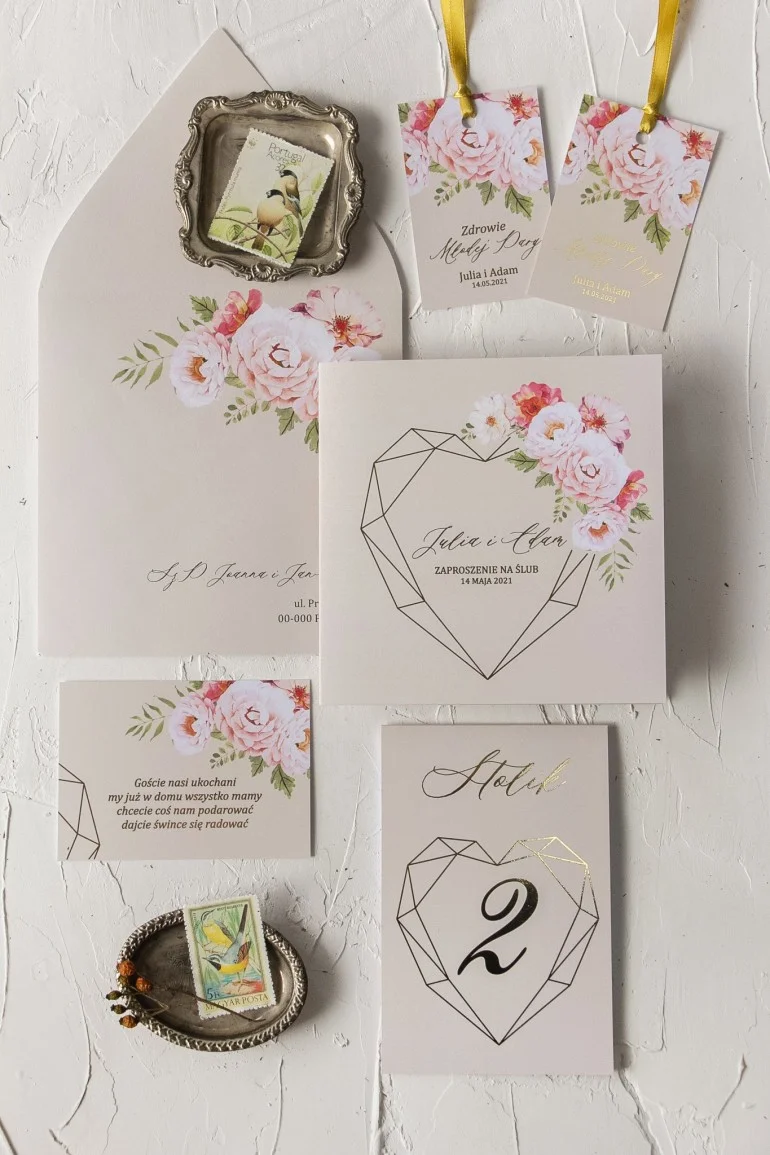
Wedding Invitations with Gold Heart and Floral Motif | Modern and Stylish | Szafirowe No. 8
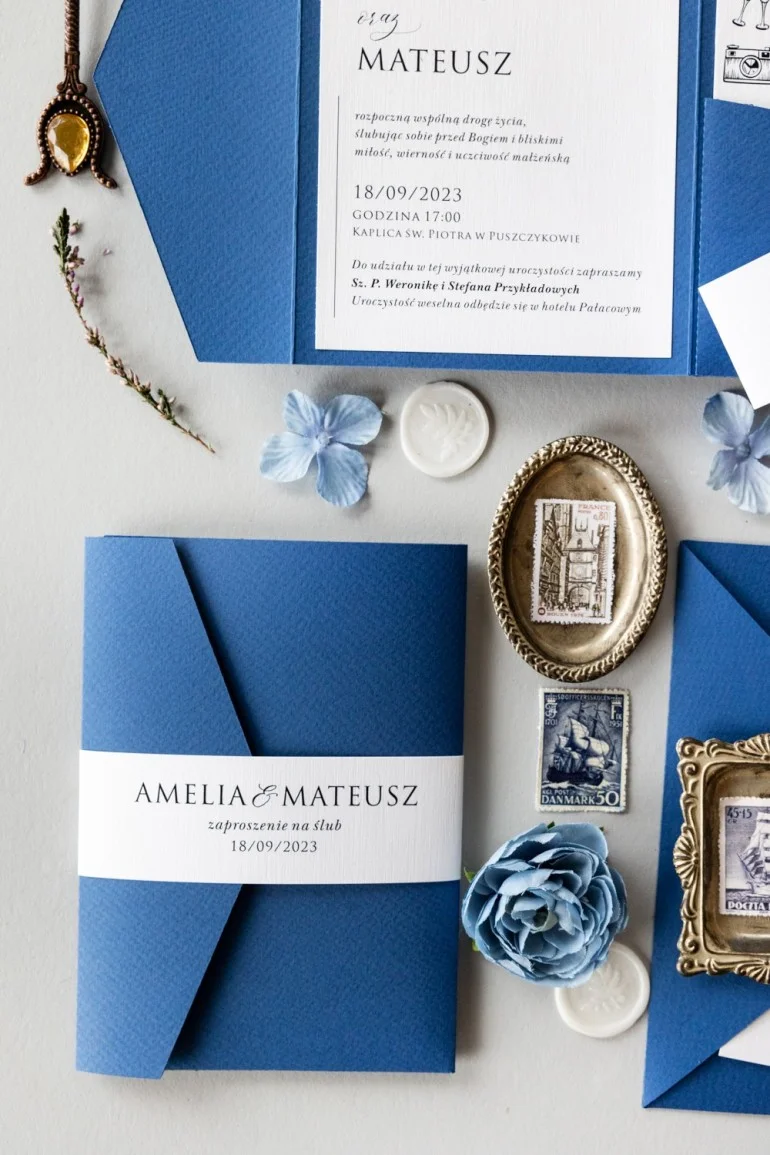
Blue, Elegant Wedding Invitation with Pocket and Personalization | Kraft No. 7

Wedding Invitations with Sunflowers and Gold Foil | Modern and Original | Rubin No. 7
-
Bad weather and forces of nature – the weather on the wedding day is a particular concern for couples planning an outdoor ceremony or reception. Insurers usually offer an option for protection against extreme weather events, such as violent storms, heavy rain, flooding, gales, or in winter, e.g., blizzards – in short, conditions that would make it impossible to conduct the ceremony as planned. If the event must be canceled or moved due to bad weather, the policy can cover the costs of renting tents, heaters, or moving the event to another available venue. In Poland, weather risk is very real – summer storms can flood outdoor decorations in minutes, and strong winds can damage infrastructure. However, one must remember that ordinary rain or cold may not be grounds for compensation; we are talking about extreme elements that make the wedding impossible (e.g., severe flooding in the area or hurricane-force winds tearing down tents). Some things, of course, cannot be insured – for example, the mere fact that the weather will be "bad" and spoil our dream wedding atmosphere is not treated as damage. This refers to situations where conditions physically prevent the ceremony from taking place.
-
Loss or damage to wedding property – another area of protection is securing important wedding items and props. Typical wedding policies cover theft or damage to items such as: the wedding dress and groom's suit, wedding rings, wedding gifts, decorations, and even the wedding cake. If, for example, the dress is damaged as a result of a traffic accident while being transported to the church or a heavy downpour on the way to the ceremony, the insurance will cover the costs of its repair or even the purchase of a new one at the last minute. Similarly, if someone stole wedding gifts from the hall or the car transporting the gifts – the policy will allow for compensating these losses. Of course, the protection will work within the limits of the sum insured – it is worth ensuring that the accepted monetary limits correspond to the real value of the property and gifts possessed. If we expect, for example, envelopes with a significant sum of cash from guests at the wedding, it is good to report this to the insurer to appropriately increase the sum insured for the "gifts" category.
-
Civil Liability (OC) – good wedding insurance should include a liability component, i.e., protection against third-party claims for damages related to the event. In practice, this means that if an accident occurs during the wedding resulting in someone else's damage – e.g., a guest breaks a leg on a slippery dance floor, a child knocks over expensive photographic equipment and damages it, or someone causes damage to the rented hall – the insurer will cover the costs of compensation, medical treatment, or repairs. Liability insurance thus protects the couple from the financial consequences of unfortunate accidents involving guests or wedding staff. It is worth noting that some such situations may already be covered by the venue owner's liability insurance (e.g., if the hall has its own liability policy), but not always and not to the full extent – which is why your own liability policy in a wedding package provides additional certainty. Such insurance is especially useful if we are organizing a reception in an unusual place (e.g., in a rented outdoor area, where we are responsible for the site ourselves), or when we have many guests and a large, intense wedding, during which accidental damage is easy.

Satino No. 3 Wedding Chocolate Favors – Custom Photo Napolitains

Mini Chocolate Favours 'Pearls No. 1' – Luxury Wedding Favours with Pearl Accents

Golden Fortune Cookies with Personalized Label | Affordable Wedding Favours | Cejla No. 3
The points listed above are the basic scope provided by most wedding policies. In addition, some insurance policies offer additional options, such as covering the costs of emergency hospital treatment if one of the key participants falls ill just before the ceremony, honeymoon travel insurance (if it had to be canceled – although this is usually a separate travel policy), and even psychological support in case of severe trauma related to the need to interrupt the ceremony. The scope can therefore often be expanded for an additional fee, depending on the couple's needs. However, it is always crucial to read the General Insurance Terms and Conditions (OWU) carefully and check what the exclusions are – for example, most insurance policies will not pay compensation if the damage resulted from gross negligence, alcohol abuse, or intentional action. In the OWU, we will also find a list of situations explicitly excluded (e.g., war, riots, and often also epidemics). It was during the pandemic that many people realized that standard policies did not explicitly cover events related to COVID-19 – which is why some insurers now offer special pandemic clauses, but this is still rare.
How much does wedding insurance cost?
The premium for a wedding policy is a fraction of what we spend on organizing the wedding – usually, it is an expense of a few percent of the total event budget. The cost of wedding insurance depends on many factors, primarily on the scope of protection, the sums insured (i.e., the maximum amount the insurer will be liable for), as well as the value of the entire event, the number of guests, the location, and any additional risks. The more expensive and lavish the wedding, the higher the sum insured required, which translates into a higher premium. The chosen policy variant is also important – a basic package will be cheaper than an extended premium option covering almost everything.
Prices for wedding policies start from as little as a few hundred PLN, which, given budgets of tens of thousands, is a small fraction of the total costs. Simple insurance protecting against event cancellation can be found in the offer for about 300–400 PLN. The average price range for typical policies is from 300 to 1500 PLN depending on the scope and guarantee sum. Of course, more extensive packages are also available on the market – comprehensive insurance with the highest protection sums, including additional clauses (e.g., health or for particularly unusual events), can cost even several thousand PLN. For example, one British company offers "Silver," "Gold," and "Platinum" packages at prices from the equivalent of about 200 to 1000 pounds, and in the United States, the price range for wedding policies varies from about 40 USD to 1000 USD depending on the sum insured, the ceremony location, and the number of guests.
To illustrate – imagine a couple organizing a reception worth 50,000 PLN. Purchasing a policy for, say, 500 PLN can provide them with financial protection of even tens of thousands of PLN (depending on the provisions, e.g., a refund of 40,000–50,000 PLN in costs in case of wedding cancellation due to random causes). Without such insurance, in the worst-case scenario, the couple would be left with nothing or would have to pursue their rights in court, which does not guarantee success. It is clear, therefore, that a relatively small premium provides a potentially very large benefit payout if needed.
Example of a situation where insurance helped: Ania and Marcin from Łódź planned their wedding for June 2019. Unfortunately, two days before the wedding, Ania was suddenly hospitalized due to acute appendicitis – emergency surgery was necessary. The celebration had to be canceled at the last minute. Most expenses had already been incurred: deposit for the venue (5,000 PLN), paid catering (about 15,000 PLN), band fee (2,000 PLN), and photographer (3,000 PLN) – a total of nearly 25,000 PLN, not counting smaller costs. If they hadn't had insurance, they would likely have lost most of this money (most contracts provided for the forfeiture of deposits in case of event cancellation just before the date). Fortunately, they had purchased a wedding policy earlier. After presenting the documents (hospital certificate, contracts with service providers), the insurer paid them nearly 20,000 PLN in compensation, covering the costs of wasted deposits and reservations. Thanks to this, Ania and Marcin could calmly recover from the experience and organize the wedding again a few months later – this time without unpleasant surprises. As they admitted, this one decision to purchase the policy saved them from financial disaster.
Below we present indicative ranges of protection and corresponding price brackets offered by insurers in Poland:

Flores No. 1 Soy Candle in Gypsum – Gilded Wedding Favour

Cejla No. 6 Soy Candle in Gypsum – Gilded Eucalyptus Wedding Favours

Kraft No. 2 Soy Candle in Plaster – Peonies Wedding Favour
- Basic package – Covers the most important risks, such as wedding cancellation due to illness or accident and problems with one of the service providers. Premium: about 300–600 PLN.
- Extended package – Contains everything in the basic package, and additionally secures property (outfits, gifts, etc.) and a wider catalog of random accidents. Premium: about 600–1000 PLN.
- Premium package – The most complete option, often also including liability, health aspects, and the highest sums insured. Protects against almost all previously mentioned risks. Premium: about 1000–1500 PLN (or more with a very high scope of protection).
Of course, these are indicative amounts, which may differ depending on the insurer and the specific parameters of the wedding. In practice, each company calculates the premium independently based on the specifics of the given event. It is worth noting that even the highest mentioned amount (around 1500 PLN) is only a few percent of the sum we spend on organizing the celebration. For a couple investing tens of thousands of PLN, an expense of, say, 500 or 800 PLN for insurance can prove to be a very reasonable security measure – in return, we gain certainty that in the event of a financial disaster, we will not be left with nothing.
Before we buy a policy, however, it is good to compare offers from several insurance companies. Competition in this field is slowly growing, new products are appearing, so checking where we can get the best scope for the price will certainly pay off. Many companies allow adjusting the sums insured to your needs (e.g., choosing a liability limit for wedding cancellation costs of 30,000 PLN, 50,000 PLN, etc., which of course affects the price). Therefore, before making a decision, it is worth asking for a premium calculation in several places, providing the planned budget, location, and date of the ceremony, and the expected scope of protection.
How to choose a wedding policy and what to look for?
Deciding to purchase wedding insurance is one thing, but it is equally important to choose the right policy tailored to our situation. Here are several key issues and tips to look for when considering a wedding policy:
1. Define the risks that are most important to you. Think about what you fear most in the context of your wedding. Is it the cancellation of the event for health or random reasons? Or are you more worried about the reliability of service providers? If you are planning an outdoor wedding, protection against bad weather will likely be a priority. Make a list of the biggest threats you perceive – this will help choose a policy that covers exactly those situations. There is no point in overpaying for a wide package if, for example, you don't care about certain options (like insurance for the cake or gifts), but on the other hand, it is not worth saving excessively at the cost of excluding a risk that is important to you.
2. Check the exact scope of protection and exclusions. Every insurance is based on General Insurance Terms and Conditions (OWU), where it is detailed what exactly is subject to protection and what is excluded from it. Be sure to read this document before signing the contract. Pay attention to the definitions of events – e.g., what situations qualify as "wedding cancellation due to random causes." Find out if the policy also covers the preparation period (e.g., whether damage to the dress the day before will also be protected). Check the monetary limits for individual categories of damage – e.g., whether there is a separate sub-limit for wedding outfits, and what it is for gifts. A very important list is the exclusions of liability, i.e., cases where the insurer will not pay compensation. Typical exclusions include: resignation from the wedding due to a change of decision (we already know this – such a thing is not covered), damage resulting from intentional action or gross negligence, damage caused by acts of war or riots, and sometimes also certain weather phenomena considered predictable for a given season. The fewer "asterisks" and exclusions, the better for the insured. If any OWU provisions are unclear, it is worth asking the insurance agent.
3. Compare offers from different insurers. Because wedding policies are still a relatively new product in Poland, differences in the offers of individual companies can be significant. Some insurers may specialize in such insurance and offer more attractive terms. Look for information on which insurance companies have wedding insurance in their offer – it could be, for example, an add-on to home insurance or a completely separate event policy. Compare the scope (whether it covers all risks you are interested in) and prices. Pay attention to the available sums insured – whether the maximum amounts offered by a given company will be enough to cover your potential scenario (e.g., the cost of the entire wedding). Also, track opinions of other clients if possible – this way you will learn how a given insurer performs in practice (e.g., whether there are problems with paying out compensation).

Rose Bow Wedding Place Cards No. 1 – Pink Satin Glass Ribbon Cards

Navy Blue Ribbon Wedding Place Cards No. 1 – Satin Ribbon Table Names

Dark Green Wedding Place Cards No. 1 – Original Satin Ribbon Table Names
If you are organizing a wedding abroad, check if the chosen policy includes protection in another country – not every standard offer provides this. It may be necessary to purchase insurance from a company operating internationally or extend the territory of protection for an additional fee.
4. Pay attention to deadlines and formalities. Wedding insurance should be handled well in advance. While many companies allow purchasing a policy even shortly before the wedding date – sometimes even a few days before the planned date – there is often a minimum period before the ceremony from which the policy begins to work (e.g., 14 days before the wedding date). It is best to start looking for a policy a few months before the wedding, when we already have the date booked and preliminary contracts signed with service providers. Thanks to this, we will be able to provide the insurer with all the necessary information (date, place, estimated budget, list of main suppliers) immediately. Remember that concluding insurance requires filling out an application and paying the premium – the policy will only start working from the moment of payment and on the terms indicated in the contract (e.g., it may protect from the day after conclusion, or from a specific date). Let's also make sure how to proceed in the event of damage – where and within what time to report it. Usually, quick notification of the insurer is required (e.g., within 3 or 7 days of the event) and documentation of losses, so it is good to know in advance what documents will be needed (e.g., contracts, invoices, confirmations of incurred expenses, photos from the scene, etc.).
5. Evaluate cost-effectiveness and whether it is worth it in your case. Finally, ask yourself if wedding insurance is really necessary for you and how much you are willing to spend on it. If you are organizing a small reception at minimal costs, and most services are from trusted people, perhaps the risk of failure is small enough that an additional policy will only unnecessarily burden the budget. On the other hand, if you are planning a large, expensive celebration, many entities are involved (restaurant, band, photographer, decoration company, etc.) and you can already see how many things can go wrong at the beginning – purchasing insurance may turn out to be a great investment giving you peace of mind. Consider the season (a wedding in late autumn or winter may carry a greater weather risk, while in summer storms can be violent), location (whether the facility is new and reliable, or whether there is a risk of defects or technical problems), as well as your personal feelings. If certain worst-case scenarios keep you awake at night, a policy will allow you to relax and enjoy the preparations.
Also, remember not to treat insurance as an incentive to neglect caution – still take care of detailed provisions in contracts with service providers, maintain common sense, and basic safety measures. Insurance is meant to be the last line of defense when, despite all efforts, something bad happens. If it is never needed – great, that means your day went perfectly.

Fortune Cookie Wedding Favours with Glamour Gold-Foiled Label | Rubin No. 1

Fortune Cookies with Gold Foliage – Ruskus No. 2

Personalized Greenery Fortune Cookies | Original Wedding Favours | Cejla No. 5
It is also worth mentioning that if for some reason you cannot find an offer for dedicated wedding insurance, consider alternative solutions. A good minimum of security is for the couple to have personal liability insurance and NNW (accident insurance). While these policies are not created specifically for a wedding, they can provide some protection – liability will cover damage caused to third parties (e.g., if we accidentally damage someone's property or someone suffers health damage due to our fault), while NNW will guarantee a benefit in case of permanent health damage caused by an accident. Having such basic individual insurance, in case of, for example, your own injury or causing an accident during the wedding, you can count on compensation to some extent. Of course, it is best to have a dedicated wedding policy – it gives the widest scope of protection related specifically to the ceremony – but liability and NNW are at least partial security that is worth having regardless.
In conclusion, it is worth emphasizing that although wedding insurance is not mandatory, it can prove to be a lifesaver in a difficult situation. For some, it will be an unnecessary expense, for others – a reasonable form of securing a large investment, which is organizing a wedding. Regardless of the decision made, the key is awareness of risks and good preparation.
And a wedding policy – if you decide on it – will turn out to be just a prudent addition that ultimately will not need to be used. After all, no policy, even the best one, will replace kind gestures and personal care for guests. It is the atmosphere created by you and your loved ones that makes a wedding special – insurance will provide financial support, but you have to take care of emotions and relationships yourself, if only through kindness, warm words, or small gifts expressing gratitude to the guests who arrived.
In Poland, wedding insurance is slowly entering the offer of an increasing number of insurers. They can be found both at large companies with a global reach and in the offer of some smaller companies specializing in niche products. Much depends on the creativity of the market – perhaps over time, such policies will become a standard, just like, for example, travel or home insurance. Already now, wedding planners often suggest their clients consider purchasing wedding insurance as an element of professional planning. This shows a change in approach: wedding organization is treated more comprehensively, taking into account risk management, and not just the aesthetics and logistics of the event. In recent years, also in Poland, there has been a noticeable increase in interest in such policies – insurers are receiving more and more inquiries from engaged couples. It can be assumed that in the coming wedding seasons, wedding insurance will become an increasingly common solution, perceived as a natural element of planning this big day.
In conclusion, if you are interested in the topic of organizing a wedding, be sure to check out other useful guides on our blog:
? How to organize an international wedding – step by step – if you are planning a wedding with a person from another country, you will find all the necessary information regarding formalities and organization here.
? The last week before the wedding – final preparation checklist – check what not to forget on the final stretch before the big day!
? Wedding day coordinator – is it worth hiring? – are you wondering if it's worth using the help of a professional on your wedding day? Check what role a coordinator plays and if this solution is for you.
? Indispensable guide to the wedding emergency kit – a list of things worth having on hand on your wedding day to avoid unpleasant surprises.
? Wedding photographer – what to look for when choosing? – we suggest how to find the perfect photographer to capture this special day in the best possible way.
? Wedding attractions for guests 2025 – ideas for spicing up the reception – if you want to surprise your guests with original attractions, be sure to check out this guide!
? First dance – how to choose a song and prepare the routine? – you will find inspiration for a unique first dance here as well as practical tips on learning choreography.
? Top 10 mistakes made by couples during wedding organization – learn what the most common pitfalls are during wedding planning and how to avoid them.
We invite you to read and wish you a perfectly organized wedding and reception! ?✨
Szymon Jędrzejczak
Wedding industry expert and stationery designer at Amelia-Wedding.pl. For years, she has been helping couples create unforgettable moments by combining tradition with modern design.